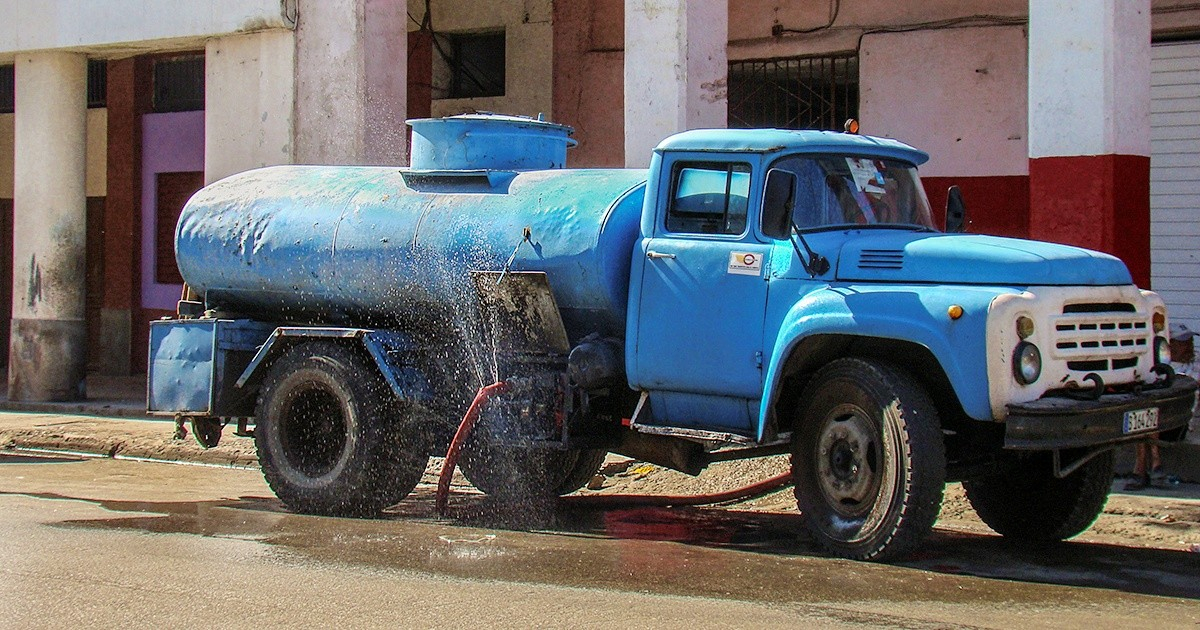
A new break in the water infrastructure of the capital has left several neighborhoods in eastern Havana without water.
The state-owned company Aguas de La Habana published an informative note on its Facebook profile this Thursday, August 13, to announce the breakdown and detail the affected areas.
The breakdown caused disruptions and adjustments in the water supply in areas of the municipalities Regla, Habana del Este, San Miguel del Padrón, Guanabacoa, and Diez de Octubre.
The problem occurred in one of the 1,000 mm ducts of the pipeline that connects Node A with the Loma de la Cruz Tank, part of the Gato System.
The breakdown directly affected the supply in Los Camilos, the Low Zone of Regla, and Casa Blanca, and forced a modification of the planned distribution operations.
In East Havana, Alamar will receive the service in its entirety, as, according to the company, "the conduction system allows it."
In contrast, the supply in the Pan American Village and Los Camilos will be resumed once the repair of the pipeline is completed.
In Regla, the Low Zone will also have to wait for the work to be completed before service can resume.
For the Intermediate and High areas, the company indicated that it would announce the date and supply schedule this Friday, August 14, in the morning.
In San Miguel del Padrón, the service will gradually reach the Upper Zone and the lower areas during the night of this Friday, according to the statement.
Regarding Guanabacoa and the Lawton neighborhood (in Diez de Octubre), Aguas de La Habana stated that this Friday morning they will announce the date and times when service will be restored, once the repairs are completed.
A pipeline at its limit for decades
The breakdown this Thursday is not a one-time accident: it is the most recent manifestation of a structural collapse that has been brewing for decades due to the regime's inaction.
The Nudo A section of the Gato System already experienced a major break at the end of February this year, when a 48-inch pipe forced the shutdown of seven pumping stations, leaving Guanabacoa and areas of Habana del Este without water.
The main drivers have accumulated between 60 and 70 years of continuous operation without sufficient replacement. Additionally, it is estimated that between 40% and 70% of the water pumped is lost due to leaks before reaching homes.
The sewage system was built between 1905 and 1915 for a city of 600,000 inhabitants. However, today it serves nearly two million, with 1,755 kilometers of pipes in a state of obsolescence.
As an aggravating factor, it is noteworthy that 87% of the system depends on the electricity grid, which means that every power outage automatically interrupts the pumping.
The rise in affected individuals: from 200,000 to more than 500,000
The crisis has only worsened throughout 2026.
In April, approximately 200,000 residents of Havana were experiencing supply issues.
In May, the president of the National Institute of Hydraulic Resources, Antonio Rodríguez Rodríguez, officially acknowledged that 376,055 people were affected in the capital.
In July, specialists from Aguas de La Habana raised that figure to over 500,000 consumers.
At the national level, around 2.7 million Cubans lack regular access to drinking water.
While the state-owned company issues notes with formal apologies, the reality faced by residents in the capital is devastating.
Recently, two girls around seven years old were seen carrying gallons of water on their own from the cistern of a primary school in Havana.
The neighbor who saw them wrote on Facebook: "There is no transportation, no fuel, no electricity to pump water, and no supply of drinking water. The children no longer laugh or sing."
In another recent report, a Cuban alerted in the group "Victims of Havana Waters" that contaminated water was coming out of his pipes.
Insufficient pressure in the cracked pipes allows wastewater to be sucked into the drinking water network, a health risk that the UN warned about in May, which increases the danger of dengue and chikungunya.
In the absence of solutions, Havana residents turn to the informal market, where a water tank can cost up to 60,000 pesos.
Related videos:
Filed under: