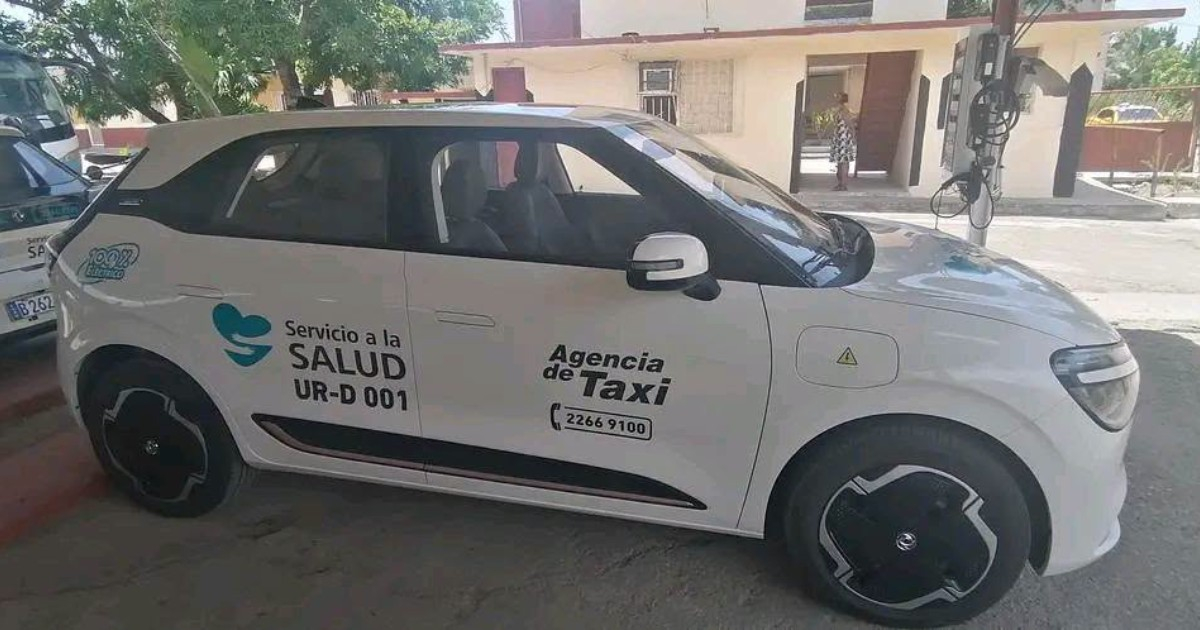
The Base Business Unit Taxis Santiago received 10 100% electric cars from the Chinese brand Dongfeng, exclusively intended for the transportation of patients who rely on hemodialysis treatment in the hospitals of the eastern city.
The vehicles were financed through the Public Transport Development Fund of the Ministry of Transport and belong to the Rajayoga Base, which already had experience in providing services to healthcare units in Santiago.
Gustavo Garlobo Enamorado, director of the UBE, confirmed the details of the acquisition and specified that the cars will serve the 106 patients with chronic kidney failure in the capital municipality of Santiago de Cuba.
The taxis, marked with the label "Health Service," will be stationed at five hospitals: the Provincial Saturnino Lora Torres, the Juan Bruno Zayas Alfonso Clinical Surgical Hospital, the Conrado Benítez Oncology Center, the José María Béguez César Children's Hospital, and the Tamara Bunke Northern Maternity Hospital.
Niurka Bell Calzado, a member of the Executive Bureau of the Provincial Committee of the Communist Party of Cuba in Santiago, urged drivers and mechanics to adhere to the planned maintenance and take care of the vehicles, emphasizing "the high human value" of the activity.
The delivery is part of a national plan announced in March 2026, through which the Cuban regime committed to 400 Dongfeng Box 01 electric vehicles to assist the more than 3,000 kidney patients who rely on regular dialysis sessions at the country's 57 hemodialysis units.
In May 2026, 200 of those cars were put into circulation as the first half of the batch. The distribution allocates 40 units to Havana, 20 to Guantánamo, 15 to Granma, 10 to each remaining province, and five to the Isle of Youth.
Before Santiago, they had already received their 10 units Las Tunas and Matanzas in early July, while Villa Clara had incorporated 10 of its 20 assigned units by mid-June.
The measure responds to a humanitarian crisis that worsened since February 2026, when the chronic shortage of fuel paralyzed medical transportation in several provinces and forced hemodialysis patients to pay up to 500 pesos per trip in informal taxis.
Santiago de Cuba had already experienced a specific crisis in July 2026, when the Saturnino Lora Torres Provincial Hospital reduced hemodialysis sessions from four to two hours due to a lack of supplies.
In Camagüey, the situation reached a critical point in June 2026, when patients went almost a week without treatment due to a lack of acid concentrate and bicarbonate.
The Ministry of Public Health acknowledged in June 2026 that the ambulance system meets less than 40% of the national demand, while the Minister of Energy and Mines, Vicente de la O Levy, admitted that same month that Cuba had "absolutely nothing" of diesel or fuel oil.
The sustainability of the project largely depends on the national electricity grid, although photovoltaic installations are planned as a backup in a country that experiences power outages of up to 20 hours a day in several provinces.
Related videos:
Filed under: