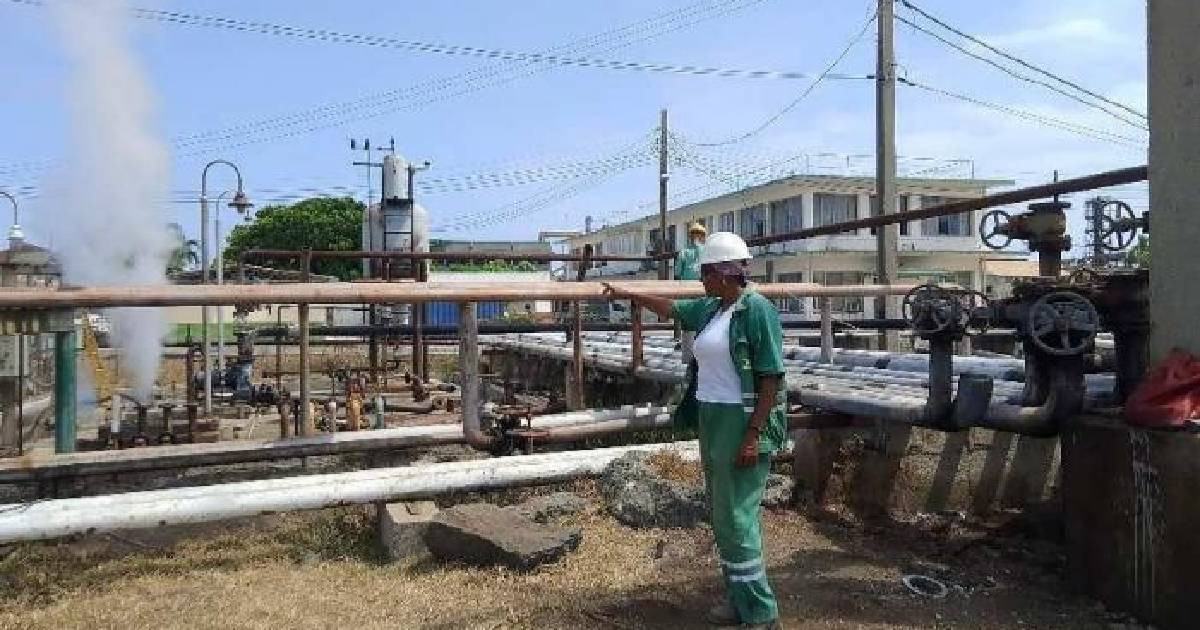
The Hermanos Díaz oil refinery in Santiago de Cuba has completed its third run of national crude, producing 2,000 tons of naphtha and 10,000 tons of fuel oil, reported on Friday the official newspaper Granma.
The general director of the plant, engineer Irene Barbado Lucio, stated to the organ of the Communist Party that the experience "is becoming consolidated after the two previous runs—in March and May—and is improving qualitatively in terms of technological solutions, mainly in the unloading of raw materials."
Barbados presented the outcome as a "progress" towards energy self-sufficiency, although it acknowledged that the process continues to be refined due to the challenges posed by Cuban crude.
The engineer Cristóbal Acosta Blanco emphasized that work is underway on "the protocols for future modifications, due to the characteristics of the national crude oil, which has high viscosity, acidity, and sulfur content, as well as the necessary actions to ensure the vitality of the infrastructure in each area."
The refinery was originally designed to process imported light crudes, not the heavy, acidic oil extracted in Cuba, which has forced technicians to adapt processes for each run.
In the second test, conducted in May, the side cut that would typically produce diesel did not meet the quality standards required due to the high sulfur content of the national crude oil, as acknowledged by the plant's own executives.
The fuel obtained in the previous runs was primarily used to support operations in the Varadero wells, while the fuel oil from the second test was utilized at the Rente thermoelectric plant, within Santiago de Cuba itself.
These tests are being conducted amid the worst energy crisis Cuba has faced in decades. Oil imports have dropped by 80% to 90% since January, impacted by the secondary sanctions imposed by the Trump administration, the cut of subsidized Venezuelan supply following the capture of former president Nicolás Maduro, and the suspension of shipments from Mexico.
Cuba produces between 30,000 and 40,000 daily barrels of an extra-heavy crude with high levels of sulfur, which only meets 40% of a national demand estimated between 90,000 and 110,000 barrels per day.
So far this year, the island has experienced at least six nationwide blackouts, with outages lasting up to 20 hours a day in some areas and a generation deficit exceeding 2,000 megawatts.
The Minister of Energy and Mines, Vicente de la O Levy, admitted that the solution to the blackouts has a "long way" to go, a statement that contrasts with the triumphant tone with which the regime presents each run at Hermanos Díaz.
The Sergio Soto refinery in Cabaiguán, Sancti Spíritus, has been processing national crude oil since 2010 and increased its capacity from 400 to 600 tons per day this year, although it also operates under severe raw material limitations.
The management of Hermanos Díaz themselves acknowledge that the volumes obtained from these pilot tests are insufficient to meet national demand, and that the process of technological adaptation to Cuban crude continues without a defined timeline for industrial-scale operation.
Related videos:
Filed under: