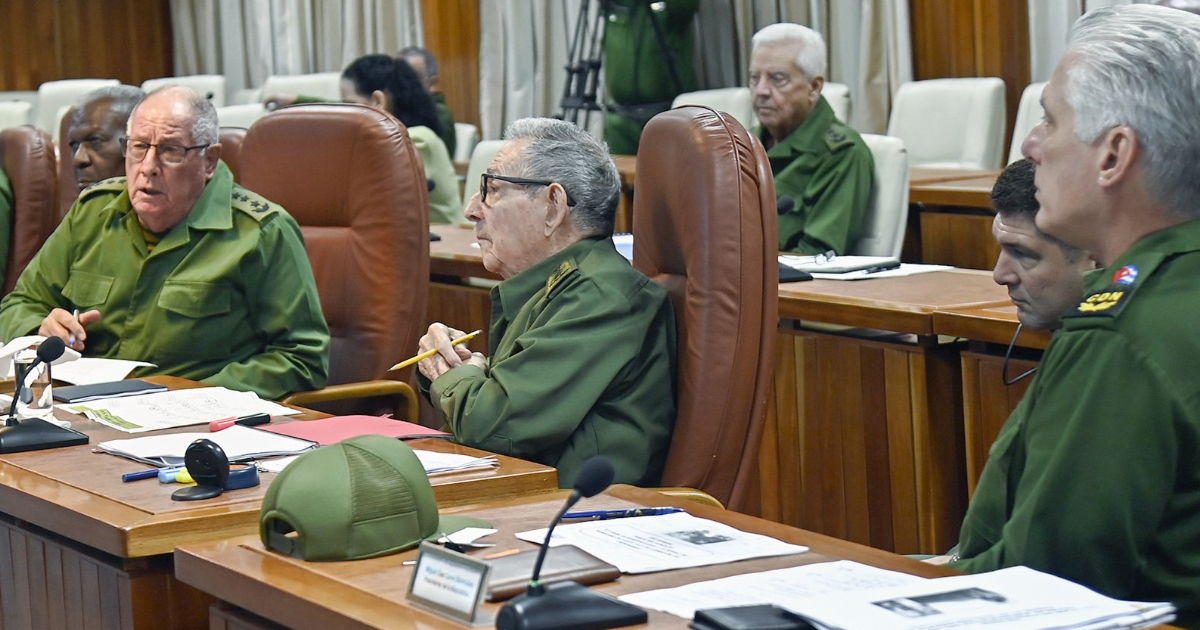
Who really holds power in Cuba? For the administration of Donald Trump, the answer goes beyond Miguel Díaz-Canel and points to a much more complex structure, in which the Castro family, the Armed Forces, and the bureaucracy of the Communist Party of Cuba (PCC) retain decisive levels of influence.
A Bloomberg report published this Saturday, based on sources familiar with Washington's strategy towards the island, asserts that U.S. officials believe that Díaz-Canel is influenced by the Castro family and that power is dispersed among members of that circle and high-ranking military officials.
This reading is crucial for understanding the current strategy of the Trump administration, which seems to be prioritizing economic pressure to weaken the regime's sources of funding and create internal rifts, while a potential military intervention takes a back seat for now.
A more complex power structure
According to Bloomberg, U.S. officials have encountered difficulties in managing the tensions among the various factions that make up Cuba's ruling elite. These include the Castro family, the Revolutionary Armed Forces (FAR), the bureaucracy of the Communist Party of Cuba (PCC), and descendants of other historical figures from the revolution.
The situation would be considerably more complex than what Washington encountered in Venezuela following the capture of Nicolás Maduro in January. In the case of Cuba, the United States would not identify a single power center whose departure would allow for a quick reorganization of the political landscape.
This diagnosis would also help explain why Washington has focused part of its offensive on the economic structures linked to the military.
In May, the United States imposed sanctions on GAESA, the powerful business conglomerate controlled by the FAR, which has a significant presence in strategic sectors of the economy, including tourism.
In July, the measures were extended to the Ministry of Tourism and other state entities as part of a strategy aimed at cutting off the flow of resources to the ruling elite and creating space for negotiations and internal fractures.
Rubio warns that the change will take time
The Secretary of State, Marco Rubio, tasked by Trump with leading policy towards Cuba, has also provided signals on how Washington envisions the timing of a potential political transformation.
In a podcast published this week, Rubio expressed his confidence that Cuba is on an irreversible path to a different future before the current administration ends in January 2029.
The head of U.S. diplomacy cautioned, however, that dismantling a structure built over nearly seven decades will not happen overnight.
The question for Washington would not only be how to increase pressure on Havana, but what would happen if that pressure ultimately fractures the system.
Bloomberg notes that the United States also does not have a consensual opposition leadership identified that could quickly take the reins of a political transition in Cuba.
Related videos:
Filed under: