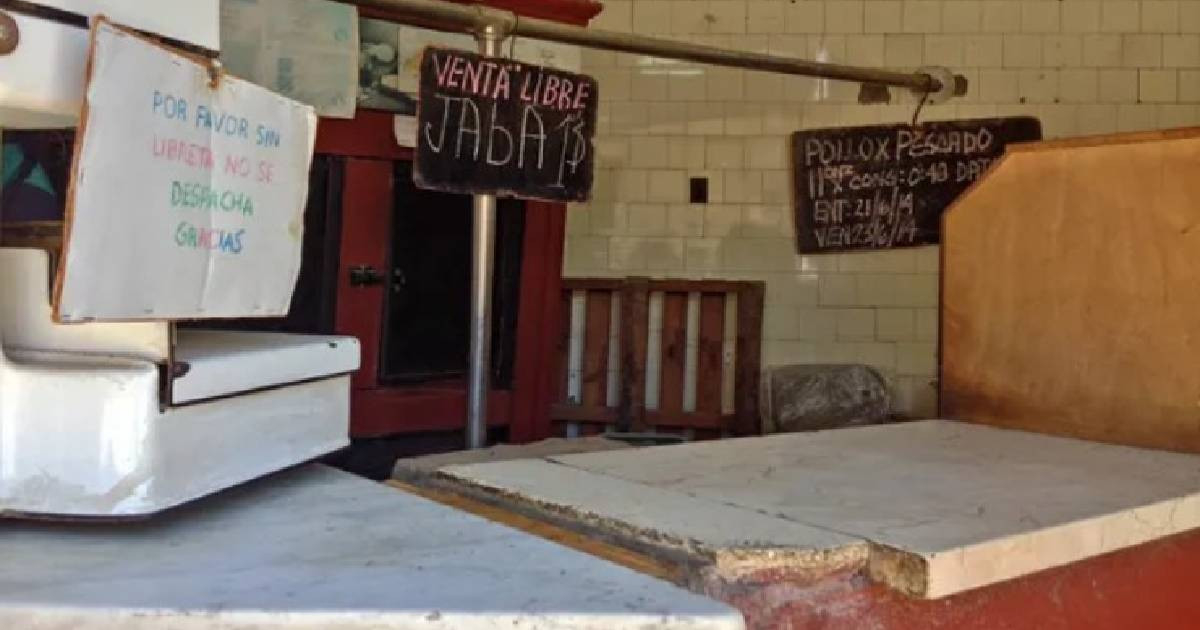
The province of Cienfuegos has initiated the bidding process for 47 of its 69 meat product establishments, popularly known as "casillas," to transfer their management to producers and other non-state actors, confirmed the official newspaper 5 de Septiembre this Saturday.
The Municipal Director of Commerce, Yanser Toledo Pérez, acknowledged that the stalls remain closed due to a lack of products.
"Due to the lack of products, the stalls have been closed, but without losing their social purpose," he explained, announcing that 47 establishments, equivalent to 68% of the total, will be offered to producers interested in providing that service.
The measure is supported by Resolution 40/2022 from the Ministry of Domestic Trade, which allows self-employed workers, non-agricultural cooperatives, small and medium-sized enterprises, and local development projects to manage state properties.
The tender is part of a broader transformation of the Commerce, Gastronomy, and Services sector. Orelvis González Suárez, provincial director of Gastronomy, acknowledged that the tendering of idle establishments has become "the main management tool" in response to the challenges faced by the sector.
The main municipality is leading the process, while the other territories in the province have already completed the assessment of closed units or those with inadequate services and are preparing to implement the same scheme.
Cienfuegos had already begun to hand over the management of other state spaces to private entities. The ice cream parlors Coppelia Prado and El Cairo were auctioned to a small and medium-sized enterprise focused on producing ice creams using renewable energy.
According to Ana Javier Chaplis, the municipal director of Gastronomy, Accommodation, and Recreation, the workers were retained and the establishments began to offer new options and adjusted prices.
The Laguna del Cura restaurant also reopened after being closed for more than two years, while the iconic Covadonga restaurant is preparing to resume its traditional paella under private management.
Authorities insist that this process does not involve the transfer of state ownership of the properties, but only their management.
Chaplis linked the mechanism to axis 19 of the 176 economic measures announced in June, based on the principle of coexistence between the state and private sectors.
The process is also linked to the , recently dissolved, which established the so-called "Neighborhood Markets", venues where state companies, small and medium-sized enterprises (mipymes), cooperatives, and self-employed workers can sell essential goods at prices 10% to 15% lower than those in other establishments, through tax incentives.
Among those benefits is a 5% bonus on the sales tax for non-state actors and a complete exemption from that tax for those who sell products wholesale through the Domestic Trade system.
Related videos:
Filed under: