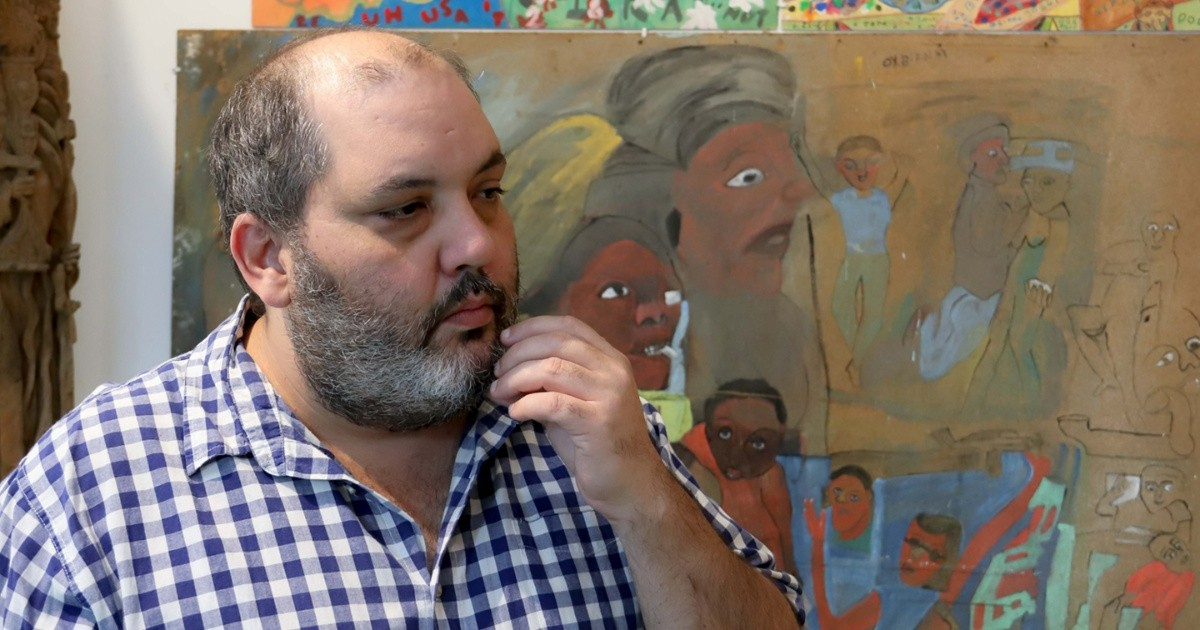
The Cuban visual artist Samuel Riera published a harrowing testimony on Facebook this weekend, in which he describes how the systemic crisis on the island has destroyed his creative capacity and reduced him to a state of pure survival: daily blackouts of up to three hours, prolonged disconnection, a fire with no response from the firefighters, and the theft of his husband's phone while they were sleeping with the window open due to the August heat.
“Living in Cuba today, from any context, inevitably pulls you towards the same collective downfall,” writes Riera in the text published on his Facebook profile, titled When Life in Cuba Exceeds Any Reality. The narrative accumulates blow after blow since early 2026.
It all began with the loss of his telephone line and Nauta Hogar connection, which allowed him to communicate with curators, museum directors, collectors, and family, as well as to monitor the artists he collaborates with. Although Riera does not express it explicitly, the interruption of telephone and Internet service is one of the repressive tactics that the regime uses against opponents and critics.
As an alternative, he turned to the wifi signal from the park at the baseball stadium in his neighborhood: “limited, unstable, but enough to bring me some joy with little when they had taken so much from me,” he acknowledges.
That solution also disappeared. Upon returning from a trip, Riera found that the park's signal had dropped due to a failure that the company neither knew how to explain nor was willing to. Power outages increased, the food went bad, and neighborhood tensions escalated into a fight that he did not seek.
The building where he lives suffered an electrical collapse because the neighbors plugged in all their appliances during the only three hours of power available: they had to wash clothes, cook, charge lamps, turn on air conditioners, and recharge batteries all at the same time. The overheating caused a fire. Neither the firefighters nor the power company responded. On the upper floors, two bedridden elderly individuals are left without access to the water they need for hygiene and nourishment.
That same night, with the window open due to the unbearable heat, someone entered the apartment and stole her husband’s cell phone, Derbis. “I wish you could see my face at that moment,” she writes.
The result of all this is creative silence. "My mind only thinks of surviving, avoiding any disturbance that provokes that intense tingling which paralyzes me. I don’t sleep. I don’t rest. I just observe life, waiting for something to change," Riera confesses, who has been unable to paint for months. "These days, art is neither a solution nor an escape. It does not fulfill the therapeutic role that has saved me so many times."
Riera is a figure in independent Cuban art with international projection: his works are part of permanent collections at New York University and the First Museum of Cuban Art in Vienna, and he has exhibited in Spain, Denmark, France, Japan, and other countries. He founded Riera Studio in 2012 and in 2013 launched Art Brut Project Cuba, along with Derbis Campos, an initiative that has taken works by Cuban creators to over twenty exhibitions abroad.
His testimony joins that of other artists who have reported the same decline. Musicians Carlos Alfonso and Ele Valdés from Síntesis described the blackouts as a "mass psychological torture", while young creator Alexis Hugo Remón Fuentes spoke in June about 30 to 50 hours of outages and the impossibility of planning a life.
A study published in Social Science & Medicine revealed that among a sample of 415 Cuban adults, there are levels of 55.4% of extremely severe depression, 66% of severe anxiety, and 65.8% of extreme stress, directly linked to the electrical crisis. Riera summarizes it with a phrase that concludes his testimony: "When I go out and tell my reality, many look at me as if I were talking about a fantasy. They do not believe what I say, even though it is what I live."
Related videos:
Filed under: