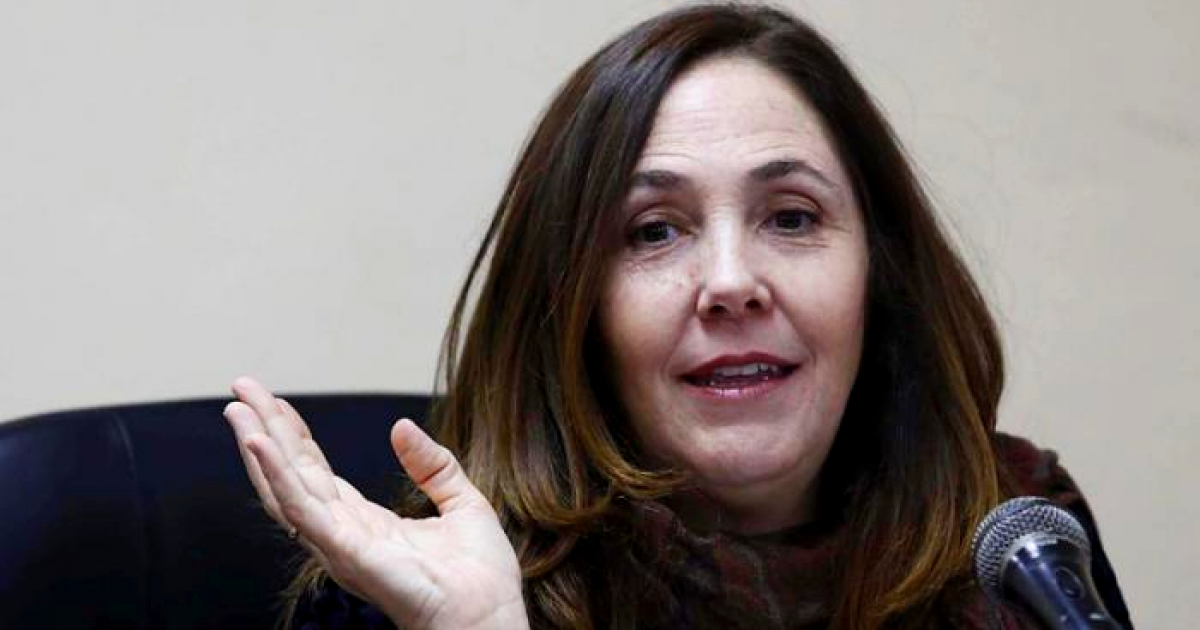
In September 2021, Mariela Castro Espín uttered a phrase that, viewed from the Cuba of 2026, takes on a very different meaning.
«No, no, absolutely not, they can't take the ration book from us!», affirmed the daughter of Raúl Castro during the virtual presentation of a book at the National Autonomous University of Mexico.
Mariela recounted that, during the discussions of the Guidelines in 2011, many Cubans who initially criticized the Supply Notebook ended up defending it after calculating how much workers earned and how much it cost to eat outside the subsidized system.
Five years after those statements, the question arises with much more intensity: what will happen now with the ration book?
Not because the government has officially announced its immediate elimination, but because it has approved an economic transformation that directly targets the core of the system established over six decades ago: the universal subsidy for certain foods.
From "they can't take away our ration book" to selling without subsidies
In June, Prime Minister Manuel Marrero Cruz explained to the National Assembly that one of the objectives of the new economic package is to "transition from the regulated family basket to controlled sales without subsidy in the retail network."
Marrero Cruz asserted, at the same time, that the government does not renounce the regulated family basket. However, his explanation made it clear that the intention is to gradually reduce the scheme through which certain products are sold to the entire population at subsidized prices and replace it with targeted assistance and controlled sales at higher prices.
"We do not abandon nor renounce the regulated family basket, but the current conditions have imposed limits on us due to the known impacts on the guarantee of monthly product deliveries," acknowledged the Prime Minister of the ruling Miguel Díaz-Canel.
In other words, the booklet may survive as a tool for control and record-keeping even if it loses much of the economic function that justified its existence for decades.
In fact, the Ministry of Domestic Trade (MINCIN) continues to use it. In July, it was still reporting on distributions in Havana of seven pounds of rice per consumer, along with sugar and oil, while other regions were distributing rice from foreign donations.
The MINCIN has even pointed out that the ration book is used to monitor the distribution of food donated by the World Food Programme to pregnant women and vulnerable individuals.
Therefore, it would not be accurate to state that the ration book has disappeared. But it would also be incorrect to say that everything remains the same.
The account that Mariela made in 2021 is much worse today
The paradox lies precisely in the words of Mariela Castro.
His argument in 2021 was that it was enough to compare the income of Cubans with the price of food to understand that the State could not remove the ration book. Five years later, that calculation is significantly more dramatic.
According to the latest official data available from the National Office of Statistics and Information, the Consumer Price Index increased by 2.82% in June alone. The accumulated inflation for the first half of the year reached 12.24%, and the year-on-year rate reached 18.27%.
The blow strikes precisely where it hurts the most.
Non-alcoholic food and beverages accounted for 66.24% of the monthly inflation effect, while cooking oil recorded a 14.79% increase in just one month. Pork, rice, and poultry were also among the products that most contributed to rising prices.
In June, ONEI itself found packaged oil prices reaching up to 2,222.22 CUP in Havana and exceeding 2,000 pesos in other areas. This is an official snapshot that does not necessarily capture all prices in the informal market or the differences that exist between neighborhoods and provinces.
This is joined by a particularly delicate decision: the government eliminated the national price caps that had been imposed on chicken, oil, powdered milk, pasta, and sausages in June.
Until then, the official limit was 990 CUP per liter of oil and 680 CUP per kilogram of chicken. These caps were lifted after the authorities themselves acknowledged that the restrictions had caused distortions and the disappearance of products from the market.
The outcome places millions of Cubans in the same calculation that Mariela claimed to have made in 2011, only now with a much more depreciated currency and considerably higher prices.
A discourse of austerity that does not always align with reality
Mariela Castro is not the only figure from families historically connected to power in Cuba who has resorted to discussing wages and food prices to present herself as just another Cuban amid the crisis.
In July 2024, Aleida Guevara March, daughter of Ernesto "Che" Guevara, stated that she earned “just over four thousand pesos” as a state employee and admitted that this income was not enough to live on. She cited examples such as a cheese costing 7,000 CUP and a carton of eggs priced at 3,000, and acknowledged that even the subsidized basic basket did not allow her to make it to the end of the month.
"I either eat eggs or do something else, but I can't do everything," he asserted.
However, her proposal to tackle the enormous disparities in purchasing power was not to expand access to food. While criticizing small and medium-sized enterprises and their imports, she even went so far as to defend the shared scarcity of the Special Period: "Let them stop importing, because after all during the Special Period, we all had needs, we all faced shortages, but it was equitable."
The contradiction became even more evident in August 2025, when Guevara March was , establishments that are regularly inaccessible to millions of Cubans whose salaries and pensions are paid in pesos.
The episode recalls the controversy sparked by Mariela Castro when she was included among those who supposedly depended on the ration booklet and stated that "they can't take" that subsidy from us.
In both cases, the discourse aims to place representatives of the historical elite of Castroism within the same economic hardships experienced by workers, while their familial and social status is considerably different from that of the Cuban who relies on the bodega, a state salary, or a pension for sustenance.
A family under pressure... and a grandson negotiating with Washington
The debate about the future of the ration book also coincides with a political landscape that was unthinkable when Mariela made those statements in 2021.
The United States has intensified its pressure on the economic and military core of the regime in 2026.
In June, the Department of the Treasury added to the OFAC List of Specially Designated Nationals Alejandro Castro Espín, brother of Mariela and son of Raúl Castro, and his son Raúl Alejandro Castro Calis. The measures entail blocking assets under U.S. jurisdiction and imposing strict financial restrictions.
Mariela, for her part, had already been affected since 2019 by a designation from the State Department that prevents Raúl Castro and his children Alejandro, Deborah, Mariela, and Nilsa from entering the United States, in connection with serious human rights violations attributed to the former Cuban leader.
There is, however, another family member that Washington has not sanctioned: Raúl Guillermo Rodríguez Castro, "El Cangrejo", grandson of Raúl Castro. His exclusion is particularly significant because Rodríguez Castro has become one of the main communication channels between Havana and Washington.
In February, U.S. media revealed contacts with officials close to Secretary of State Marco Rubio. Subsequently, meetings in the Caribbean were reported, and in April, the State Department itself confirmed that a senior U.S. official had held a private meeting with El Cangrejo in Havana.
The Cuban regime publicly acknowledged the existence of conversations with the United States, although it has avoided revealing much of their content.
Months later, even officials from the Communist Party publicly defended El Cangrejo in response to internal criticisms regarding its role as an interlocutor.
Who will still be able to buy subsidized items?
In the midst of all that political and economic reconfiguration, a much simpler question arises for millions of families: What will they be able to put on the table?
The Díaz-Canel government claims that it does not intend to abandon the most needy sectors. Their proposal is to move from general subsidies for products to directly subsidizing certain individuals, particularly retirees, chronically ill patients, children, and households officially classified as vulnerable.
The problem arises with those who do not fit into those categories.
If products that up until now had a symbolic price through the ration booklet begin to be sold in a controlled manner but without subsidies, many families will rely on salaries and pensions that are already insufficient in comparison to the market.
And there inevitably return the words of Mariela Castro.
In 2021, it was asserted that Cubans had calculated and concluded that the ration booklet could not disappear because those who earned the least did not have enough money to buy those foods outside the regulated system.
Today, prices are much higher, inflation continues to erode incomes, and the government itself admits that it can no longer sustain the subsidies in the same way.
Perhaps the question is no longer simply if they will "eliminate the ration book".
The question is what will remain within it, how much will need to be paid for what was previously subsidized, and how many Cubans will be deemed sufficiently poor by the State itself to retain some form of protection.
And there is another unanswered question for Mariela Castro: Does she still believe, in Cuba 2026, that «they cannot take away the ration book»?
Related videos:
Filed under: