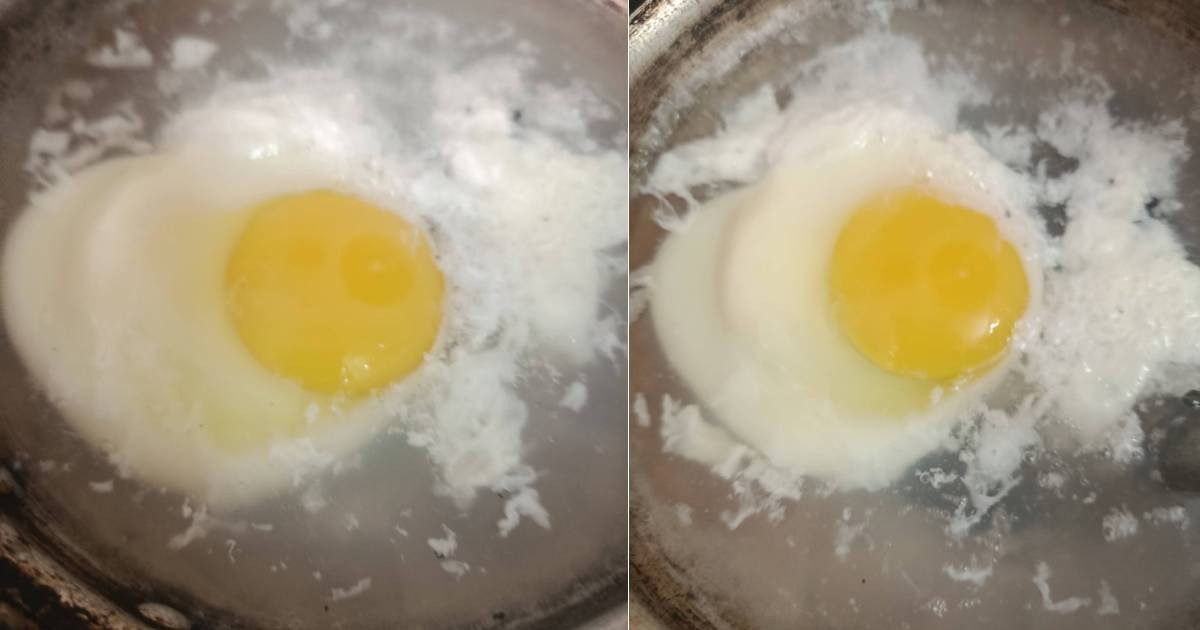
A photograph of an egg cooked in boiling water has become yet another everyday image of the crisis affecting Cuban households. In a group of Cuban mothers, a user shared that they resorted to that preparation because they had no oil to fry the egg, a product whose price can currently exceed the monthly salary of many workers on the island.
“Never in my life have I done this… how long, for God’s sake. Frying an egg in boiling water. The sad reality,” wrote an anonymous participant under their profile in the public Facebook group “Cuban Fighting Mothers 2”, a community with over 28,000 members.
In the post, he even explained how he had resolved his meal: "Bring water to a boil, and when it's boiling well, add the egg and wait a moment to your liking."
She didn't present the preparation as a recipe or as a healthy alternative. It was simply the way she found to cook in the absence of oil in her home.
The post sparked a debate that ultimately reflected a reality much broader than the photograph.
Some users recalled that cooking eggs in water is a common practice in other countries and that preparations like poached eggs are part of international cuisine.
"The difference," other Cubans replied, "lies in the ability to choose. 'But in other countries, they do it that way because it's something people like, not because there’s no oil to fry with and no other option,' noted a participant."
Another summed it up in one sentence: "The sad part is doing it out of obligation."
A liter of oil can cost more than a monthly salary
Behind this testimony is the increasingly prohibitive price of one of the essential items in any kitchen.
The Resolution 150/2026 of the Ministry of Finance and Prices, published on June 20, removed the price caps established for imported cooking oils. Since then, prices have continued to diverge from the earnings of a significant portion of the population.
A liter that could be found for around 1,500 Cuban pesos (CUP) in April rose to about 2,500 CUP in July, and in August it is being sold between 4,000 and 7,000 CUP, depending on the province and the establishment.
The comparison with income explains why a family may end up cooking without oil: the lowest salaries in Cuba amount to just a few thousand pesos per month.
For many workers, buying just one liter can mean spending the equivalent —or even more— of their entire monthly income.
Even the egg has become a luxury
Having the egg is not guaranteed either.
For decades, it was one of the most accessible proteins for Cuban families, but its price has also skyrocketed.
A carton of 30 units can currently cost between 3,600 and 7,500 CUP, depending on the province. In Santiago de Cuba, prices have been reported as high as 7,500 pesos.
"At least you have eggs, as the price of cardboard is already higher than that of oil," a woman joked in the comments.
Another response revealed an even harsher reality: for some families, the problem isn't how to cook it, but how to obtain it.
"It's terrible to think that I have to eat them raw and I can't find them anywhere," wrote a participant.
Another woman asked not to lose sight of that dimension: "I do not justify the misery of the people; I just say that it must be cherished because many do not have a single egg in their home."
"During the Special Period, my mom used to do it."
The image also awakened memories of the hardest years of the Special Period, when scarcity forced Cuban families to constantly improvise in order to feed themselves.
"In the special period, my mom used to do it," recalled a user.
"Then you didn't live through the 90s," commented another person, surprised by the peculiar way of cooking.
Three decades later, practices associated in collective memory with one of the periods of greatest hardship in recent Cuban history are re-emerging in households.
The current food insecurity has also reached concerning levels.
According to data released by Food Monitor Program, 96.91% of the Cubans surveyed lack adequate access to nutritious food, and 33.9% of households reported that at least one member had gone to bed hungry in the past 30 days.
The organization also estimates that a family needs between 10 and 11 minimum wages to cover a basic food basket. These are alarming figures, but everyday experience can be even more telling. The problem is not that an egg can be cooked without oil. The problem is being unable to decide how to cook it because buying a bottle has become a luxury for too many Cuban families.
Related videos:
Filed under: