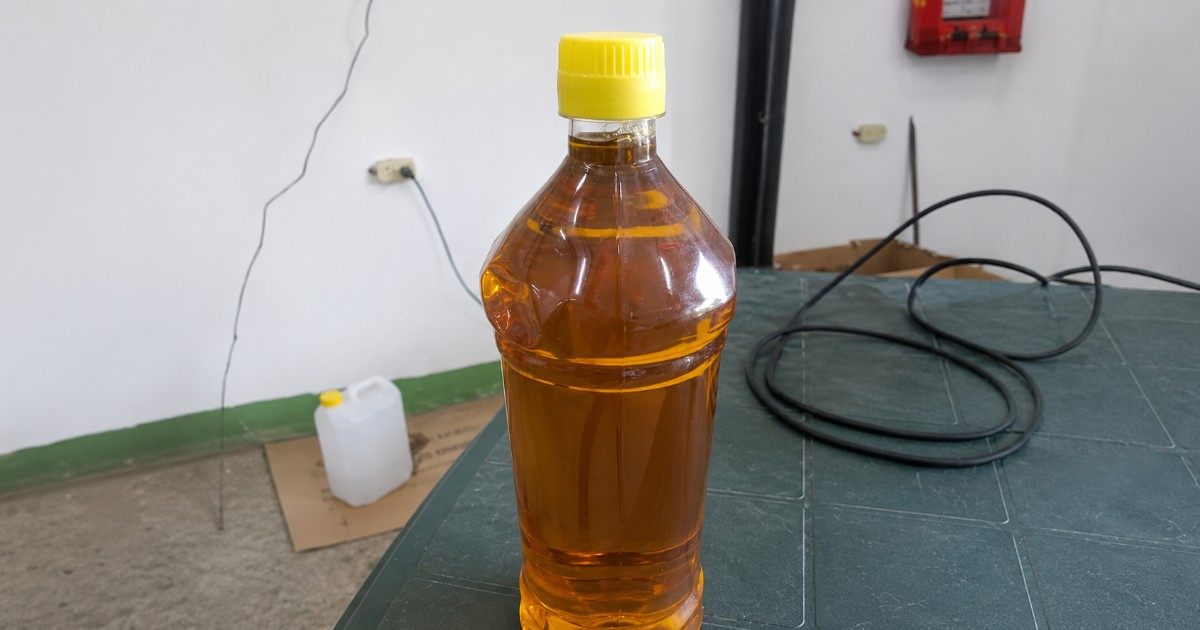
The health authorities of Mayabeque alerted the population this Friday not to consume an oil sold at the El Rodeo Fairgrounds, after tests conducted on the product determined that it is crude vegetable oil intended for animal consumption and not human consumption.
The Directorate General of Public Health of Mayabeque issued the warning and expressly requested that the product not be ingested.
«The General Directorate of Public Health of Mayabeque informs our population that they should not consume an oil sold at the Recinto Ferial el Rodeo in the Capital of Mayabeque as it has been determined after testing that it is a raw vegetable oil for animal consumption and not for human consumption,» stated the institution.
The alert comes at a particularly sensitive time for Cuban consumers, characterized by the shortage and rising prices of cooking oil, a staple product whose high cost forces many families to seek alternatives wherever they can find them.
However, the brief official statement leaves fundamental questions about what occurred unanswered.
Public Health does not identify in the publication who sold the oil, its origin, the quantity that was sold, how long it was available, at what price it was offered, or how many people might have purchased it.
It also does not explain what tests were conducted on the product, what the specific results were, whether it has been completely removed from the fairgrounds, or if there is a possibility that it has reached other points of sale.
Similarly, it did not specify what type of animals the product was intended for, what the consequences of its consumption in humans might be, or what people who have already ingested it should do.
The institution also recommended that the public refrain from purchasing products without guarantees of identification and quality: "It is important not to buy products that lack labels or a quality certificate," it stated.
The notice itself also exhibits an evident deficiency: the publication is incomplete.
The last sentence ends abruptly with the words "and with its value of," without disclosing what information Public Health intended to add, demonstrating a lack of seriousness for a health alert concerning a product that has already been sold to the public and potentially consumed by many people.
The lack of details provoked numerous questions and criticisms among users who commented on the alert, especially regarding how the sale could have been finalized before it was determined that the product was not intended for human consumption.
YV Jimenez wrote: "I DON'T UNDERSTAND... HOW IS IT POSSIBLE THAT SALE WAS MADE?... SPEECHLESS... I'M SHARING THIS...".
Madeleine Armas Núñez was more direct: «Who authorized that sale?».
José Ignacio Martínez questioned the official controls: «And where was the body of inspectors? All those products must be approved by the authorities of the municipality. There are unscrupulous vendors.»
Angel Miguel German Almeida also focused on oversight. "I wonder: WHERE WERE THE PESTICIDES AT THAT MOMENT?" he wrote.
The user added that, in their opinion, the products entering through ports and airports must be certified and questioned what went wrong with the documentation. "A note is not sufficient nor does it resolve the issue," they concluded.
Jan Miguel asked how the product could be identified: «And how is it identified? It must have some different smell or color».
This question is relevant because the released statement does not provide physical characteristics, brand, packaging, lot number, or any other information that would allow a person to independently determine if the oil they purchased corresponds to the one analyzed by Public Health.
The comments also included testimonies from individuals who claim to have purchased or used oil that they believe is related to the alert. These are accounts from Facebook users that have not been confirmed by health authorities and do not, on their own, establish a connection between the analyzed product and the described symptoms or characteristics.
Adianeilis Marrero stated: «My God, that oil was being sold in San José and it was irritating our throats at home. We thought it was due to the cold we had, but apparently, it was the oil that was causing the throat irritation. We are going to end up harming each other, my God.»
Dayi Fruto Ciudad provided another testimony: «My aunt bought it and says it was bitter and produced a green foam when frying. Be careful».
Mey De Armas said that she finally decided not to buy an oil due to the characteristics she perceived. “I never liked it. I went to buy it and I smelled a strong odor, and I said to myself: 'I won’t buy that'. We must be very careful with the sales that take place, because the health of people is at stake,” she wrote.
There was also concern about a possible commercialization outside of the El Rodeo Fairgrounds. Reinier Alfonsomartines stated: "But the fact is that some micro, small, and medium enterprises bought it and are reselling it everywhere. Be careful with that."
Other users demanded to know potential responsibilities. Tocororo Cubano asked, "How many did they imprison?" while Iglesias Tatiana responded, "I assure you that NO ONE... You can be sure of that."
Lisset Nuñez Diaz linked the situation to the economic difficulties facing the country: «That is what hunger, misery, and the need experienced in this country bring».
The comments reflect alarm, but also a concrete demand for information that the official statement does not provide.
The incident is also not isolated amidst the repeated complaints about the quality and authenticity of products sold in Cuba.
In May, a fraud was uncovered in Cienfuegos involving the refilling of original Ciego Montero water containers with uncertified water and reselling them as if they were the legitimate product. At least one person was arrested in connection with the case.
A month earlier, consumers warned about the alleged sale of counterfeit or repackaged La Llave coffee packages in stores that operate in dollars.
The whistleblowers pointed out differences in the size and labels of the packages, as well as the absence of the characteristic aroma of the original product.
Also in April, a citizen complaint led the authorities in Las Tunas to detect serious irregularities in 392 liters of milk intended for children.
The analysis revealed a density of 16.5 g/mL compared to the 30 g/mL required by the standard, a result that indicated potential adulteration. The case concluded with five fines of 10,000 pesos and a complaint against the legal representative present in the distribution vehicle.
Related videos:
Filed under: