
Related videos:
A complaint posted on Facebook by an internet user has sparked a wave of concern among Cuban consumers after alerting them about the alleged sale of counterfeit packages of La Llave coffee in stores that operate in dollars on the Island.
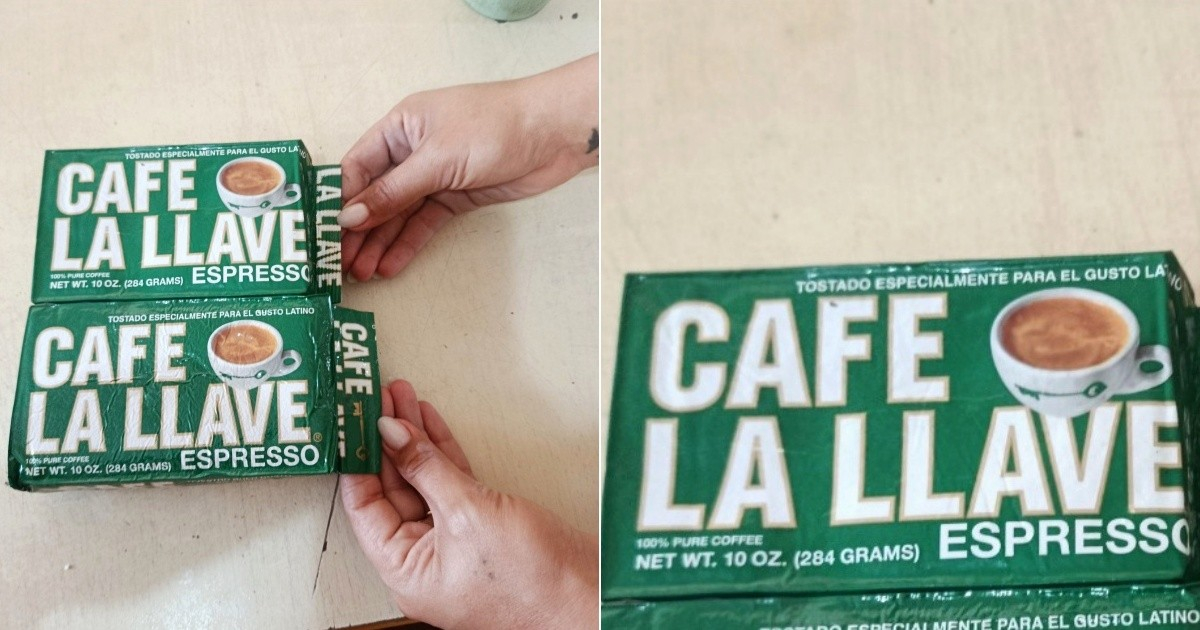
“Be careful when buying coffee in USD stores. They are putting out repackaged packages. They have no smell, are smaller, and do not have the complete label as shown in the photo,” wrote Javier Solís in a post that has quickly gone viral.
"The one below is the original and the one above is a scam. Take care of your money, as dollars are hard to come by," he added alongside a photo of the real package and the fake one.
According to their testimony, the differences between the original product and the alleged counterfeit would be visible at first glance: smaller packaging, incomplete labels, and, above all, the absence of the characteristic coffee aroma.
Testimonies that reinforce the alert
Following the report, dozens of users began to share similar experiences, which has contributed to amplifying the alarm.
Some comments point directly to the repackaging of the product:
"That's true, they're offering it for $2000... It's repackaged coffee... Who knows if it's even coffee they're selling. There's no trust anymore. There's no respect. The deception is blatant," commented a user.
Others report having detected irregularities even before the issue went viral: "As soon as I tried it, I told my husband that it wasn't La Llave", noted another internet user.
There are also those who assert that the problem is not new: “This has been happening for a while, anyone who knows how to make coffee can see the difference.”
The suspicion of an organized network emerges in several comments: "I see how people digging through the garbage collect empty packages because they pay very well for them," warned a user, suggesting a possible reuse of original containers.
"You can no longer trust."
Beyond specific cases, many comments reflect a general decline in trust in the market:
"If it were just the coffee, they are adulterating most of the products..."; "They're scamming you everywhere, we no longer know what to do in this country"; "You can't trust what you buy"; "It happened to me... it didn't smell or taste like La Llave"; "That coffee was purely dirt... it's incredible what they are doing," were other comments.
Others expand the issue to different brands, such as Bustelo and El Pilón
A phenomenon that repeats in Cuba
Independent media outlets have reported similar complaints in recent years. Consumers are advised to "carefully inspect the packaging, ensure that the seal is authentic, and be wary of packages with incomplete labels or sizes that differ from the usual."
The irregularities with coffee would not be an isolated incident.
There have been documented cases on social media of adulterated or counterfeit products, including food and hygiene items, both in the informal market and in networks linked to state-owned stores.
Scarcity, prices, and fertile ground for fraud
The Cuban economic context helps to explain the proliferation of these practices. The chronic shortage of basic goods and high prices have turned coffee into an almost luxury item.
A package can exceed 2,000 or even 3,000 CUP, making it particularly attractive for resale or counterfeiting networks.
In this scenario, weak controls and the lack of effective consumer protection mechanisms have left citizens virtually defenseless, forcing them to turn to social media as the primary means of alert.
Scams involving La Llave coffee are not a new phenomenon in Cuba. In March 2024, users in Holguín alerted about packages that contained sawdust instead of coffee, and in Las Tunas, a similar case was confirmed with the counterfeit product priced at 800 pesos.
In November 2025, an entrepreneur reported on TikTok that she had purchased from a small business in Matanzas La Llave coffee for over 2,000 pesos per package, which turned out to be "pure pea".
In February 2025, vacuum-sealed packages with counterfeit logos were reported circulating in businesses in Havana, identifiable by thin plastic, printing errors, and a taste described as "pea water".
In March 2024, journalist Delia Proenza reported in the weekly Escambray having paid 1,200 pesos for an adulterated package purchased from a small business at the interprovincial terminal in Sancti Spíritus, describing the loss as "a significant amount of money".
The context in which these scams occur is crucial. A package of original La Llave coffee is sold in stores for freely convertible currency at around $7.50, while in the informal market its price exceeds 2,000 Cuban pesos, nearly half of the monthly minimum wage of 2,100 pesos.
The national coffee production has steadily collapsed. In the first half of 2025, Cuba only produced 2,887 tons, which is 23.7% of the national plan, and in Santiago de Cuba, the harvest barely reached 65% of the set goal.
Filed under: