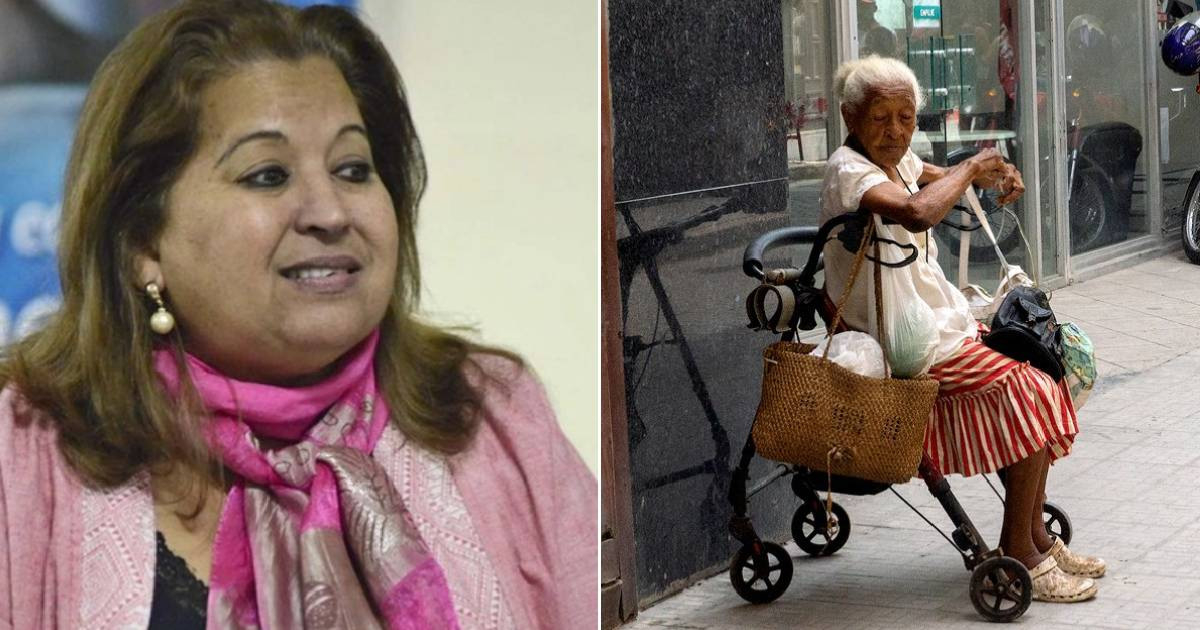
The Federation of Cuban Women (FMC) commemorates its 66th anniversary this Sunday amid a crisis that its General Secretary, Teresa Amarelle Boué, described as a situation of accumulating needs, ranging from power outages and lack of water to difficulties in preserving and acquiring food.
In an interview published by the official agency Prensa Latina, Amarelle stated that the FMC must strengthen its work in the neighborhoods and acknowledged that current conditions require intensifying actions such as family farming, food preservation, sewing brigades, and community solidarity.
"It's not just about the blackout; when there's a blackout, there's also no water," said the leader, who also pointed out that families must buy food daily to prevent it from spoiling. The organization, as she explained, is teaching them how to preserve it with advice from people connected to the culinary arts.
The leader also recounted that during visits to families facing complex situations, she observed how medications are shared among neighbors, while others share food and prepare communal meals. The FMC, she added, promotes community projects to alleviate the situation and foster solidarity.
In labor matters, Amarelle Boué acknowledged that there is a "significant gap in employment" and stated that one of the priorities is to integrate women into the workforce. To achieve this, the organization promotes projects alongside small and medium-sized enterprises, non-agricultural cooperatives, and state-owned companies.
Regarding women in vulnerable situations, the general secretary of the FMC was explicit in defining the organization's strategy. "We need to teach women in vulnerable situations how to overcome them," she stated, while rejecting welfare dependency and arguing that support should help them move forward.
As an example, he mentioned the ESPUmás project, developed between the FMC and the Ministry of Domestic Trade, which has provided employment for women with challenging family situations.
According to what he explained, some began generating income from their homes and later expanded their activities to include sewing workshops and other services.
Amarelle Boué also acknowledged that there are measures aimed at mothers of children with severe disabilities and people who care for dependent family members, mostly women, but she admitted that some proposals have not been able to be implemented because they require budgets and resources that are currently unavailable.
The difficulties described by the leader occur in a context of prolonged energy and supply issues. Cuba has experienced several partial and total collapses of the National Electric System this year, while blackouts exceed 24 continuous hours in numerous localities.
A few days ago, a content creator residing in Manatí, Las Tunas, published a video in which she ironically and frustratingly dismantles the chain of energy promises made by the Cuban regime, while, like hundreds of thousands of women on the island, she cooks with charcoal due to the lack of electricity and liquefied gas.
The lack of electricity also impacts the water supply. Official data indicates that approximately 2.7 million Cubans lack regular access to drinking water.
In recent weeks, complaints about the lack of this vital liquid have multiplied, forcing women to improvise rainwater collection systems after days without supply, while others report the situation in neighborhoods that have gone over nine months without receiving piped water, an unsustainable situation for many people who cannot carry buckets and large bottles.
The crisis also affects the healthcare system. Approximately seven out of ten medications in the national basic list are unavailable and Ciego de Ávila recently operated with only 10% of the available medications.
This situation is compounded by the increased prices of basic goods following the removal of retail price caps on oils, chicken, and powdered milk. Oil has reached 6,000 pesos and a carton of eggs has hit 4,500 pesos in the informal market, according to citizen reports from several provinces.
The situation has also led to women speaking out about the conditions their families are facing. Gaby Milán Zequeira Hernández, a mother from Havana, described on Facebook nights without electricity alongside her sick child and stated that the situation “is killing us slowly.”
In the field of gender-based violence, Amarelle Boué acknowledged that the FMC faces challenges in ensuring the operation of specialized counseling services in its offices. She admitted that some do not function properly due to a lack of trained personnel, insufficient outreach, or organizational issues in certain municipalities.
The leader herself noted that there is a challenge in the implementation of regulations regarding gender violence at the local and community levels, as well as another related to how stereotypes that sustain violence are normalized.
This issue becomes relevant in light of the data provided by the Gender Observatory of Alas Tensas, which documented 44 femicides during the first seven months of the year, a 112% increase compared to the same period in 2025, for a total of 359 cases since 2019.
Two days before the anniversary of the FMC, the leader Miguel Díaz-Canel presided over a ceremony where distinctions were awarded to more than 300 women. The event sparked mockery on social media, where one user questioned how this recognition could not resolve the shortages of electricity, water, medicines, and food affecting the population.
Amarelle Boué attributed a significant portion of the economic difficulties to the measures taken by the United States and the policies of the administration of Donald Trump. At the same time, she defended women's ability to support their families and communities through solidarity and creativity.
The Secretary General stated that the FMC has more than four million members, equivalent to 92% of women over the age of 14 in the country, and emphasized that this would be the organization's main strength.
"Because we will overcome this difficult moment," affirmed Amarelle Boué at the end of the interview. However, her diagnosis acknowledges a scenario where power outages, lack of water, scarcity of medicines, and difficulties accessing food are part of the needs that the FMC is trying to address from the neighborhoods.
Related videos:
Filed under: