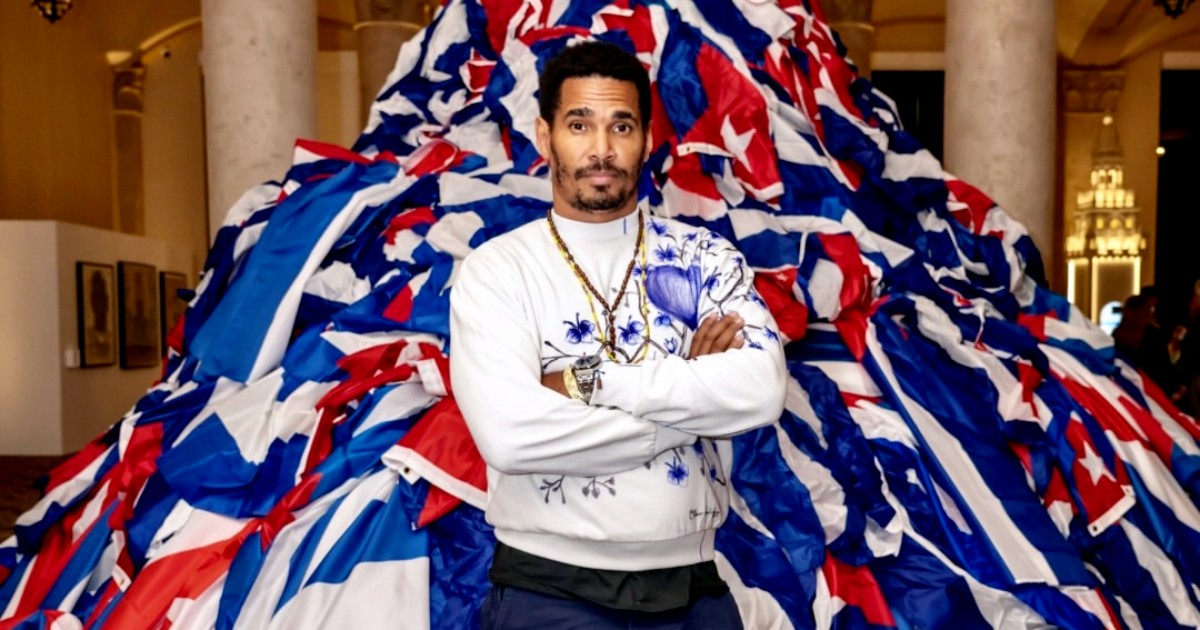
The Cuban artist and activist Luis Manuel Otero Alcántara received this Tuesday, from Amnesty International, more than 27,000 letters and messages of solidarity that people from around the world sent him during his five years of political imprisonment in Cuba, which he never got to read while behind bars, as reported by El Nuevo Herald.
The event, titled "Letters of Freedom and Solidarity," took place at El Espacio 23, the Miami art center where Otero Alcántara has been a resident artist until September, just over a month after his arrival in the city on July 18, when he first set foot on U.S. soil after being released on the condition of permanently leaving Cuba.
The letters and postcards are a result of the annual campaign "Write for Rights," through which Amnesty International selects a dozen cases each year that require international solidarity. The Cuban artist was one of the chosen in 2022, after being recognized as a prisoner of conscience by the organization.
Before the audience gathered at El Espacio 23, Otero Alcántara read a response letter he had drafted days earlier. "Even though I did not have the letters in physical form, in that moment of anguish, the energy and love from everyone reached me behind the bars. They were the nourishment for my heart's beating and for maintaining faith that a better future is possible," he wrote. He concluded with a direct statement: "I thank you all for so much love, you saved my life."
The Deputy Director of Research for the Americas at Amnesty International, Astrid Valencia, who personally delivered the letters along with two colleagues from the organization, emphasized the significance of every gesture of solidarity: "A letter may seem like something small, a simple gesture, but when a person is unjustly imprisoned, a letter can mean much more than just a piece of paper."
Otero Alcántara described how correspondence worked within the prison: the inmates kept the letters for years and read them over and over again. "Gifting a photo, giving a letter, writing something by hand meant a reaffirmation of one's concern for another," he recounted, defining it as a pact of friendship in a place where no one is a friend of anyone.
He also spoke about his creative process during the lockdown. Since he couldn't physically send out the drawings he made in his cell, he would describe them over the phone to artist friends outside the prison, who would interpret them.
"I was literally convinced that if the works didn't get released, I wouldn't go out," he stated. As a gesture of gratitude, he gifted Amnesty International one of those drawings: a door, symbolizing the search for an exit. Referring to the organization, he concluded, "They are light in the darkness."
Cofounder in 2018 of the Movimiento San Isidro, a collective of artists and intellectuals that emerged against cultural censorship and Decree 349 of the Cuban regime, Otero Alcántara was arrested on July 11, 2021, during the historic protests of 11J and sentenced in June 2022 to five years in prison for contempt, public disorder, and disrespect to national symbols.
His release from prison was marked by uncertainty: he was taken from Guanajay on July 7 without notification to his family, days before his sentence was set to end, which led to Amnesty International denouncing a possible forced disappearance.
Months earlier, in March, he had staged an eight-day hunger strike inside the prison following alleged death threats. His first words upon arriving in Miami were a rejection of forced exile: «I was expelled from Cuba».
Since arriving, he has exhibited over 4,000 paintings created during his imprisonment at El Espacio 23, and in mid-August, he participated in the exhibition "We Meet" at the Museum of Art and Design at Miami Dade College in the Freedom Tower, where he added a flag to his installation "3.5 Million Flags." His residency at the art center concludes in September.
Related videos:
Filed under: