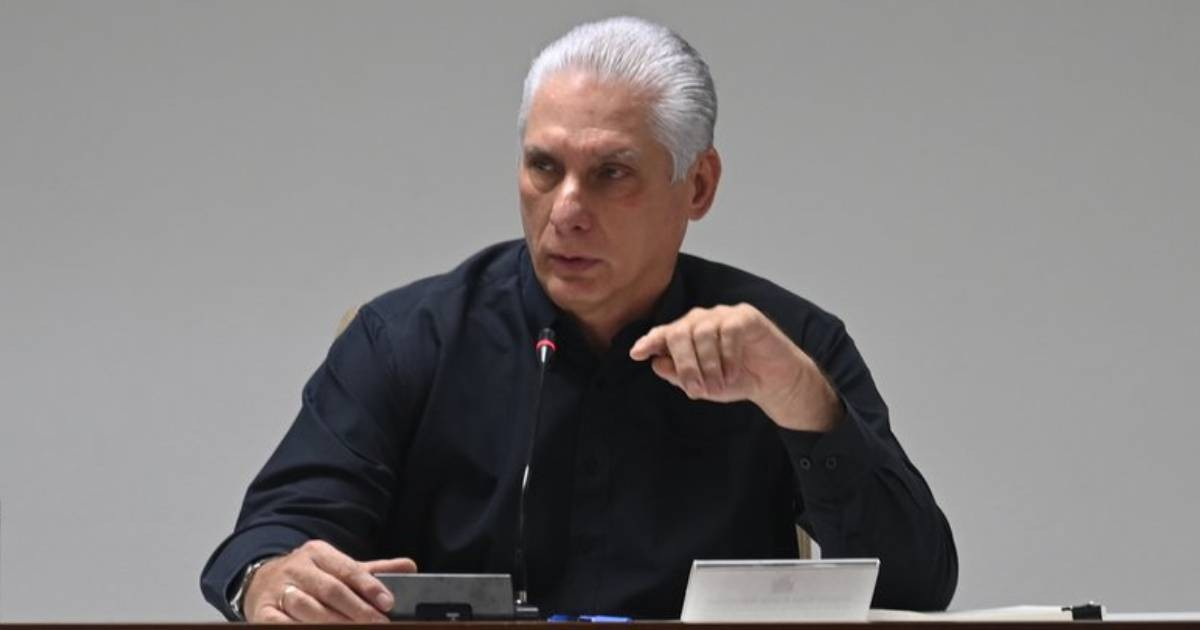
The Cuban ruler Miguel Díaz-Canel met on Tuesday with representatives of the Cuban private sector in a gathering where he promised greater dialogue, but also issued a warning regarding prices, tax evasion, electronic payments, and other practices that the regime deems illegal.
"This sector cannot become a space for illegal activities, tax evasion, speculation, corruption, hoarding, or pricing that is disconnected from reality," stated the leader, according to the official website of the Cuban Presidency.
The meeting was attended by businesspeople from sectors such as food, agriculture, energy, transportation, and legal consulting. The government presented it as the beginning of a permanent dialogue with both state and non-state economic actors, amid the implementation of the 176 economic and social measures approved last June.
Díaz-Canel was accompanied by several high-ranking officials from the Communist Party and the government, including the Secretary of Organization of the Central Committee of the Communist Party, Roberto Morales Ojeda. Also present were Óscar Pérez-Oliva Fraga, Deputy Prime Minister; Jorge Luis Broche Lorenzo, head of the economic department of the Central Committee; and Lázara Mercedes López Acea, in her role as president of the National Institute of Non-State Economic Actors.
"Offensive" against businesses that do not accept transfers
One of the issues that prompted a more direct warning was the refusal of numerous private businesses to accept payments through electronic transfers.
Díaz-Canel described that practice as "harmful" and announced an "offensive until its complete resolution."
The warning comes at a time when authorities have intensified inspections and sanctions against the private sector.
In Centro Habana, 232 businesses were inspected in a single day, resulting in 15 permanent closures and over 360 fines. In Las Tunas, another crackdown ended with 22 establishments closed, eight licenses revoked, and fines exceeding 1.2 million pesos.
Despite the tightening of controls, Díaz-Canel defended the necessity of keeping channels open with entrepreneurs.
"If there is no systematic dialogue, we cannot know what we are thinking and how we are building consensus," he stated.
He also requested that the success of projects not be evaluated solely by the money they generate, but by their impact "on a family's table, in the employment of a young person," and on the development of municipalities.
Business owners, for their part, acknowledged that they continue to face "prejudices and obstacles" at intermediate levels of administration. During the meeting, they presented business and community projects and highlighted, among other priorities, the need to move towards alternative energy sources.
An opening that Díaz-Canel himself calls a "concession."
The meeting took place just a day after Díaz-Canel acknowledged in an interview with the Brazilian newspaper Folha de S.Paulo that the expansion of the private sector does not constitute "an ideal of socialism", but rather a "concession" during a transitional period.
At the same time, he denied that the reforms represent a shift of Cuba towards capitalism.
The contradiction characterizes much of the current economic policy: while the 176 measures approved in June remove the limit of 100 workers for small and medium-sized enterprises, include private banking, and open up investment possibilities for non-state actors, the government simultaneously increases inspections, fines, and closures on those same businesses.
Díaz-Canel concluded the meeting by asserting that economic transformations must be carried out with the participation of everyone and aimed, he said, "at the well-being of the people and the development of the country."
The meeting once again highlights the difficult balance that Havana is trying to maintain: it needs the private sector to support an economy in crisis, but insists on keeping it under strict state supervision.
Related videos:
Filed under: