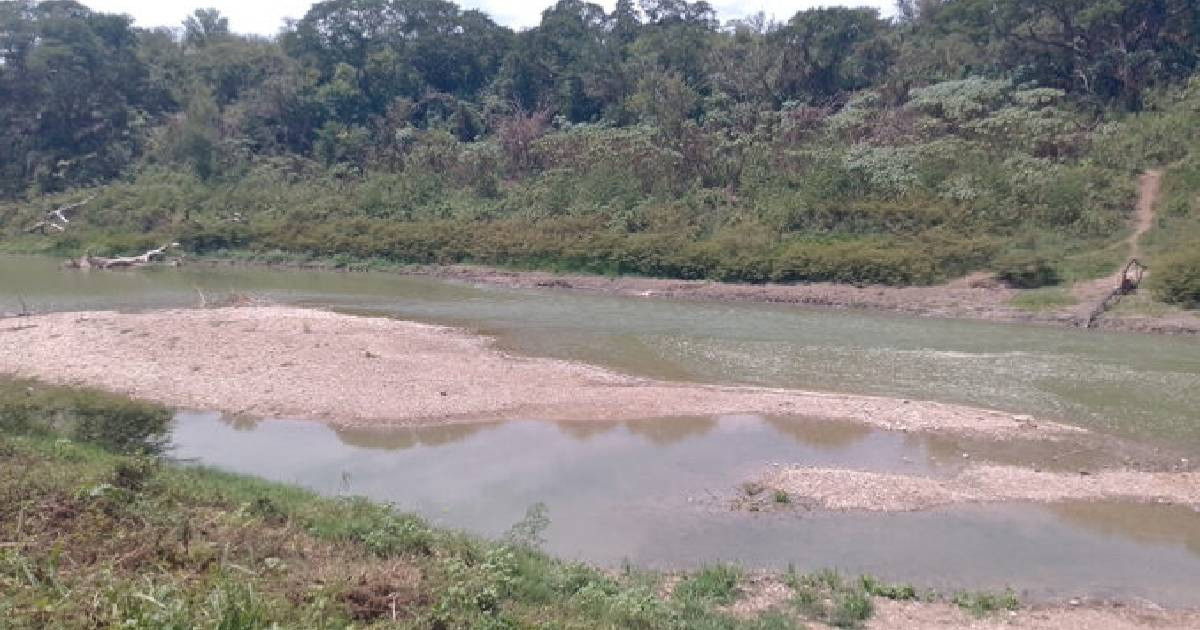
The Cauto River, the main waterway of eastern Cuba, is experiencing a historic decline in its flow due to the drought, forcing families in Cauto Cristo, in the province of Granma, to consume saline water laden with mud extracted directly from the riverbed.
The situation is particularly striking because just nine months ago, the same river experienced a historic overflow following the passage of Hurricane Melissa, which made landfall in eastern Cuba on October 29, 2025, as a category three storm, and forced the evacuation of more than 8,000 people in that province.
"At least in Cauto Cristo, the water that comes through the pipes is very saline and contains remnants of the mud from which it is extracted," highlighted a report from the station Radio Bayamo this Saturday.
The same official source acknowledged that "it would be difficult to think of a quality liquid under these conditions," although it added that health studies have not detected any viruses or bacteria in laboratory analyses.
The organoleptic quality of water—its color, odor, and taste—is, however, a daily issue for thousands of families who depend on the Cauto for survival.
The river is the longest in Cuba, with a length of 343 kilometers. Its basin drains more than 8% of the national territory and spans the provinces of Granma, Santiago de Cuba, Holguín, and Las Tunas, where around one million people live.
Evaporation in the Cauto Valley reaches one of the highest rates in the country, making it one of the river systems most vulnerable to extended periods of drought.
According to the source, "the drought in the Cauto River is not just a climatic issue; it is a social matter that hinders access to quality water in the communities."
This episode is part of a national water crisis of historic proportions. As of March, drought was affecting 62% of Cuban territory, and water reserves were at 38% of their capacity, the lowest level since 2015.
In May, nearly 2.7 million Cubans lacked regular access to drinking water, while several million received it intermittently.
The situation is exacerbated by the El Niño phenomenon, whose intensification is projected to create additional water stress conditions for the island. Researcher Luis Lecha Estela from the Meteorology Institute warned that the phenomenon "could promote meteorological drought conditions and water stress in the country, with summers warmer than usual."
In Camagüey, a neighboring province, 100% of the territory reported a precipitation deficit in July, with 99.8% classified as severe-extreme, highlighting the regional scale of the issue.
While the authorities do not provide concrete solutions, Radio Bayamo acknowledged that "the people, in their resilience, find practical but fleeting ways to bring water to their homes," a description that summarizes the sad reality of thousands of Cuban families facing another worsening crisis.
Related videos:
Filed under: