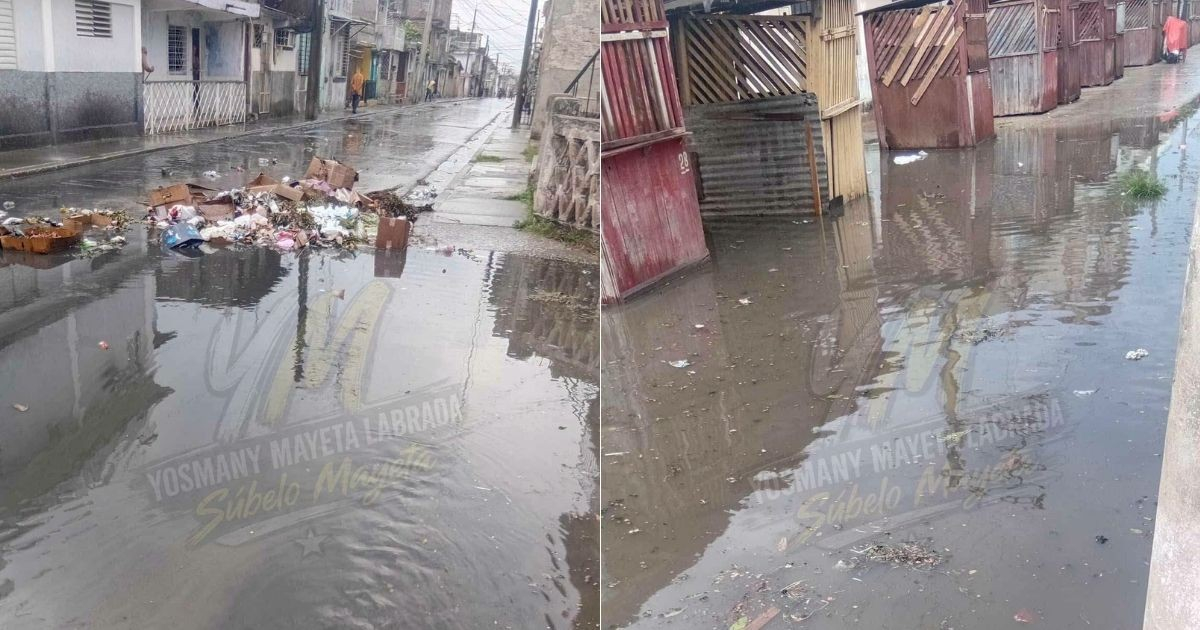
Accumulated wastewater for almost three weeks in the middle of the public road, floating waste, and piled-up garbage create the scene that residents of Moncada Street, between Martí and San Ricardo, are suffering in the heart of Santiago de Cuba. The complaint, published this Friday by journalist Yosmany Mayeta Labrada, describes a health hazard that local authorities have not addressed despite being notified.
The affected area is popularly known as "the block of the leaves" or "witchcraft street," just a few meters from Paseo de Martí, one of the busiest thoroughfares in downtown Santiago. According to the testimony of a neighbor identified as Alfonso, who provided the images and account, the sewage water comes from the San Ricardo corner at Callejuela, where the sewage system has been blocked for three weeks.
"About 21 days ago, the sewers became clogged with wastewater coming from the corner of San Ricardo and Callejuela," Alfonso stated.
The photographs that accompany the complaint show the roadway completely covered in dark water, with disintegrated cardboard boxes, plastic bags, and all kinds of debris floating adrift. This is not the image of a street after a brief rain; rather, it reflects a persistent infrastructure problem that deteriorates week after week.
What makes this focal point a top priority health emergency is the population living on that block, which includes, according to Alfonso's testimony, "four infants under five months and elderly individuals." "It's a major epidemic hotspot," he asserted.
The neighbor claims to have exhausted the available institutional channels. He went to the family doctor's office, to the management of the Polyclinic Finlay of the General Directorate of Health of Santiago de Cuba, and to the head of the People's Council, identified as Viviana. The response he received starkly summarizes the state of communal services in Cuba: "They said there is no fuel to send the truck."
That excuse —the lack of fuel— is not a local oddity. It's the same one that recurs across the island in response to similar complaints. In Havana, less than half of the garbage collection trucks were operational at the beginning of 2026, halted due to fuel shortages and mechanical deterioration.
The case of Moncada Street is not an isolated incident in Santiago. In February 2026, a manhole exploded in the Vista Hermosa neighborhood due to a blockage in the main sewer line, flooding homes with wastewater. Just three days before this new report, a mass food poisoning affected 52 people in the José Martí Pérez urban center, with 18 hospitalized, including two pregnant women and three minors.
In April 2026, the provincial government of Santiago itself admitted a "concerning deterioration" in hygiene and epidemiology, with poor sanitation, issues in water purification, and infestation levels of the Aedes aegypti mosquito—vector for dengue and chikungunya—above the average of the last five years.
The healthcare collapse is not exclusive to Santiago. This Friday, writer Rodolfo Alpízar Castillo reported the overflow of sewage in Santos Suárez, Havana, where black waters mix with potable ones and, in his words, "the street no longer exists." Additionally, last Tuesday, residents of Cienfuegos reported that the water they receive comes with large larvae, little red worms, and living organisms, supplied from the Damují pipeline in Abreus.
With each rain that falls on Moncada Street, the accumulation grows and the danger spreads. Residents are calling for urgent intervention before what is currently a sanitation issue turns into a major public health crisis tomorrow.
Related videos:
Filed under: