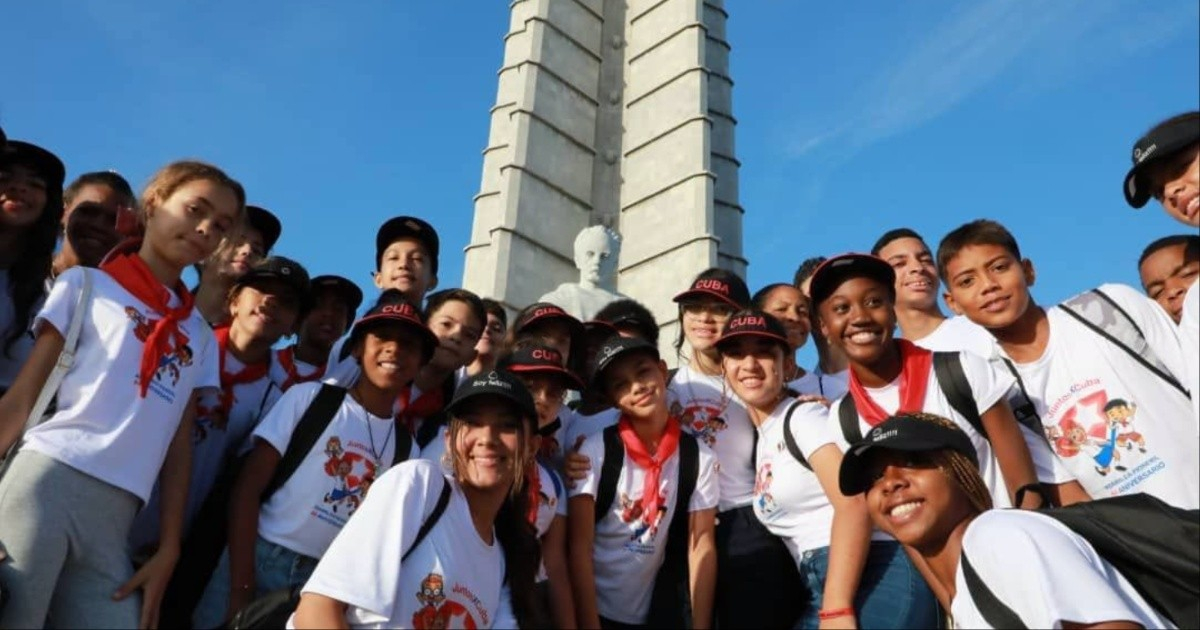
The Communist Party of Cuba published on its official Facebook account this Saturday that the start of the 2026-2027 school year represents “another act of heroism and a firm determination to not give in”, accompanying the message with the hashtags #CubaEstáFirme and #CubaVencerá.
The response from hundreds of Cubans in the comments was an avalanche of criticism that described a reality radically different from the one portrayed by the regime.
The 2026-2027 academic year is set to begin on September 1, according to Resolution 43/2025 from the Ministry of Education, but it is happening amidst the worst energy and educational crisis the island has experienced in decades.
The PCC publication included a photograph of young students wearing red neckerchiefs of the Pioneers in front of the José Martí Memorial at the Plaza de la Revolución. Instead of generating enthusiasm, the message sparked a wave of indignation among those who described the real conditions in which children and teachers must attend classes.
"Truly, those who attend classes after long hours without electricity and in the midst of horrendous heat are heroes. Many go without breakfast and without snacks to bring. Others wear patched shoes and lack uniforms, heading to schools in terrible conditions for studying," wrote a user identified as Andria GianAnt.
Another commentator, Floria Juban, was more direct: "What hope and future are they talking about? If it's not about young people leaving for Guyana and then to Brazil."
The backdrop that frames these words is devastating. The power crisis left 65% of the island without electricity on Thursday, and by Friday, the percentage reached 72% of the territory, with outages lasting up to 40 hours in provinces inland. Cuba has experienced at least seven total collapses of the National Electric System so far in 2026.
The activist Thais Mailén Franco Benítez questioned whether teachers and students can perform after more than 30 hours without electricity: "There is no power, no water, no food, no health."
The energy crisis is compounded by a structural deficit of nearly 3,000 teaching positions in Camagüey to serve more than 95,000 students across 690 schools, and over 2,000 missing teachers in Holguín to start the school year. Nationwide, the deficit exceeds 24,000 teachers, which is equivalent to 12.5% of the required positions.
In light of this situation, the Ministry of Education acknowledged "exceptional" conditions and announced emergency measures such as a reduction in class hours and the possibility of a single teacher managing multiple institutions. The production of uniforms would barely meet 20% of the student population: 2.3 million garments compared to the 3.6 million needed.
Cuban mothers also raised their voices. "When there’s no electricity: it doesn't work. When there’s no water: it doesn't work. When I have nothing to give him for breakfast: it doesn't work," wrote Verónica C. Barrios in the comments. Yunia Avila, the mother of a high school student, added: "He has been sleeping on the floor for more than a month, barely has any water, and he goes because he wants to, because on my part, it doesn’t work."
This rhetoric of "heroism" is not new. The First Secretary of the PCC in Camagüey, Walter Simón Noris, recently described the start of classes as a "blow to imperialism", a statement that also sparked mockery and widespread criticism on social media.
The immediate background exacerbates the situation: last May, the government was forced to advance the end of the 2025-2026 school year due to a lack of fuel and suspend university entrance exams. Reynier Curbelo Sanchez summarized the feelings of many in the comments on the PCC's publication: "You are only interested in your slogans and your cheap politics; you do not care about the suffering of people and the little ones."
Related videos:
Filed under: