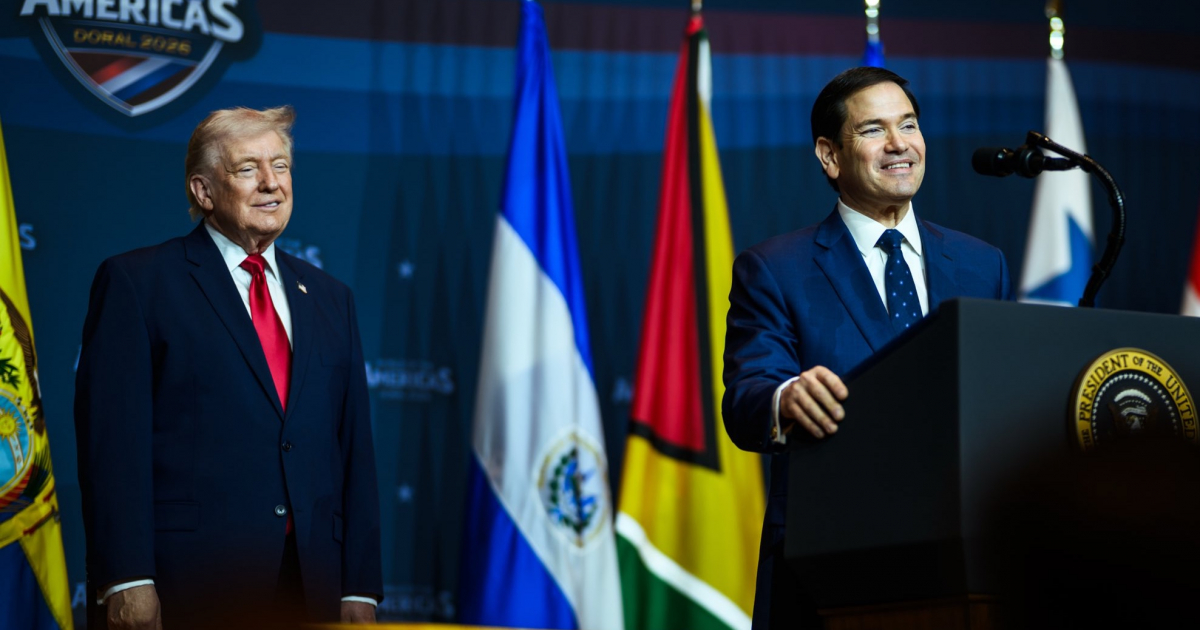
A few days ago, Marco Rubio made a statement about Cuba that sparked mixed reactions. The Secretary of State recalled a fundamental reality of his position: "I work for the United States of America" —he works for the United States of America—though he quickly added that Cuba matters to him, that he has a personal connection to it, and that a stable and profoundly different Cuba also serves the U.S. national interest.
Even more importantly was his forecast: he expressed confidence that before the end of Donald Trump's administration, Cuba would be on an irreversible path toward a very different future. He warned that transformations of that magnitude do not happen overnight. To illustrate this, he gave an example: Poland.
Indeed, Poland has much to teach us.
On August 30, 1980, 46 years ago today, the Polish communist regime had to sit down to negotiate with the workers and sign the historic Szczecin Agreement. The following day, August 31, the more well-known Gdańsk Agreement would be reached. This would be followed by developments in Jastrzębie-Zdrój and other industrial centers. These were not spontaneous concessions from a suddenly generous dictatorship. They were the result of an extraordinary workers' mobilization that achieved something far more significant than an occasional protest: organization, coordination, and solidarity.
In Gdańsk, around 800 workplaces became coordinated around the Inter-Company Strike Committee. The workers put forth 21 demands that went beyond just wages or food prices. They called for genuine independent unions, the right to strike, freedoms, and guarantees that directly challenged the political monopoly of the Communist Party.
This marked a significant transformation. Social discontent ceased to be merely a reaction to daily hardships and evolved into organized civic awareness.
From those events, Solidarność —Solidarity— was born. On September 17, 1980, representatives from various strike centers established an independent national organization. In a short time, it gathered approximately ten million members: workers, peasants, intellectuals, students, and citizens from very different sectors. It was something unprecedented within the communist bloc.
The regime understood the danger.
On December 13, 1981, General Wojciech Jaruzelski declared martial law. He suspended freedoms, prohibited strikes and gatherings, militarized workplaces, and filled prisons and detention centers with leaders and activists of Solidarity.
More than 10,000 people associated with the movement were imprisoned during that period. There were fatalities. On December 16, 1981, during the repression of a strike at the Wujek mine, the regime's forces opened fire and killed nine miners. The Polish Institute of National Remembrance estimates that around a hundred people lost their lives as a result of the repression associated with martial law. It was a brutal crackdown, surpassing that of July 2021 in Cuba.
The objective was clear: to destroy Solidaridad. But they couldn't. They made it illegal, yet it continued to operate clandestinely. They seized its publications, and clandestine printing presses emerged. They imprisoned leaders, and new leaders arose. They cracked down on meetings, but the gatherings persisted. They fired workers, threatened families, and forced thousands to flee the country.
Solidarity survived because it had stopped being merely a union. It had transformed into a culture of civic resistance, supported by networks of citizens, workers, intellectuals, religious communities, and millions of people who had understood that the issue was not simply the price of a product or a specific economic deficiency: it was the political system that prevented society from freely deciding its own destiny.
Something that Cubans on the Island still do not understand, and nor do many in Exile. It is not just about blackouts and hunger, or specific groups or projects. It is about unity, coordination, discipline, solidity, and a constant struggle, not just for one day or one weekend.
Years went by. In this context, Rubio's recent words take on special significance: major historical changes require processes. In February 1989, nearly nine years after the strikes of August 1980, the communist regime was finally forced to negotiate with the opposition it had tried to destroy. The Round Table talks began. On April 4, agreements were reached that allowed for partially free elections for the Sejm (Parliament) and fully competitive elections for the new Senate.
On June 4, 1989, the candidates supported by Solidaridad achieved an extraordinary victory. They were well organized. The Polish communist regime had lost politically.
A few months later, a democratic transformation would begin that would have repercussions throughout Eastern Europe. The movement initiated among workers, shipyards, factories, and strikes had decisively contributed to the overthrow of one of the most significant communist systems on the continent.
Historical teaching is particularly suggestive when observing Cuba.
Power outages can provoke protests. Hunger can lead to demonstrations. A lack of medicine can result in discontent. A hospital in poor condition, wages that are insufficient, and crumbling housing can drive a desperate group of people to take to the streets. However, a surge of indignation and a structured civic movement are different phenomena.
The Polish experience demonstrates that transformative strength emerged when numerous individual demands began to converge into a common call for rights, representation, and freedom; when factory workers realized that their issues were connected to those of workers in another factory; when laborers, farmers, students, and intellectuals started to recognize themselves as parts of the same society. Szczecin and Gdańsk also teach that an initial victory does not mean the journey is over.
After August 1980 came Jaruzelski, martial law, prisons, deaths, underground movements, propaganda, and long years of uncertainty. Many Poles may have thought that everything was lost.
It wasn't. Solidarity had achieved something that repression could not easily erase: a society aware of its own capacity to organize.
Cuba has changed profoundly over the past few decades. Fear no longer induces the absolute silence of former times; public protests have emerged in numerous places, and there is a civil society that, despite enormous difficulties, continues to demand rights. However, Polish history reminds us that no profound transformation should be measured solely by what happened yesterday, by what is happening today, or by what might occur tomorrow.
Historical processes are built by accumulating awareness, experience, social connections, perseverance, and organizational capacity.
That is why it is so fitting to remember Poland this August 30th.
Those workers did not know for sure that nine years later they would begin to dismantle the communist regime. They could not foresee the final outcome when they went on strike, when they secretly printed a newspaper, or when they were pursued by the political police. But they persevered.
And finally, the victory of 1989 arrived. Poland demonstrated that even a system supported by a powerful repressive apparatus and by the Soviet Union could ultimately yield when a society developed enough civic awareness, solidarity, and perseverance.
That is probably the most important part of the comparison mentioned by Marco Rubio. History rarely changes from one moment to the next. But it does change.
And when a society learns to transform scattered discontent into solidarity, desperation into awareness, and fear into perseverance and organized action, even that which seemed immovable for decades can begin to crumble.
And this does not mean that we have to fight for 9 more years as happened in Poland from 1980 to 1989. No. Cubans have come a long way: we have the Varela Project, the Black Spring of 2003, July 11, 2021, and many other milestones in the struggle for freedom.
We have the support of the United States, from Donald Trump and Marco Rubio, along with other advantages that the Poles lacked in the 1980s. However, we must overcome the limitations that are solely our responsibility and no one else's—those that prevent us from becoming, with everything we have in our favor, a movement as large and effective, or even more so, than Solidarność in Poland.
Related videos:
Filed under:
Opinion article: Las declaraciones y opiniones expresadas en este artículo son de exclusiva responsabilidad de su autor y no representan necesariamente el punto de vista de CiberCuba.