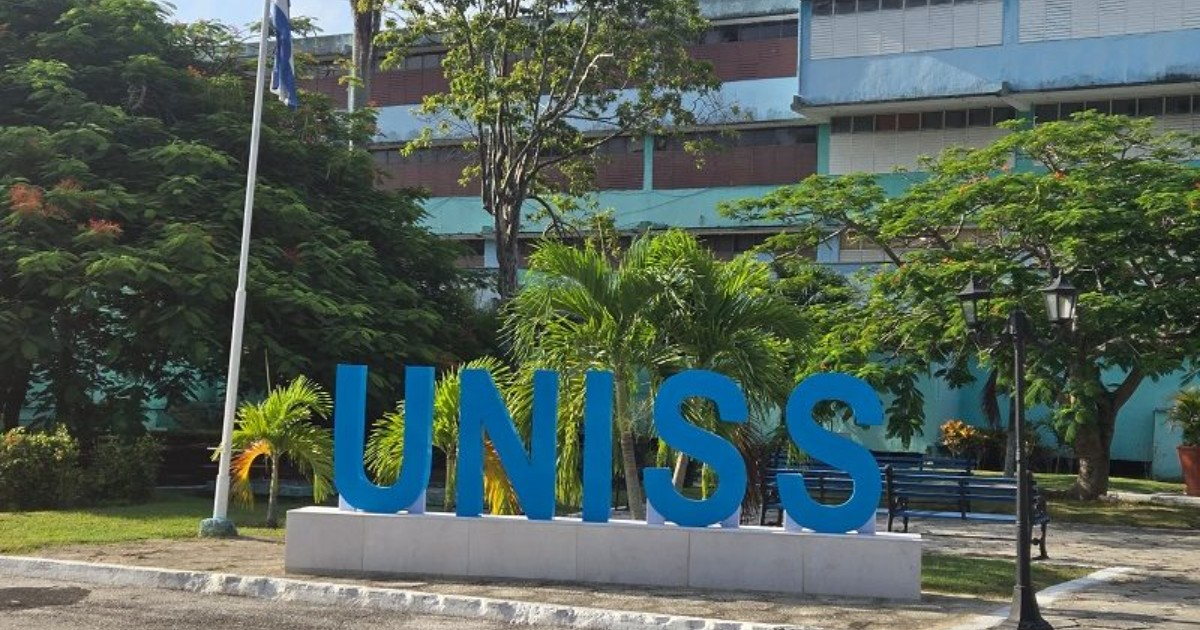
The University of Sancti Spíritus José Martí Pérez (UNISS) will begin the new academic year with around 1,000 students in the regular daytime course and a primarily blended format, amid power outages, connectivity issues, and transportation problems that concern students and families.
The official newspaper Escambray highlighted this Monday the challenges that will shape the academic year and posed as a challenge achieving, through the efforts of teachers, students, and families, "the miracle of knowledge in such difficult times as those we are experiencing today."
Incredibly, the newspaper itself acknowledged that distance education does not yield the same results as in-person teaching, which contrasts with the traditional official narrative.
Although Cuba already resorted to that modality during the covid-19 pandemic and again in the second half of the previous school year, it noted that the results "can never be compared to those achieved when students receive content in front of their teachers in the classroom."
The Ministry of Higher Education (MES) announced that during the new academic year, teaching processes will be organized in a decentralized manner with activities based in local areas.
In the case of UNISS and the Central University Marta Abreu of Las Villas, the first semester was organized so that students stay on campus for approximately one month in total, distributed by year and specialty.
In Sancti Spíritus, students residing in the municipal capital will normally receive in-person instruction.
For those living in other municipalities, a one-week concentration each month at the university is planned, during which they will receive intensive classes corresponding to their studies.
During the other three weeks, these students will connect with the Municipal University Centers (CUM) and labor entities to undertake internships and complement their professional training.
The schedule will repeat each month until completing the four planned in-person weeks during the semester.
The Higher Technician programs and courses that are conducted in-person will return to face-to-face meetings at least once a month to guide and evaluate learning tasks, while distance courses will continue their usual operation. Postgraduate activities will also resume.
Regarding this, students and parents consulted by Escambray expressed several concerns, among which they mentioned that, due to the economic crisis, many young people have started working and may have less time to study or even abandon their studies.
They also pointed out that power outages and connection difficulties severely complicate virtual learning and expressed concern that those who manage to graduate will end up with "serious gaps in their knowledge of their field."
The rector of UNISS, Edelvy Bravo Amarante, explained at a press conference that they are currently coordinating with local authorities the necessary logistical resources to ensure those in-person periods, including transportation to and from for the students.
The official indicated that students who, for any reason, are unable to attend when called upon will be able to stay engaged through virtual spaces to continue their education.
The newly admitted students will gather at the university during the second week of September and will accumulate about 15 days of in-person attendance.
During this time, initial assessments will be conducted, and guidance will be provided on how to use the virtual platforms and manage part of the academic content independently.
The university plans to accommodate them in a residence located in a protected electrical circuit, with the aim of enabling them to take advantage of connectivity and access the digital platforms used during the course.
The institution of higher education currently has more than 500 full-time faculty members and around 300 professionals from various entities and organizations who collaborate in university training.
It will also take on the responsibility of supporting students from Sancti Spíritus enrolled in regional and national programs offered at other universities.
Escambray concluded its analysis by acknowledging that the success of this period will largely depend on the creativity and dedication of the teachers, but also on the personal will and motivation of each student and on the real and unconditional support from their families.
It will be through this combination of efforts, the newspaper concluded, that teachers, students, and families must try to "achieve the miracle of knowledge in such difficult times as those we are living today."
The reorganization of the Cuban university system has recent precedents.
In February, the University of Havana temporarily transitioned its Higher Technician programs to a hybrid format amid the energy and fuel crisis.
However, a month later, students staged a protest on the steps of the University of Havana in a context of discontent regarding the conditions under which they had to continue their studies during power outages and connectivity issues.
Dissatisfaction later spread to other faculties. In June, medical students from various provinces voiced their concerns related to their academic processes, amid issues with electricity, transportation, and teaching organization.
The crisis also prompted the Government to suspend the entrance exams for Higher Education for the 2026-2027 academic year and to establish other ways to organize access to university programs.
The planned model in Sancti Spíritus is no exception. University students from Santiago de Cuba will also begin the semester with not fully in-person modalities.
Related videos:
Filed under: