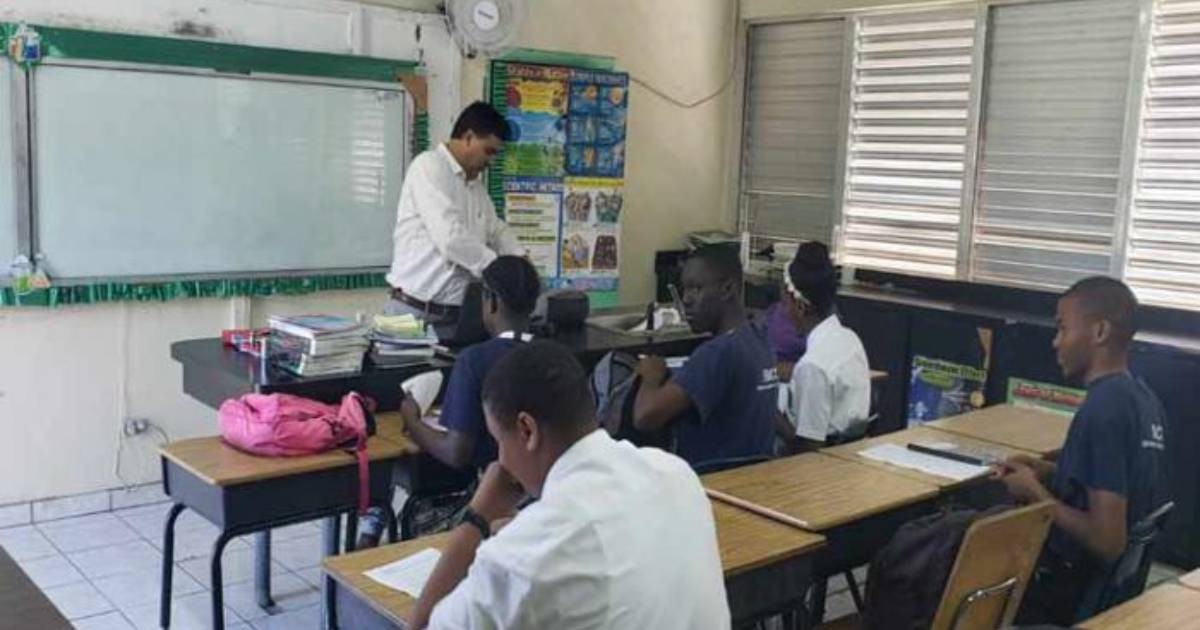
The government of The Bahamas has decided not to renew the contracts of 31 Cuban teachers for the 2026-2027 school year, while the hiring of medical personnel from the island remains suspended amid negotiations with Washington regarding the working conditions of these workers.
The teachers learned of the decision abruptly. One of them, speaking on condition of anonymity, reported that the group received the news during a meeting at the Breezes hotel, shortly after arriving in the archipelago to start the new school year, according to The Tribune.
The Bahamian Ministry of Education confirmed the measure and clarified that the renewal of contracts was never guaranteed, although it acknowledged that some teachers had expressed their interest in continuing to work in the country.
"Our priority remains the recruitment and hiring of qualified Bahamian educators," the institution stated, assuring that it has incorporated a significant number of new local teachers into public schools.
The 31 Cubans taught specialized subjects such as welding, agriculture, and other technical and vocational areas where the Bahamas has struggled to fill positions.
The representative for Central Grand Bahama, Frazette Gibson, questioned the manner in which the decision was communicated and warned about the potential impacts on programs that were already in place.
The Ministry of Education, however, left open the possibility of hiring foreign teachers when there are no qualified Bahamian candidates for certain positions.
Cuban doctors are also awaiting a decision
The uncertainty extends to the healthcare personnel on the island. The Public Hospitals Authority has also not extended the contracts of Cuban medical workers, except for those who have legal status in the Bahamas or are married to citizens of the country.
The Minister of Health and Welfare, Michael Darville, confirmed that discussions with U.S. officials are ongoing and that a meeting was scheduled for this Monday with Cuban Ambassador Juan Carlos Marcof Sánchez to discuss the next steps.
For his part, Chancellor Fred Mitchell refrained from specifying whether the pressure from Washington influenced the decisions made regarding Cuban workers.
The situation is part of a process that began last year. In August 2025, more than 100 Cuban teachers returned to classrooms in the Bahamas through a direct hiring scheme, after the country ended the agreements involving the Cuban state agency responsible for those hires.
Negotiations for a similar model for doctors continued throughout 2025 and 2026. In July, Darville informed Parliament that only 35 Cuban healthcare professionals remained in the country.
Pressure from Washington on Cuban missions
The United States has intensified its campaign against the model through which the Cuban regime sends workers abroad, especially healthcare professionals, considering that there are practices of labor exploitation.
Washington has indicated that the regime was retaining between 83.9% and 91.6% of the money paid by Bahamas for each doctor. The disbursements reached up to $12,000 per month per specialist, while the professional received between $990 and $1,200.
In July, the United States sanctioned the Minister of Public Health of Cuba and other individuals associated with the Cuban medical cooperation system, which Washington links to forced labor practices.
The pressure does not solely come from the United States. In April, the Inter-American Commission on Human Rights (IACHR) recommended that countries in the region withdraw from those programs after documenting practices such as document retention, salary confiscation, and surveillance of workers.
The number of Cuban healthcare professionals deployed abroad has also decreased. According to data from the State Department cited this year, there were between 15,000 and 18,000 Cuban medical workers in 51 countries, compared to about 24,000 in more than 58 countries at the beginning of 2025.
Related videos:
Filed under: