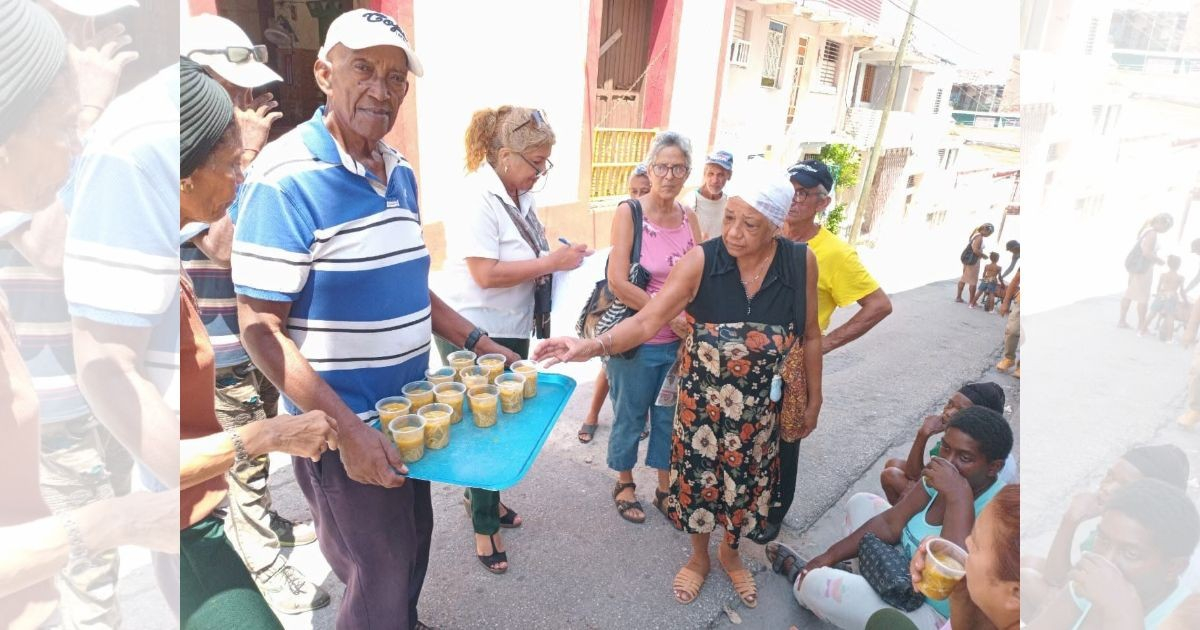
A small business offered stew to retirees while they waited for their turn to collect their pensions at a bank branch in Santiago de Cuba that was trying to maintain services despite the lack of electricity.
The provincial office of the Banco Popular de Ahorro (BPA) in Santiago de Cuba announced this Wednesday that Branch 8152, located on Enramadas Street, has adopted "organizational measures" to continue payments to the elderly amid the blackouts.
During the wait, mipyme La Piu Seducente joined in on the care for retirees and offered them a hearty stew, rated as "exquisite" by the bank itself.
"An increasing number of economic actors are joining in support of payments to retirees at banking offices," the BPA noted, presenting the initiative as "a gesture greatly appreciated by those benefiting."
Help can alleviate the conditions faced by the elderly for a few hours, but it highlights the reliance on palliative measures to make an enduring wait more bearable, the underlying issue remaining the same: the difficulties in accessing cash and receiving pensions normally.
The banking system itself has acknowledged that retirees need to wake up early to try to get cash, a situation exacerbated by power outages and the limitations of bank offices.
In recent days, actions to provide food, drinks, and places to rest for those waiting to collect their pensions have increased in Santiago de Cuba.
Recently, a local establishment at Enramadas and Corona opened its doors to provide coffee, cookies, and other drinks to retirees who were coming to collect payments at another BPA branch.
Several private businesses collaborated with this initiative.
Days before, state entities and students had brought food, drinks, and chairs to retirees waiting outside Santiago banks, another response aimed at alleviating the conditions of long waits.
However, the difficulties in paying pensions have also led to transferring part of that process outside the banks themselves.
In July, the Central Bank announced that local economic players could use the cash from their sales to pay retired individuals in their communities, through a partnership with banks.
The measure aims to reduce queues and bring payments closer to beneficiaries, but it has also raised questions about the ability of those businesses to always have the necessary funds available, as the regime forces them to accept payments by transfer.
In this regard, the economist Elías Amor questioned what would happen if a small or medium-sized enterprise responsible for paying pensions does not have enough cash due to a low sales day or if there are delays in the reimbursement of funds by the bank.
Related videos:
Filed under: