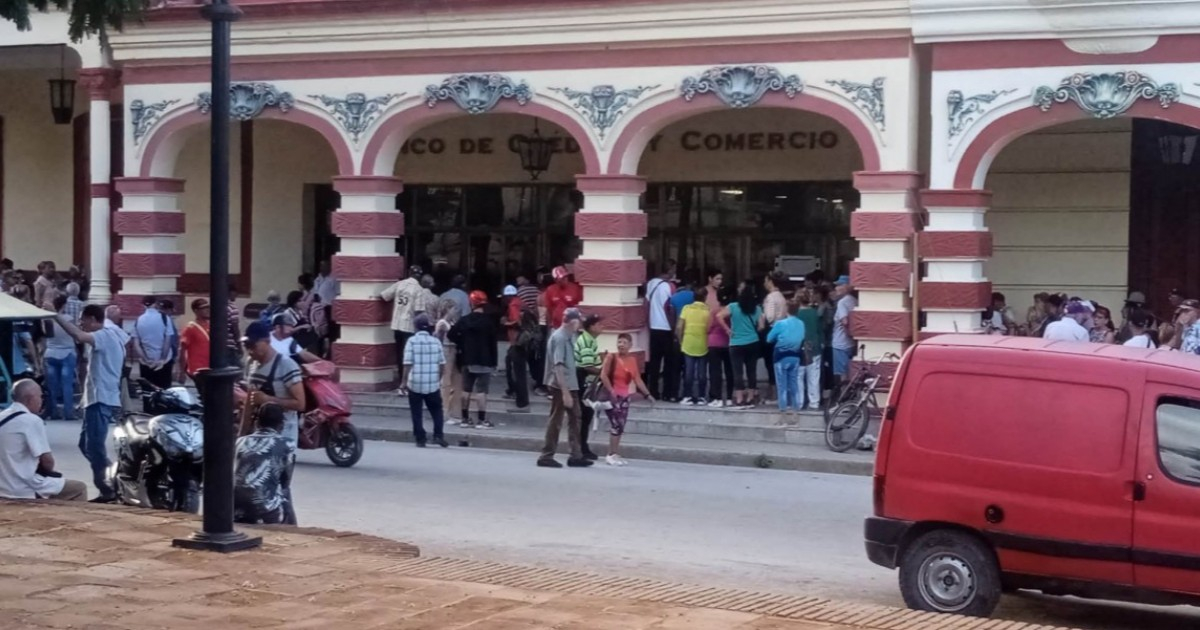
A photograph published on by the page Holguín Memories starkly captures the reality faced each month by more than 1.7 million retired Cubans: a long line of elderly individuals at Parque de San José in that eastern province, waiting in the sun to collect their pensions.
"A picture that speaks volumes on its own," wrote the author, who laments that retirees, after so many years of work, have to endure situations like this.
And add a phrase that thousands of Cubans share: "Something should change."
In recent months, reports have increased regarding the situation that retirees in Holguín face each month to cash their checks.
On August 18, the writer Manuel García Verdecia reported that those collecting at the post office were unable to do so because the money had not been deposited, while in front of the BANDEC and Banco Popular de Ahorro banks, in his words, “a sea of the desperate” was forming. He posed a question that no government official answers: “Is there any official who cares about this carousel that repeats itself every month, sowing anguish and bewilderment?”
In July, a branch of the Banco Popular de Ahorro in Holguín closed at 3:00 PM and left dozens of elderly people unable to cash their checks despite there being electricity, cash, and connectivity. It was not a technical failure: it was institutional neglect.
The crisis is spreading throughout the Island. In June, the authorities of Granma admitted that they did not have the more than 400 million pesos necessary to pay their more than 111,000 retirees that month.
In Guantánamo, the provincial government acknowledged that the banks also did not have enough cash. In Santiago de Cuba, some branches only serve about 50 retirees per day, forcing many to line up as early as the previous afternoon.
The institutional response to this crisis has been, at best, cosmetic.
In July, the Central Bank expanded the "Caja Extra" scheme, allowing small and medium-sized enterprises (mipymes) and private businesses to pay pensions with their own cash and receive state compensation within up to 72 hours.
Economists have questioned the mechanism for shifting a constitutional obligation from the State to private actors. In Holguín, about 20 small and medium-sized enterprises participated in an initial phase that covered around 5,000 retirees, but lines and complaints persisted.
The crisis has also created room for corruption. In San Luis, Pinar del Río, the theft of over three million pesos intended for pensions left more than 1,110 retirees unpaid at the beginning of June.
In Ciego de Ávila, a postal employee was sentenced to four years in prison for telling retirees that "there was no cash" while embezzling their funds.
In February, the Minister of Finance and Prices, Vladimir Regueiro Ale, promised that pension payments were "guaranteed in the budget". The image of San José Park contradicts that promise more eloquently than any official figure.
The state newspaper Venceremos acknowledged in early July that the situation "has ceased to be a banking difficulty and has become a social problem." Meanwhile, Cuban seniors continue to wait in line.
Related videos:
Filed under: