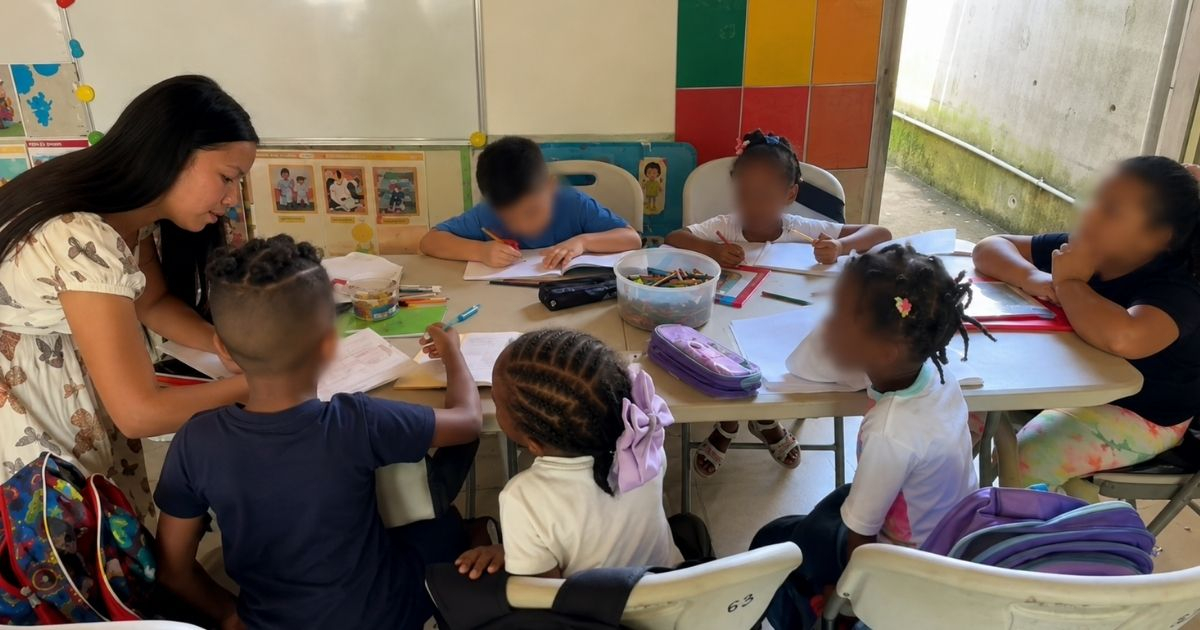
Cuban children and teenagers make up the majority of around 120 migrant students who started the new school year in an educational program in Tapachula, a Mexican city that has become a temporary —and in some cases permanent— residence for numerous families from the island.
The information was published this Monday by Diario del Sur, which detailed that the project Education Without Borders began the school year with Mexican, Cuban, Honduran, Salvadoran, and Haitian students, aged between three and 17 years.
Esther Berenice, head of the primary level, explained to the newspaper that most of the enrollment currently consists of Cuban students, although the program continues to receive minors from other countries.
The approximately 120 students are distributed among preschool, primary, and secondary education, and receive classes at the Community Development Center (CEDECO) Estación Ferroviaria, located in the old train station of Tapachula, in the state of Chiapas.
The program operates under a multigrade scheme, due to the differences in age, academic level, and educational background of the children.
The content follows the model of the New Mexican School, but teachers must adapt it to a population that is constantly changing due to the very nature of migration movements.
The predominant presence of Cubans is not appearing for the first time in reports about these classrooms. In May, Diario del Sur reported that Cubans and Haitians made up the majority of students in the Migrant Education Program and linked this phenomenon to families choosing to remain in Tapachula due to changes in U.S. immigration policies.
The report from this Monday presents a nuance regarding that situation: it now specifically points out the Cubans as the predominant nationality among the students.
One of the challenges within classrooms is precisely the coexistence of children from different educational systems and with different languages.
The most evident case is that of Haitian students who arrive speaking Creole and have not yet mastered Spanish.
Teachers turn to translators and technological tools to communicate with them and even receive help from students who are proficient in both languages and act as interpreters for their classmates.
The situation also requires modifications to school activities because some children arrive with different academic levels or join when the school year is already well underway.
According to Diario del Sur, Education Without Borders has assisted since 2021 over 1,150 minors from more than 15 nationalities.
On July 10th, 25 students completed an educational phase as part of a multicultural promotion called "Generation of Peace." This graduation was also reported by the Chiapas newspaper, which highlighted the interaction among students of different nationalities within the program.
The project is still accepting applications for the 2026-2027 cycle. In August, the same news outlet reported that girls, boys, and adolescents in a situation of mobility could enroll, even when families did not have all the academic documentation for the minors.
The presence of Cuban children in the classrooms occurs amid a much broader migration phenomenon in Tapachula.
Local authorities have warned throughout 2026 about the sharp increase in citizens from the island who remain in this border city, some awaiting the resolution of immigration procedures and others after being deported from the United States.
Estimates on how many Cubans remain in Tapachula, however, vary considerably depending on the source and the time.
In May, Mayor Yamil Melgar Bravo mentioned more than 10,000 Cubans in the city, while organizations cited in a subsequent report by Human Rights Watch estimated around 800 deported Cubans stranded specifically in Tapachula.
Human Rights Watch also documented that Cubans were the largest group among citizens of third countries deported by the United States to Mexico, from January 2025 to March 2026, with 4,353 people sent to the country during that period.
The extension of stay has led many to seek ways to integrate into the daily life of Tapachula, on the southern Mexican border. A Cuban migrant joined, for example, as a children's basketball coach, while other compatriots have turned to informal work to support themselves while attempting to regularize their situation.
Related videos:
Filed under: