The oil agreement signed between the United States and Venezuela cannot be evaluated solely based on its barrels, investments, or potential revenues for Caracas.
The pact also reveals how much the nature of the relationship between Washington and the interim government of Delcy Rodríguez has changed.
Since January, the Trump administration has maintained that its ultimate goal is a democratic Venezuela, but has constructed that process by primarily working with those who control the State: Delcy Rodríguez and the sector of chavismo that remains in the institutional framework.
At the same time, the leaders who represented the main electoral alternative to Maduro have had a much more limited participation.
The difference is significant.
María Corina Machado was received by Donald Trump at the White House and later had contacts with Marco Rubio.
For his part, Edmundo González retains support from U.S. lawmakers who believe that the opposition won the 2024 elections. However, neither of them is part of the core negotiation mechanism that Washington has promoted with Caracas.
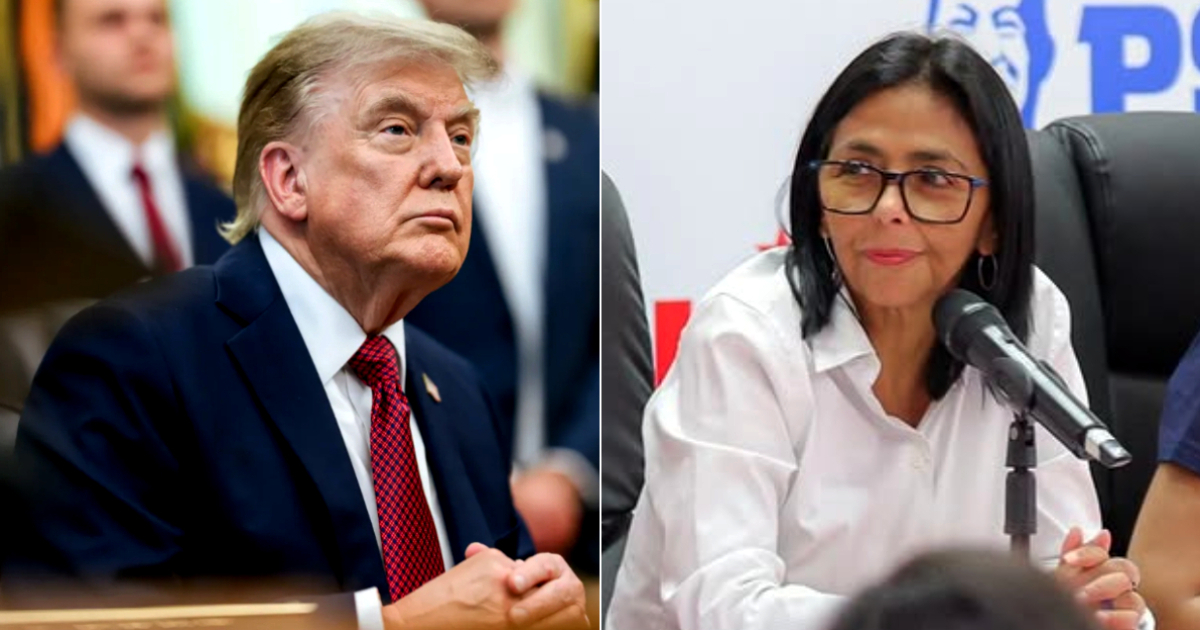
In contrast, Delcy Rodríguez has become a regular interlocutor for the White House, as her government directly negotiates with the United States on issues as sensitive as oil, security, public revenue, sanctions, and reconstruction.
That contrast represents the true political context of the oil agreement.
Washington first chose who controls the State
The U.S. decision has an obvious explanation.
After the capture of Nicolás Maduro, Washington faced a paradoxical situation: the political structure that had supported the former regime still controlled a significant portion of the institutions, the Armed Forces, and the security apparatus.
Rubio explained it in January before the Senate, pointing out that those who held the weapons and controlled the institutions were still the same elements of the old regime. His reasoning was that the United States needed to work with that reality to prevent the collapse of the state and subsequently lead to a transition.
The strategy made sense. A transition cannot be carried out over the ruins of a state that is incapable of governing.
But it contains a known vulnerability: the interlocutor who is essential to stabilize the country can also become the actor with the greatest ability to influence the transition.
During the first months, Washington clearly chose to manage that contradiction through cooperation.
The relationship reached a point where the administration lifted sanctions against Delcy Rodríguez, a decision that was criticized by senators who reminded that she had been part of Maduro's inner circle and had been sanctioned precisely for her role in the authoritarian regime.
Jeanne Shaheen and Elizabeth Warren demanded a detailed explanation from Rubio and the Secretary of the Treasury, Scott Bessent, regarding that decision.
The senators' question was essentially this: what concrete changes justified rewarding a figure from the old regime with relief from sanctions?
That question became more relevant as the political negotiations began to progress.
The problem is not that Washington is talking to Delcy
Negotiating with an interim government that controls the state is not, in itself, an illegitimate concession.
The issue is what role that dialogue plays in relation to the democratic objective declared by the Trump administration.
In August, the first formal conversations between the government and the opposition took place between Jorge Rodríguez, brother of Delcy and the main negotiator for the Executive, and Dinorah Figuera, former president of the National Assembly elected in 2015 and leader of Primero Justicia.
María Corina Machado and Edmundo González were excluded from that mechanism.
Chatham House expressed concern about the structure of those talks and pointed out that the first meeting did not even take place in person, and that the subsequent statements were too vague to show substantial progress toward a transition.
The decision can be explained from a pragmatic perspective: a negotiation requires parties capable of sitting down with the adversary and seeking agreements.
But it also has an evident political consequence: the actors who negotiate are the ones who ultimately shape the new balance of power.
And there Machado appears again.
Machado remains important to Washington, but he is less present at the table
Trump has not broken ties with Machado. Neither has Rubio.
The opposition leader met with the Secretary of State and continues to describe her relationship with the administration in positive terms. The issue is not the breakup.
The problem is the centrality.
Machado is not participating in the negotiations that are defining Venezuela's immediate political structure. González is not participating either. Both have stated that they will assess the process based on its results and have demanded concrete conditions: the release of political prisoners, guarantees for all actors, institutional restoration, and an electoral calendar.
This leaves Washington in a delicate position. The administration needs Delcy to cooperate in governing the present. However, it also requires the opposition to have enough influence to shape the future.
If the first relationship becomes much deeper than the second, the transition runs the risk of acquiring an institutional bias before Venezuelans can express their opinions in an election.
The Congress is precisely pointing out this problem
The concern does not arise exclusively from the Democrats.
On August 4, Ted Cruz and Jeanne Shaheen introduced a bipartisan resolution on Venezuela demanding free and fair elections, the release of all political prisoners, and guarantees for María Corina Machado and other leaders to return and participate freely.
Among the co-sponsors are Republicans and Democrats: Rick Scott, Dick Durbin, Tim Kaine, Adam Schiff, and Jacky Rosen.
The Republican chairman of the House Foreign Affairs Committee, Brian Mast, had called days earlier for negotiations to result in a clear path toward free and fair elections.
That is to say, there is a widespread concern in the Capitol: stabilization may be necessary, but it cannot become a substitute for transition.
That is also the issue behind the oil agreement.
Oil changes the incentives
So far, Washington needed Delcy primarily for one political reason: she controlled the Venezuelan state.
Now there is a second reason: the oil agreement creates a relationship of enormous economic scale.
The Trump administration has announced a potential investment of up to $100 billion, the development of 17 fields, and U.S. rights over part of the production. The agreement revolves around North American Blue Energy Partners and the entrepreneur Alejandro Betancourt, while doubts remain regarding some of its legal and financial terms.
That means that Washington now has long-term material interests associated with the functioning of the Venezuelan state and the stability of the structures that manage the oil industry.
It doesn't mean that I want to preserve Delcy. But it does mean that stability ceases to be just a political goal. It also becomes an economic condition.
And when stability and transition are in conflict, that difference matters.
The risk lies in the sequence
Rubio originally presented his Venezuelan strategy as a three-phase process: stabilization, recovery, and transition.
The problem arises if the first two phases produce results more quickly than the third.
The desired sequence would be: stabilize → recover → institutionalize → hold elections.
The risk sequence would be: stabilize → recover → invest → consolidate relationships → postpone elections.
In the first instance, the economy prepares democracy. In the second, the economy may end up making continuity more valuable.
That risk does not require a conspiracy. It can arise simply from incentives.
The greater the U.S. investment, the more interest Washington will have in ensuring predictability. The more integrated the administration is with the interim government, the higher the cost of a sudden break will be.
The longer time passes, the harder it will be to distinguish between a transitional government and a new de facto government.
The real test for Rubio
The agreement can be extremely beneficial for Venezuela.
The recovery of its oil industry could generate investment, jobs, foreign currency, and infrastructure. It could also be a strategic victory for the United States. However, for Rubio, the benchmark for success is more demanding.
The question is not only whether Venezuela will produce more oil in three or five years.
Yes, when that happens, Venezuelans will be able to freely choose who manages that wealth and under which institutions.
Because a Venezuela that is economically recovered but politically supervised would still have the most important part of the program that Rubio announced in January pending.
And here it is important to remember something that Congress itself is demanding from the administration: free elections require much more than just a date. They require the release of political prisoners, the freedom to organize parties, freedom of the press, credible electoral institutions, and safety for all candidates, including Machado.
The oil agreement does not indicate that Washington has abandoned those objectives. However, it does make the question more urgent.
The deeper the economic relationship with the interim government, the greater the need to demonstrate that Delcy Rodríguez is a bridge to the transition and not the center of a new political balance.
That will be the true test of Rubio's strategy. Not who controls the oil.
Related videos:
Filed under: