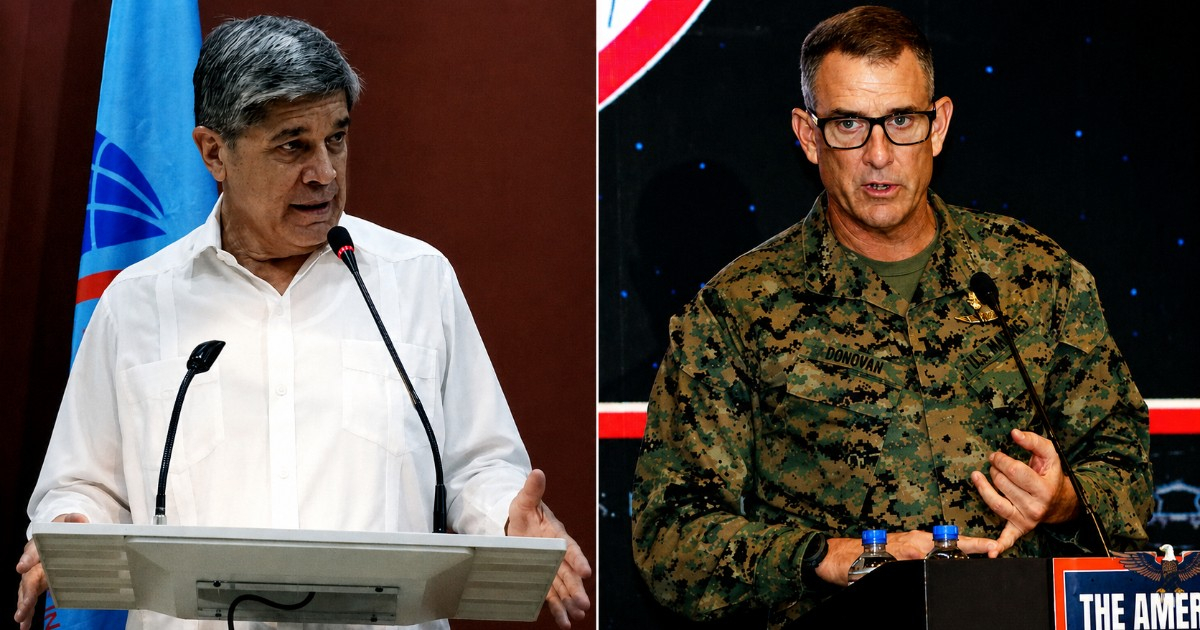
The Cuban regime's Deputy Minister of Foreign Affairs, Carlos Fernández de Cossío, published a message on social media in which he accused Washington of funding press articles to "convince the public of the inevitability, natural materialization, and eventual execution of a military aggression against Cuba," pointing out that "the trending news is the military movements and maneuvers in Puerto Rico."
The publication, dated Sunday, August 30, not only limited itself to denouncing the alleged plan of aggression: its most direct targets were the journalists and analysts reporting on the U.S. deployment in the Caribbean.
Fernández de Cossío referred to them as "contractual liars" whose task would be to "inflate the falsehood that Cuba constitutes or could constitute a threat to the U.S.", and described Washington as a power with "5,200 nuclear warheads, 11 aircraft carriers, and military bases or presence throughout the hemisphere."
The background of the statements is real and documented. Southern Command has intensified its presence in the Caribbean throughout 2026: reactivated the Roosevelt Roads naval base in Ceiba, Puerto Rico —closed since 2004— with a projected investment of 79 million dollars, and deployed the 24th Marine Expeditionary Unit, with over 1,300 personnel, under Operation Southern Spear.
The governor of Puerto Rico, Jenniffer González Colón, confirmed that more than 8,100 soldiers would be conducting exercises on the island between May and August 2026. Since February, the U.S. has accumulated over 150 hours of aerial surveillance around Cuba using P-8A Poseidon, RC-135V Rivet Joint, and MQ-4C Triton aircraft.
Direct warnings to the regime have also been present. Secretary of Defense Pete Hegseth warned from Guantánamo in June that Cuba "will find out very quickly" the consequences of acquiring weapons that threaten U.S. territory, and reiterated from Panama in mid-August that “all options are on the table.”
What Fernández de Cossío's post omits is as revealing as what it actually states.
The deputy minister did not mention the Chinese intelligence facilities on Cuban territory, documented by the State Department and the Center for Strategic and International Studies (CSIS), which identified operational sites in Bejucal, Wajay, Calabazar, and El Salao.
Just days before, the regime's senior official had dismissed those same accusations as "slander", using the same rhetoric he now applies to those reporting on military movements in Puerto Rico.
The pattern has been consistent since the beginning of the year. In March, Fernández de Cossío stated that the Cuban army is "always prepared"; in May, he threatened "fierce resistance" in the face of any aggression; and in July, he accused Washington of seeking to intimidate the Cuban people.
The regime, which declared 2026 the "Year of Preparation for Defense," conducts weekly exercises of the doctrine "War of the Entire People" supervised by Miguel Díaz-Canel, which include ambushes, laying mines, and evacuation drills.
The regime has also denied the presence of the Chinese military on the island with the same emphasis that it now uses to denounce media coverage of the U.S. deployment in the Caribbean, a stance that its own critics on social media have pointed out as contradictory, reminding that Havana also denied for years the presence of Cuban troops in Venezuela.
Related videos:
Filed under: