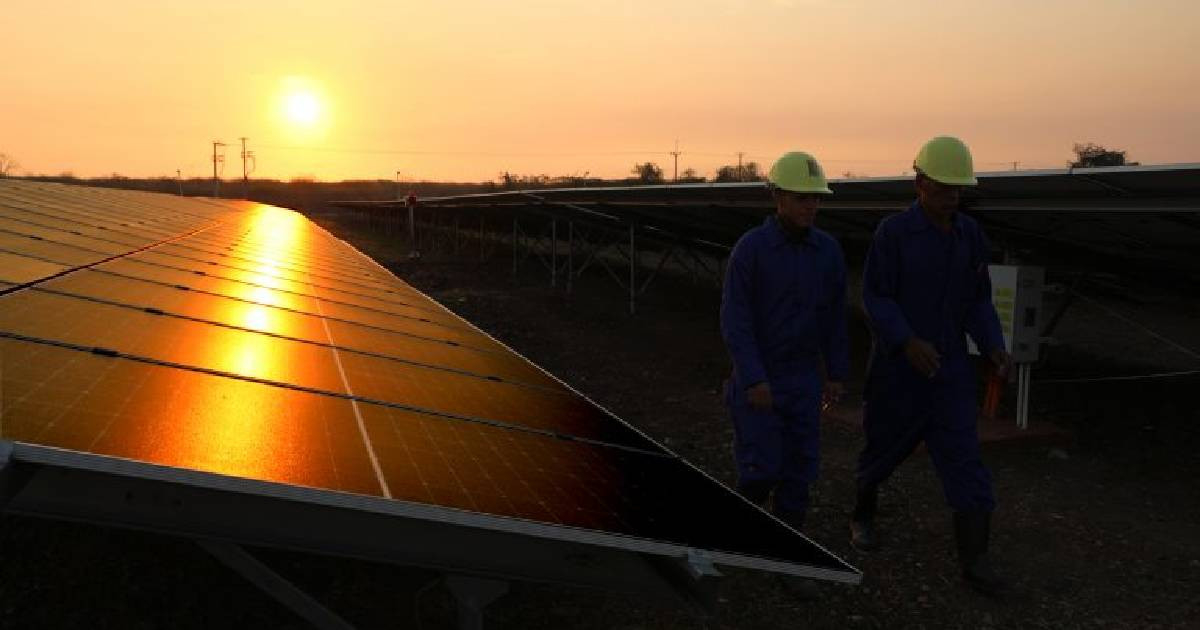
Even in the best-case scenario —with all of its solar parks operating at full capacity— Artemisa only manages to reduce its daily blackouts from 22 hours to 18. This was acknowledged by the provincial Electric Company in a publication by the state-run newspaper El Artemiseño (Periódico Artemisa on Facebook) this Thursday, which, instead of calming the population, sparked a wave of outrage on social media.
Yamirka Fernández Pérez, director of the Cargo Office of the Electric Company, explained that the province has 140 MW of installed capacity in solar parks, compared to a maximum provincial demand that hovers around 170 MW during the day.
During the peak radiation hours—between 11:00 a.m. and 3:00 p.m.—the parks can provide about 70 MW for the territory, as long as the National Electric Power System (SEN) allows it, the source stated.
That gap between the 140 MW installed and the 70 MW that actually reach the province did not go unnoticed. "The lie is evident; if the capacity of the park is 140, the actual generation would be 20 or 30% less under real conditions, not half. The effective solar radiation lasts until about 6 PM, not until 4," questioned a netizen in the comments.
Another internet user pointed directly to the figures: “I see a math problem. If 140 MW are installed and the province consumes 170 MW, how come when the sun is blazing down on the street, the panels only deliver 70 MW? Calculate that for me or explain where the other 70 MW are.”
The situation worsens after 4:00 p.m., when the parks cease to supply energy. From that moment on, the province operates with a base of just 35 MW —primarily allocated to hospitals and essential services— along with a surplus of about 7 MW that allows for the rotational energizing of certain circuits during the night, with a frequency of every six to eight days.
When the SEN restricts the direct use of parks due to load balancing reasons, the situation becomes even worse: the province operates only with those 35 MW baseline, and two-hour rotations are applied to each of the 122 circuits in the province, excluding those that are protected, such as hospitals and water pumping systems.
The director acknowledged the precariousness of the scheme without offering any prospects for improvement: "That's how it has worked since June 11. At times, we have been able to provide energy to the population, and at other times we haven't, always depending on the system's availability."
The paradox of having installed parks but being unable to use their energy because the SEN restricts it generated one of the most compelling criticisms. "Having energy that cannot be used because the SEN restricts it while we continue to install parks [...]” wrote a netizen. Another summarized the situation with a metaphor: “The parks in our province are like potato planting: they are cultivated here and mostly go to Havana.”
Several residents reported that municipalities like San Cristóbal go entire days without electricity. "I don't know which region San Cristóbal belongs to; there's no power here at all," wrote an internet user. Distrust in official figures was encapsulated in another comment: "Little math: for lies, they multiply, and for everything else, they subtract and divide as it suits them."
This scenario reflects the structural contradiction of the Cuban electric system: the solar parks installed in Cuba mostly lack large-scale storage systems, which prevents the transfer of generated energy to nighttime. For months, the National Electric Union has been reporting daily deficits that hover around or exceed 2,000 MW, and Cuba has already experienced seven total collapses of the electrical system so far this year.
Related videos:
Filed under: