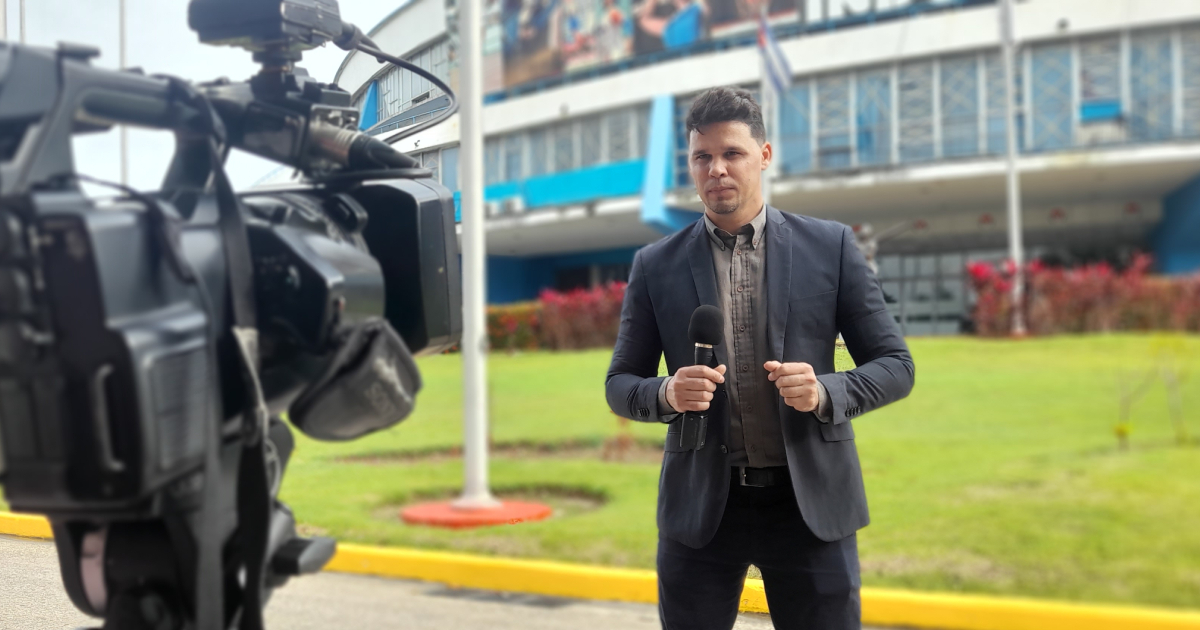
From athlete to television studies, her path to sports journalism was not linear. Before stepping in front of a microphone or a camera, she experienced sports from the inside: she practiced taekwondo, baseball, kayaking, and water polo; she studied at the "Marcelo Salado" sports school and graduated with a degree in Physical Culture. It was precisely that education that rekindled her desire to tell the story of sports from a different perspective.
Generally, I interview sports personalities or artists who have established their paths, but today I am speaking with a promising sports journalist who still has a journey ahead, Alejandro Rodríguez, who is currently brightening up the small screen in Cuba.
You enter sports journalism after having lived the sport from the inside; you practiced it and studied it. It's clear that you were confident about your future.
Sports have always been a passion, but there is a huge difference between practicing it and being able to tell its story. Since I was a child, I have always participated in some kind of sport, whether it was taekwondo, baseball, kayaking, or water polo.
My dad had a significant influence on my interest and motivation for competition. By the age of just four, he was already a "monitor" for a taekwondo group of kids my age.
After studying at a sports school, I didn't have much passion; I wasn't sure which career to pursue, but I at least knew that I loved sports.
I considered fields that I could relate to in some way, such as Journalism or Psychology, but each one only offered two spots, and my ranking did not allow it.
Completing his degree in Physical Culture and Sports, the interest in journalism resurfaced, largely influenced by the figure of Professor Jorge Alfonso Chacón.
At that time, he offered Journalism as an elective and saw qualities in me that could be developed in the world of communication. He taught me to view sports through a reporter's eyes, to deeply understand its history, and to respect both the athlete and the audience.
After graduating, I took the exams for a sports commentator course and passed. Years later, I began my journey in radio and never settled for what I had learned. I attended all kinds of courses, diplomas, workshops, and more.
Your entry into television happens through a casting. How do you remember that moment and what did it mean for you to reach such an important medium?
Indeed, the Caribbean Channel, later Cuban News Channel, needed its own professionals to take on the sports segments of the newscasts, in a schedule that also expanded in hours and slots. I remember the mix of nerves and excitement when I was chosen. Suddenly, I was alongside those individuals I admired, and each broadcast was an exhilarating experience.
From that moment on, everything changed. The recognition on the streets, the advice, the new opportunities, even outside the sporting world... It was a complete turnaround in my professional life.
There is an inevitable image: occupying spaces and podiums where figures like Eddy Martín, René Navarro, or Héctor Rodríguez once stood. Does it feel like a privilege, a responsibility, an unavoidable comparison, or a bit of everything?
A little bit of everything and much more. It is a tremendous privilege because I grew up listening to them, watching them, admiring their storytelling; in some cases, towards the end of their careers. They are role models for all communication professionals.
I had the opportunity to start at a young age, but my goal is different; I live for the reporting aspect of television—hosting, interviewing, covering events. I have never done narration and I don't plan to; at most, I provide analysis and commentary, which is something they also did. They always serve as a reference.
After several years in television, with international coverage such as the Pan American Games in Lima 2019 and the Central American and Caribbean Games in San Salvador 2023, as well as numerous national events, who are your role models in sports journalism today and which journalists or commentators would you have liked to have as mentors?
One can learn from everyone, even from those who share the day with me. We learn from both good and bad examples. In the field of journalism, the documentary materials from the multi-sport events produced by you and Carlos Alberto González are very inspiring.
Times change, resources change, rules change, but the essence, which is to tell and to evoke emotions, remains the same. I admire those who narrate with depth, sincerity, and without extravagance. However, I reiterate, teachers are everywhere; every colleague is a teacher, and I learn from them every day.
Do you think that Cuban sports journalism has lost—or gained—anything compared to that generation that turned sports commentary and narration into a true school?
When we compare one generation to another, there is always controversy. And every past era was better… or so they say! Now, it's undeniable that that generation (Eddy, Navarro, Héctor, and so many others) created a style, a way of narrating that was unique, with an unquestionable mastery of the language and a deep knowledge of the sport.
However, I wouldn't dare say that journalism, commentary, or sports reporting has diminished. Today, there has been an increase in diversity of voices, coverage of more disciplines, and a stronger digital presence. Perhaps the speed at which we live has resulted in a loss of depth, in the literary weight that chronicles and commentaries require, primarily. These are different times, different rhythms, perhaps with less space for reflection... But the essence remains!
Let's delve into a more uncomfortable territory. How do you view Cuban sports television today? Does it have the resources, journalists, and platforms necessary for Cuban sports, or has it lost quality, audience, and the ability to tell our own stories? And in that context, what are your thoughts on the current state of the Sports Editorial team and platforms like NND?
Cuban sports television has enormous potential, but it is severely limited, like almost everything in Cuba, by technical and economic resources. It is also hindered by poor decisions. However, we have trained journalists and professionals who are eager and discerning. Sometimes what is lacking is time, editorial will, and opportunities to delve deeper, to engage in investigative journalism, and to tell the stories behind the medals. The emphasis on immediacy and content repetition works against us.
I am not part of the Sports Editorial Team of Tele Rebelde or the National Sports News, as I am from the Cuban News Channel, but I have collaborated with them and it continues to be a school for many, a place where the voices of Cuban athletes and coaches are heard.
Let's talk about Cuban sports. For years, Cuba “dominated” the Central American and Caribbean Games; today, the reality is different, and the results from the San Salvador 2023 Central Caribbean Games already showed that loss of hegemony, and in the recent competition in the Dominican Republic, the outcome was similar, with a third-place finish by country. What is happening to us?
It’s a combination of factors; there is no single cause. The reality is that we have become accustomed, from my perspective, to reaching levels and comparisons that are now unsustainable. The world has changed. Today, countries that previously did not prioritize sports now do.
Countries with more resources, larger populations, and better infrastructure. It is very difficult, for example, to have a diverse range of sports when there are no resources available even for practicing traditional disciplines. We cannot compare the active population of Mexico, Brazil, Colombia, Canada, Argentina, and the resources they have for training athletes with our conditions... And that’s considering we have a fairly solid base for talent identification and development!
All of this is compounded by the exodus of athletes and coaches, which represents a severe blow, as it disrupts teams, projects, and years of hard work and training.
As a journalist who reports on this reality from within, I believe that criticism is necessary and should extend as far as it is constructive. It's not about destroying, but about pointing out what is lacking so that improvements can be made.
One must speak with data, with respect, and with proposals, even if the space to do so is sometimes limited. As everywhere, there are limits and taboo subjects; however, today, for instance, there is much more discussion about professionalization, sponsorship, and the necessary changes to refresh the Cuban sports system. Unfortunately, there are still many people who fear criticism and others who are bothered by constructive criticism.
If I ask you if you see a bright future, what do you see?
I don't dare to speculate about the future, but clearly many things need to change. That being said, Cuban sports have an impressive human foundation. If we can improve planning, investment, and talent retention, the future could be bright. But that requires structural changes, not just in sports.
I still believe that sports are one of the most powerful tools for bringing us together and showcasing who we are. Whether it will be a bright future or not will depend on the decisions made from today onward. From my position, I will try to contribute my little bit with honesty and passion, which is the only thing I have never lacked.
Undoubtedly, Alejandro Rodríguez is a professional with sound judgment who deserves respect. Whether we agree or disagree on certain aspects is not what matters; what is truly important is his perspective and way of narrating sports from his era.
Generations do not repeat; they succeed one another, and in that succession, a new wave of journalists is emerging who, with their own voices, doubts, and certainties, will have to learn to tell the story of the Cuba that is theirs, the Cuban sports with which they must coexist.
Perhaps there, between the memories of those who paved the way and the drive of those who are just beginning to traverse it, lies the future of our sports journalism. Because as long as there is an honest perspective, an open notebook, and a voice ready to speak about what is happening, there will always be a story to tell.
Related videos:
Filed under: