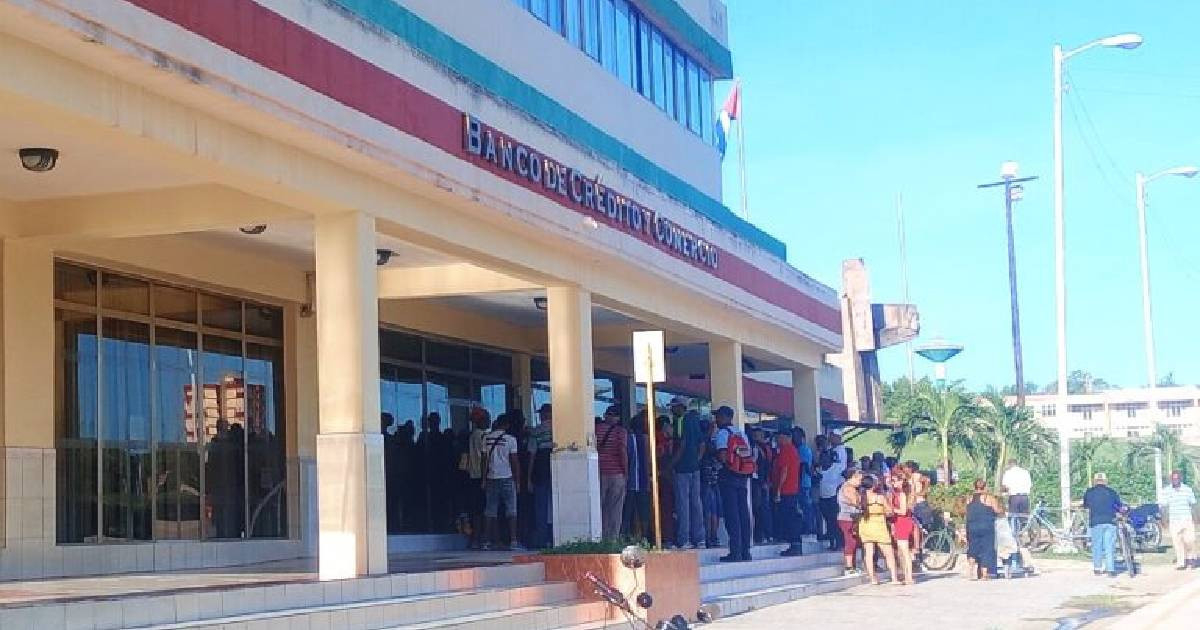
Provincial authorities in Guantánamo discussed on Saturday the need to expand pension payments through small and medium-sized enterprises, cooperatives, and self-employed workers, with the aim of reducing congestion in banks and sparing the elderly from the long lines they have been enduring for months.
The topic was discussed during the daily assessment of the operational, economic, and social situation in the province, presided over by the highest authorities of the Communist Party of Cuba (PCC) and the local government, with participation from all municipalities via audioconference, reported the station Radio Guantánamo.
The meeting mentioned that the eastern province has more than 49,600 pensioners, a figure that makes it urgent to include micro, small, and medium enterprises, non-agricultural cooperatives, and self-employed workers as alternative payment points to bank branches.
Governor Alis Azahares Torreblanca emphasized the need to expedite agreements between non-state actors and banks to advance the process.
On his part, Yoel Pérez García, the first secretary of the PCC in the province, instructed the National Association of Small Farmers to meet with cooperatives and productive forms to join the scheme, in order to facilitate farmers in collecting their pension checks.
This new push comes weeks after the program, launched in mid-August, showed insufficient results. According to data reported at that time, 113 private businesses were paying pensions to more than 3,000 retirees, a figure well below the target: that 70% of the total retirees in Guantánamo receive payments through this method.
A report from the official newspaper Venceremos specified at that time that the province of Guantánamo had a total of 68,000 retirees or pensioners, of which 18,000 receive cash payments through the postal service, while the remaining 50,000 do so by card.
A stark image of the failure of the banking process became evident just last month when retirees gathered once again in front of the BPA on Prado Street in the city of Guantánamo, as they waited under the sun to withdraw cash.
"Horrible, it's very sad what is happening, and many elderly people there even faint," wrote a citizen in a video that circulated on social media.
The crisis is a result of a structural liquidity deficit that the provincial government itself acknowledged in July: Bandec was capturing only 35% of the nearly 15 million pesos needed daily to operate, while Venceremos admitted that the situation "has stopped being a banking difficulty to become a social issue."
The payment scheme for private actors was formalized at the national level through Resolution 74/2026 of the Central Bank of Cuba, effective from July 20, as part of a package of 176 economic reforms approved by the National Assembly. The pilot plan began in April in four municipalities of Havana and expanded to Holguín in May.
The paradox of the model does not go unnoticed, as the government forces private businesses to accept electronic payments under the threat of sanctions, while at the same time, it tasks them with distributing the cash that state banks do not have.
The economist Elías Amor described the scheme as "madness" and warned that pension payments "are a state responsibility that cannot be shifted to the private sector."
Cuba has more than 1.7 million retirees whose minimum pension is 4,000 pesos per month, less than 10 dollars at the informal exchange rate, while a basic basket requires over 50,000 pesos a month, according to some estimates.
Related videos:
Filed under: