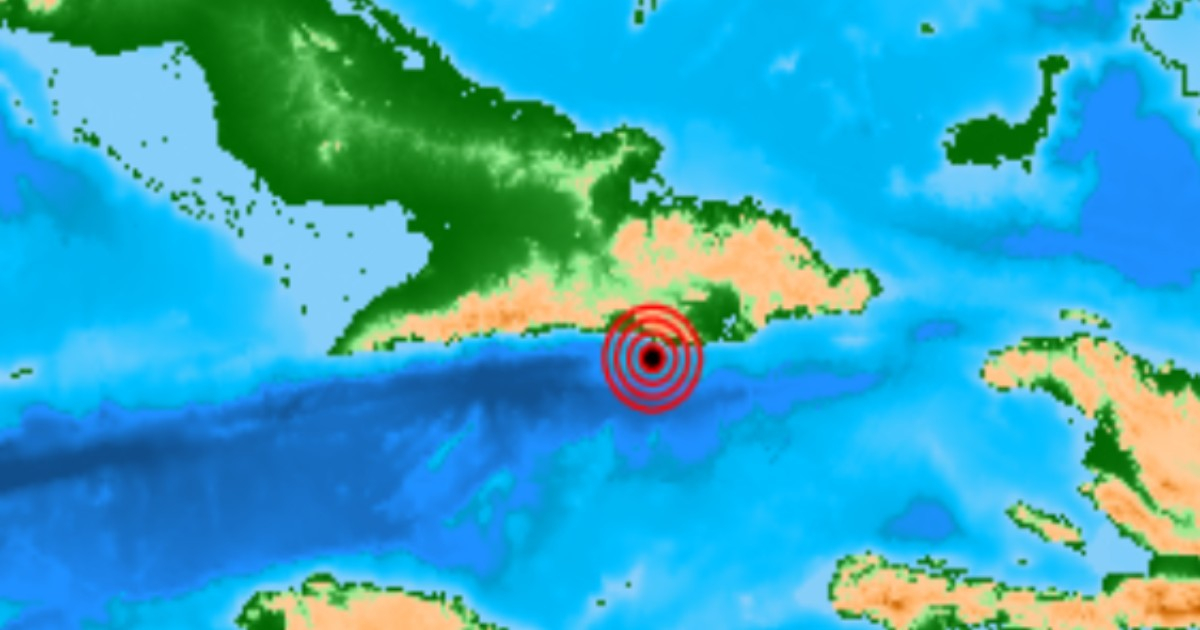
The National Center for Seismological Research (CENAIS) recorded 17 earthquakes in the Santiago-Baconao area over the last 24 hours, according to the official seismic report published this Monday.
The events had magnitudes ranging from 0.2 to 2.5, and none were perceptible to the population, according to the report for the period from 6:00 AM on Sunday to 5:59 AM on Monday.
The Dr.C. Enrique Diego Arango Arias, head of the National Seismological Service of CENAIS and Cuba's main scientific authority in seismology, shared the report directly through his Facebook profile with a message aimed at reassuring Cubans: "Good morning, our Santiago-Baconao area has experienced 17 earthquakes in the last 24 hours. The number is increasing, but the energy remains within the parameters of daily routine."
In addition to the 17 events in Santiago-Baconao, the CENAIS report indicated four earthquakes in the Imías area, with magnitudes ranging from 1.4 to 2.3, and one in Paso de los Vientos/Gran Inagua, with a magnitude of 3.2.
In the Caribbean region, the most significant event of the period was a magnitude 3.6 earthquake recorded in the Dominican Republic on Sunday at 23:46 UTC, at a depth of 143 kilometers.
The last noticeable earthquake in Cuba occurred on August 21, with a magnitude of 3.6, with its epicenter located 31 kilometers southeast of Santiago de Cuba and a depth of 10 kilometers, without any material damage or casualties. It was the tenth noticeable earthquake of the year on the island.
The increase in the number of events this Monday occurs in a context of high public sensitivity to seismic activity in eastern Cuba, partly due to the false seismic alarm of August 18, when alerts were sent to mobile phones without any real event being detected by CENAIS.
Arango Arias immediately dismissed that alert, and ETECSA subsequently took responsibility for the incident. At that time, the seismologist stated that, in his personal opinion, "it was something malicious."
The Santiago-Baconao area has historically been the most seismically active region in Cuba, due to the Oriente fault —also known as the Bartlett-Caimán fault— which marks the boundary between the North American and Caribbean tectonic plates.
The year 2026 has been especially intense for the east of the island: in the first semester, 3,882 earthquakes were recorded in Cuba and adjacent areas, of which 885 were in the Santiago-Baconao area.
The most significant events of the year were a magnitude 5.6 earthquake in February and one of magnitude 6.0 in Imías on March 17, which generated more than 620 aftershocks in just over 24 hours.
CENAIS identifies Santiago de Cuba among the Cuban cities with a permanent seismic alert, along with Pilón, Bayamo, Manzanillo, Gibara, Moa, and Baracoa.
Related videos:
Filed under: