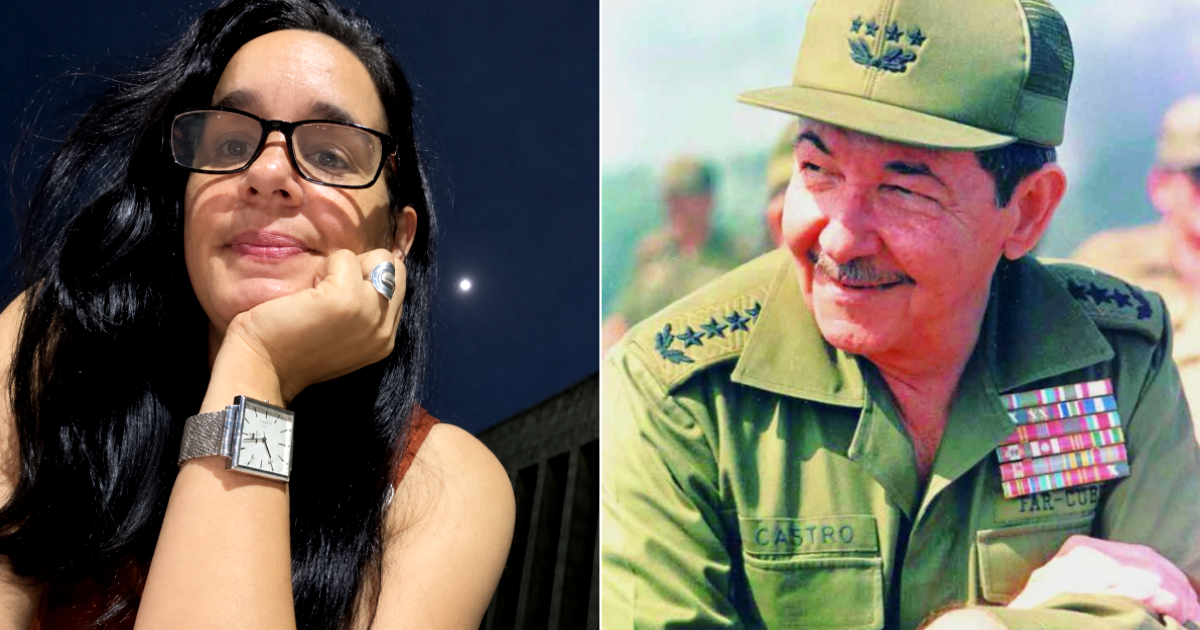
The communications director of the Cuban Presidency, Leticia Martínez Hernández, triumphantly celebrated the reappearance of Raúl Castro after several days of rumors regarding his death or serious health deterioration and took the opportunity to criticize the media in Miami using images of the 95-year-old general.
"Miami media has been claiming for a week that Raúl has died, or at best, that he was seriously ill. They have even cited supposed sources close to the Army General," Martínez wrote on the social network X.
They haven't learned after all these years. Raúl is out again and their party is over, he concluded.
The appearance of Castro during the ceremony for the 65th anniversary of the Personal Security Directorate clarified at least one mystery: the rumors of his death were false.
But the enthusiasm of an official in charge of communication for the Presidency reveals something more: for the Cuban regime's propaganda apparatus, having a 95-year-old leader appear alive before the cameras can still be portrayed as a political victory.
A cycle that has already repeated itself
Martínez's phrase "they don't learn after all these years" does not come from nowhere.
Rumors about the death or health deterioration of Raúl Castro have emerged several times over the past few years and frequently ended with a public reappearance used by the regime to discredit those who believed in unconfirmed reports.
In September 2024, a false news regarding his death went viral that fraudulently used the visual identity of CiberCuba. The outlet had to clarify at that time that it had not published any similar information.
A year later, something even more noteworthy occurred. In September 2025, a Facebook profile spread a supposed hospitalization of Castro, which ultimately turned into false news about his death. The author himself later admitted that he had fabricated the story.
The regime responded by launching a coordinated campaign on social media with the slogans "Raúl is Raúl" and "And he's still here".
Ministries, state agencies, state-run media, and accounts linked to the government apparatus then shared images of Castro as a leader "steadfast, present, and in combat," once again accompanied by the old slogan that he remained "with one foot in the stirrup."
Days later, the general made a public appearance.
In May of this year, CiberCuba refuted another false news story about Castro's death, once again spread through a fake layout that fraudulently imitated the image of the outlet.
The very coverage of CiberCuba has repeatedly warned about the irresponsibility of presenting unchecked versions as facts. But there is also another reality that is hard to ignore: the secrecy of the regime regarding the health of its historical leaders creates the perfect environment for such rumors.
A 95-year-old man whose health continues to be treated as a state secret
Speculations do not arise in a vacuum either.
Raúl Castro has significantly reduced his public appearances. Miguel Díaz-Canel acknowledged in April of this year that he is retired "for health reasons" and that he is a person "fragile due to his advanced age".
Martínez herself had starred in an episode months earlier that contrasts with her current mockery: in May, she published photographs of Raúl that appeared to be altered to soften his physical deterioration, after he reappeared visibly worse for wear following a five-month absence.
The background reveals a contradiction: the official communication attempts to control and embellish the image of a 95-year-old leader, whose fragility has been acknowledged by Díaz-Canel himself, while later blaming others exclusively for the speculations that are also fueled by the regime's enduring secrecy.
Last August, during the celebration of the centenary of the dictator Fidel Castro, he appeared at the Karl Marx Theater, but the official images showed him mostly from a distance and in dim light. He did not speak, and no close-up shots were released that would allow for a clear view of his physical condition.
The absence of significant actions and institutional opacity periodically fuel speculation.
Instead of providing transparent information about the status of the man who ruled Cuba for decades and continues to be officially presented as the "leader of the Revolution," the regime prefers to manage his appearances as political events.
And each time it reappears, the propaganda turns the proof of life into a small epic.
"Unconquered guerrilla," "foot in the stirrup," and another imaginary victory
This time was no different.
The Presidency presented the elderly general as a man of "steadfastness" and "the lineage of an undefeated guerrilla fighter," while the head of Personal Security assured that he remains "
The metaphor has been repeated to the point of exhaustion by the official apparatus. In May, the regime itself claimed that Raúl was "
In June, for his 95th birthday, Díaz-Canel once again dressed him in revolutionary epic and described him as a "fearless fighter" and "guardian of the essences."
Now Martínez Hernández contributes another piece to that construction: Raúl did not simply reappear: his physical existence would be a defeat for the adversaries and the end of a supposed "party" in Miami.
While the Presidency celebrates that Raúl is alive, millions are trying to survive
The problem with the message is not about debunking false news. It's clear that unverified information regarding the death of anyone needs to be corrected.
The problem lies in turning the physical survival of a leader into a political victory while the country he governed for decades is going through one of the worst crises in its recent history.
While Díaz-Canel's communication chief euphorically celebrates that "the party is over" for the media in Miami, for millions of Cubans, everyday concerns are far removed from knowing whether Raúl once again appeared seated in the front row.
The question for many families is much more basic: what they will eat tomorrow, when electricity will return, if they will be able to get water, medications, or how much they will have to pay for a little rice.
In August, CiberCuba reported the testimony of a Cuban who went out with a wheelbarrow to fetch water but returned empty-handed because the blackout prevented the pumping. “The greatest blockade we feel is living without water, without electricity, and without basic conditions,” he denounced.
Other documented testimonies from the past few weeks show families for whom feeding themselves has become practically a luxury, with prices that are out of reach for state salaries, along with blackouts that make it difficult to cook and preserve food.
That is the country governed by the Presidency, whose head of communications finds reasons to celebrate because a 95-year-old man has appeared before the cameras again.
Propaganda needs an eternal Raúl
The insistence has a political explanation.
Raúl Castro has formally stepped down from his main positions, but the regime continues to use him as a symbol of authority, continuity, and survival.
For this reason, every appearance needs to demonstrate something more than just its mere presence. Raúl must continue to be the "undefeated guerrilla," the man "with one foot in the stirrup," the fighter ready for a "machete charge," and now, the elder whose reappearance supposedly ruins a celebration in Miami.
The official propaganda seems unable to present the simplest reality: Raúl Castro is a 95-year-old man, with health issues acknowledged even by Díaz-Canel, who inevitably appears less and less.
Instead, each life test becomes a reaffirmation of the regime.
And there lies the essential contradiction of Martínez Hernández's message.
A victory with an expiration date
Martínez can celebrate that those who declared Castro dead this time were mistaken. He can mock them and repeat that "they never learn after so many years."
But there is a reality from which neither propaganda nor slogans can escape.
Each reappearance can dispel a rumor. None can defeat time.
Raúl Castro is 95 years old. That is why it seems strange to turn his survival into a sort of political competition that the regime can win indefinitely.
One day the Presidency will have to officially communicate the same news that today its press officer celebrates having denied, because—simply—the condition of being human.
Until then, the cycle will likely repeat itself: absence, rumors, secrecy, re-emergence, and propaganda.
The difference is that for a population focused on surviving the cycle of blackouts, water shortages, scarcity, and prohibitive prices, periodically confirming that Raúl Castro is still alive can hardly be considered a victory.
Let alone a party.
Related videos:
Filed under: