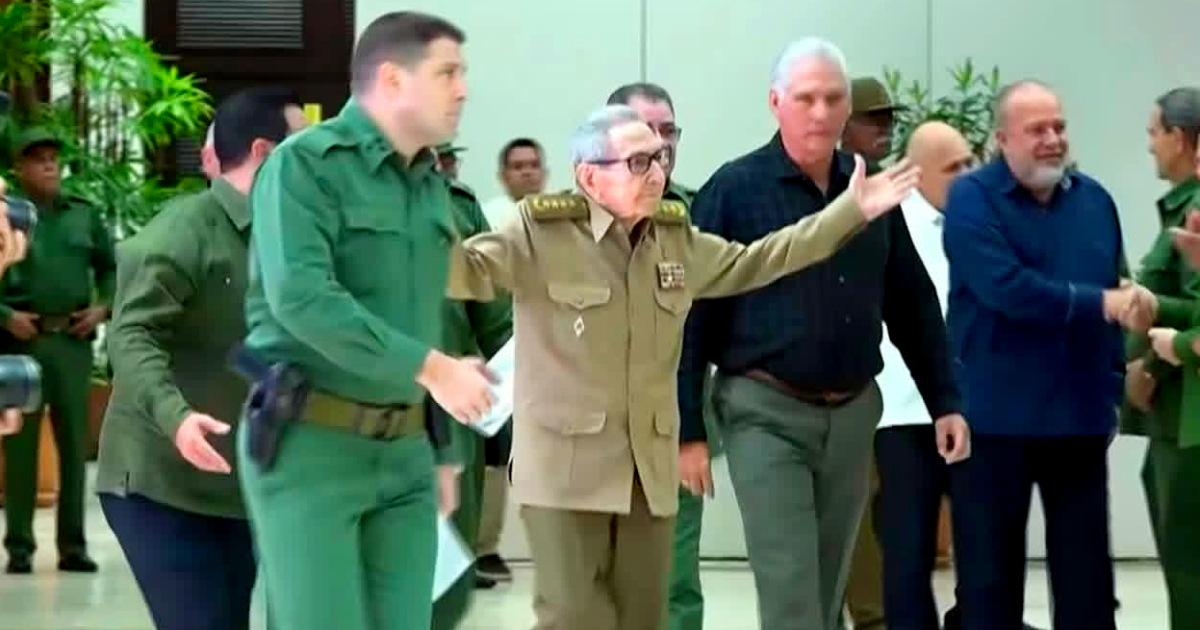
The Cuban regime once again resorted this weekend to one of its favorite propaganda images to present Raúl Castro: that of the old warrior who, despite the passage of years, is supposedly still ready to enter into battle.
During the event for the 65th anniversary of the Personal Security Directorate of the Ministry of the Interior (MININT), held in Havana and led by Castro alongside Miguel Díaz-Canel, Brigadier General Emir Mesa Corona stated that the former leader, at 95 years old, remains “ready to defend the Revolution.”
The phrase is neither casual nor new. It has become a recurring element of the propaganda surrounding Castro since he formally stepped down from the leadership of the Communist Party of Cuba (PCC) in April 2021.
In that farewell, Raúl himself asserted that he would continue as a “revolutionary fighter, ready to make my modest contribution until the end of my life” and that he would be “ready to defend the homeland, the Revolution, and socialism with more strength than ever.”
Since then, the official propaganda has repeatedly revived the equestrian metaphor to convey a very specific idea: Raúl may have stepped down from his positions, but not from the symbolic power or his role as the guardian of the system built by the Castro brothers.
A "ready" Raúl for battle
The Cuban Presidency took the rhetoric much further this time. In its account of the event, it described Castro as a man of "resolution" and "the lineage of an undefeated guerrilla," while Mesa Corona referred to him as an “example of austerity” and “a paradigm of organization, planning, demand, and discipline.”
The head of Personal Security also stated that Castro "has dedicated his life to upholding the principles of the Socialist Revolution" and maintained that it is he who teaches that "there is no battle impossible to win."
The epic image inevitably contrasts with the protagonist's age and with the recurring rumors about his health that have accompanied his prolonged absences from the public scene.
This Saturday, Castro remained seated in the front row during the event, received recognition as the "Founding Chief" of the Personal Security Directorate, and listened to the tributes prepared in his honor. His appearance took on special significance following renewed speculation about his health.
CiberCuba has previously documented how each episode of rumors surrounding Castro tends to provoke a reaction from the official machinery aimed at publicly reaffirming his political vitality.
From "Raúl is Raúl" to "foot in the stirrup"
One of the most evident examples occurred in September 2025. After a rumor circulated about the supposed death of the general, state institutions, ministries, official media, and accounts linked to the regime's apparatus launched a coordinated campaign under the slogans "Raúl is Raúl" and "And he's still here".
The posters shared virtually identical colors, designs, and messages. They featured Castro dressed in olive green and once again accompanied by the slogan “With a foot in the stirrup.”
The Ministry of Tourism then proclaimed: "It continues with one foot in the stirrup. It hasn't gotten down, it hasn't left. Its mark continues to set the pace."
The phrase «Raúl is Raúl» also reflects another old mechanism of the Cuban official discourse: to turn the leader's name into a sufficient argument to legitimize their authority.
For decades, «Fidel is Fidel» served as an expression of the exceptionalism attributed to the founder of the regime. In 2022, even Prime Minister Manuel Marrero Cruz resorted to the phrase «Fidel is Fidel and Raúl is Raúl» while discussing the need to maintain the trust of Cubans in their leaders.
The difference is that now the propaganda tries to transfer part of that cult to the figure of a Raúl Castro who does not formally hold the Presidency or the leadership of the PCC, but continues to be presented as a superior reference of the so-called "continuity."
"Charge with the machete"
The metaphor of the stirrup also does not appear in isolation. It is associated with a military rhetoric that the regime has intensified in its political messages for decades.
On the past May First, the Presidency itself disseminated a message from Castro stating that they remained "with one foot in the stirrup and ready for the machete charge".
The Army General had practically used the same formula on January 1, 2024, during the event marking the 65th anniversary of the revolutionary triumph in Santiago de Cuba.
In May of this year, during another act of support for Castro, Díaz-Canel once again invoked the metaphor and concluded his message with a phrase that explicitly conveyed the symbolic hierarchy still attributed to the elderly leader: «Please continue with one foot in the stirrup. Command!».
The result is a carefully repeated image: a 95-year-old man who, although officially retired from his main political responsibilities, is repeatedly presented as a commander ready to issue orders and engage in combat.
"Unconquered Guerrilla," "Immense Men," and "Hermetic Bastion."
The chronicle published this Sunday on the website of the Presidency also serves as a catalog of the epic language that continues to dominate much of the Cuban institutional narrative.
Raúl Castro is portrayed as an "undefeated guerrilla"; those tasked with protecting the leadership are described as "valiant and loyal," forming a "heroic troop" and a "hermetic bastion"; Fidel and the other protected leaders are referred to as "immense men"; and the 32 Cubans who died in Venezuela are depicted as men who "fought like lions."
The very Directorate of Personal Security is defined as a "loyal family" to those who have had "the responsibility of leading the Revolution."
In a message signed by Castro and read during the event by Lázaro Alberto Álvarez Casas, Minister of the Interior, the general urged that the blood of the 32 Cubans who died in Venezuela "never be forgotten" and that their example become "the guiding principle" for the members of Personal Security.
Mesa Corona went even further by publicly questioning what the Armed Forces, Military Counterintelligence, MININT, and "every revolutionary Cuban" would do if someone attempted to "kidnap or assassinate" one of the regime's top leaders.
The military leader concluded his speech by recapturing one of the oldest slogans of Castroism: “We have been, we are, and we will be a Personal Security of Homeland or Death: We will overcome”.
An epic that transcends its protagonists
The insistence on portraying Castro as an active warrior is particularly significant because the regime is experiencing the inevitable aging and disappearance of the generation that came to power in 1959.
CiberCuba pointed out in 2023 the contradiction between the announced generational change and the continued presence of Raúl Castro and other historical leaders in positions of power. A year later, following the deaths of several generals from his generation, this outlet revisited the image of "a foot in the stirrup" to highlight the growing contrast between the propaganda of vitality and the inexorable passage of time.
However, far from abandoning that representation, the official apparatus has reinforced it.
The reappearance this Saturday once again demonstrates this. The propaganda does not simply showcase a 95-year-old former leader attending a commemorative ceremony: it builds around him the image of a permanent warrior, surrounded by escorts turned into "family", lurking enemies, martyrs serving as examples, and fighters prepared to defend the leadership.
More than five years after officially stepping down from the leadership of the Communist Party, Raúl Castro continues to ride the official narrative on the same imaginary horse. And the regime insists that it still has one foot in the stirrup.
Related videos:
Filed under: