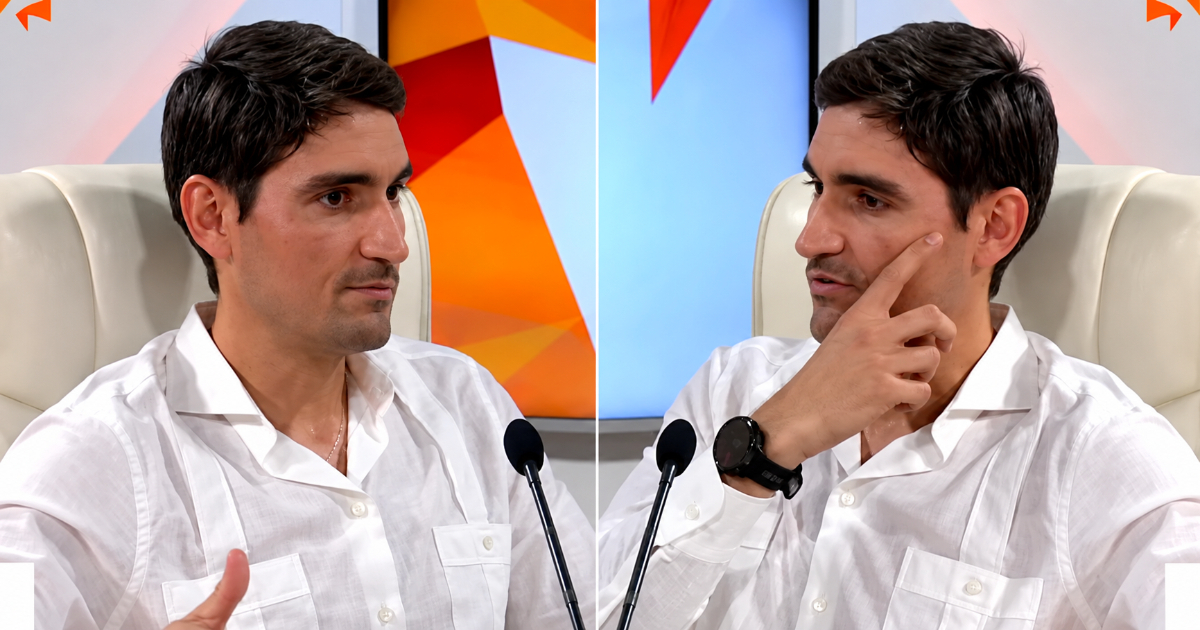
Carlos Luis Jorge Méndez, Cuban Deputy Minister of Foreign Trade and Foreign Investment, has once again defended the regime's new economic opening before the U.S. press.
But a statement from his interview with deserves special attention.
There are transformations we are making that are changing the very way the national economy behaves, and which will be very difficult to reverse, he stated.
Very difficult to reverse. Not irreversible.
The difference is important in a country where previous openings to the private sector ended up subjected to new restrictions.
USA Today itself raises the question about the permanence of the reforms and cites businessman John Kavulich, who believes that Cuba would need to amend its Constitution to make them truly permanent.
Méndez seeks to clear up exactly that distrust. “This is serious. It’s not a ploy,” he assured.
However, the legal guarantees of that permanence remain unclear.
Opening, but under the control of the PCC
The 176 transformations announced in June significantly expand the space for private initiative and foreign investment.
Among other changes, the government of Miguel Díaz-Canel envisions greater participation of private capital, new opportunities for small and medium-sized enterprises, and significant modifications regarding investment, foreign trade, and business ownership.
However, at the same time, political discourse has repeatedly set the boundaries.
Díaz-Canel has insisted that Cuba is not renouncing socialism. Prime Minister Manuel Marrero Cruz has stated that the measures do not represent a shift towards capitalism, but rather an "updating of the socialist model."
And Díaz-Canel himself has made it clear that the transformations will continue under the direction of the Communist Party.
There lies the contradiction —or, at the very least, the ambiguity— of the message.
Outwardly, Havana needs to convince entrepreneurs, investors, and governments that the opening is real and lasting. Inwardly, it ensures that socialism will remain the framework of the process and that the PCC will retain its control.
Méndez is well aware of that double discourse. He accompanied Raúl Guillermo Rodríguez Castro, 'El Cangrejo', in his first international interview, where they both advocated for a greater economic openness without proposing a political opening.
And now it projects once again an image of Cuba ready to change towards the United States.
Where are the guarantees?
Converting the 176 measures into laws does not necessarily solve the problem.
Legally permitting a private activity does not equate to legally guaranteeing its permanence. Legislation that today allows for direct imports, hiring workers, or receiving investments can also be modified tomorrow.
A truly protected opening would require higher-level guarantees
- constitutional recognition of private property and private enterprise
- effective protection against expropriations or arbitrary restrictions
- legal security for investors
- due process and independent mechanisms capable of enforcing those rights against the state itself
No economic reform is completely irreversible: even a constitution can be amended. However, there are enormous differences between having to change a constitution and merely modifying a resolution, a decree, or a law.
And there is the question that the official discourse still does not answer: what would legally prevent the Communist Party from closing the economic spaces it is opening today?
There is no evidence to suggest that the regime designed the 176 transformations with the intention of reversing them later. However, there are also, as of now, no sufficient guarantees to rule out that possibility.
This ambiguity can be politically convenient. Havana can present to Washington and investors a "welcoming attitude," attract capital, and claim recognition for its reforms without explicitly committing to making them irreversible.
That is why Jorge Méndez's words must be read exactly as they were spoken.
The deputy minister assures that the process "is serious." He says that the transformations will be profound. He states that they will be "very difficult to reverse."
But it does not say that they are irreversible.
And while the same Communist Party that promises openness also retains the political and legal ability to determine its limits, that difference is not a mere semantic nuance: it is a matter of guarantees.
Related videos:
Filed under:
Opinion article: Las declaraciones y opiniones expresadas en este artículo son de exclusiva responsabilidad de su autor y no representan necesariamente el punto de vista de CiberCuba.