Razones de Cuba came out this Wednesday to respond to the recent statements made by the U.S. Secretary of State, Marco Rubio, regarding the energy crisis on the island, but left one of the most uncomfortable questions for the regime unanswered: why did Cuba allocate enormous resources for years to build hotels while its electrical system deteriorated?
In a social media post, the platform linked to State Security reproduced Rubio's assertion: «the resources that should have gone to the energy system were used to build hotels and fill the pockets of the Government».
But, instead of denying that accusation or providing data that contradicts the Secretary of State, Razones de Cuba questioned his intention and immediately shifted the debate toward U.S. sanctions.
"Notice the movement: it does not deny the suffering of the Cuban people, it acknowledges it and uses it. It recognizes the blackout in order to avoid having to explain the blockade," the publication stated.
The reasoning is significant: Razones de Cuba accused Rubio of politically exploiting the suffering caused by the blackouts, but did not respond to the argument just mentioned.
He did not clarify whether it is false that hotel investments were prioritized over the energy system, how much money was allocated to each sector, or why the regime maintained that investment policy for years.
In other words, the publication attributed to Rubio a distraction maneuver while she herself avoids addressing the specific and verifiable element of her complaint: the allocation of the country's resources.
From there, Razones de Cuba focused its response on holding the United States sanctions responsible and maintained that this is "the real framework" in which Cuba tries to keep an aging electrical system operational.
But he did not provide figures to prove that Rubio is lying about the investment priorities, did not explain why hotels continued to be built in the midst of the crisis, and also did not address the role of GAESA—the business conglomerate of the Armed Forces that controls much of the tourism business and other strategic sectors of the economy—in the imbalanced investments of the Cuban state.
An accusation that Rubio has been repeating
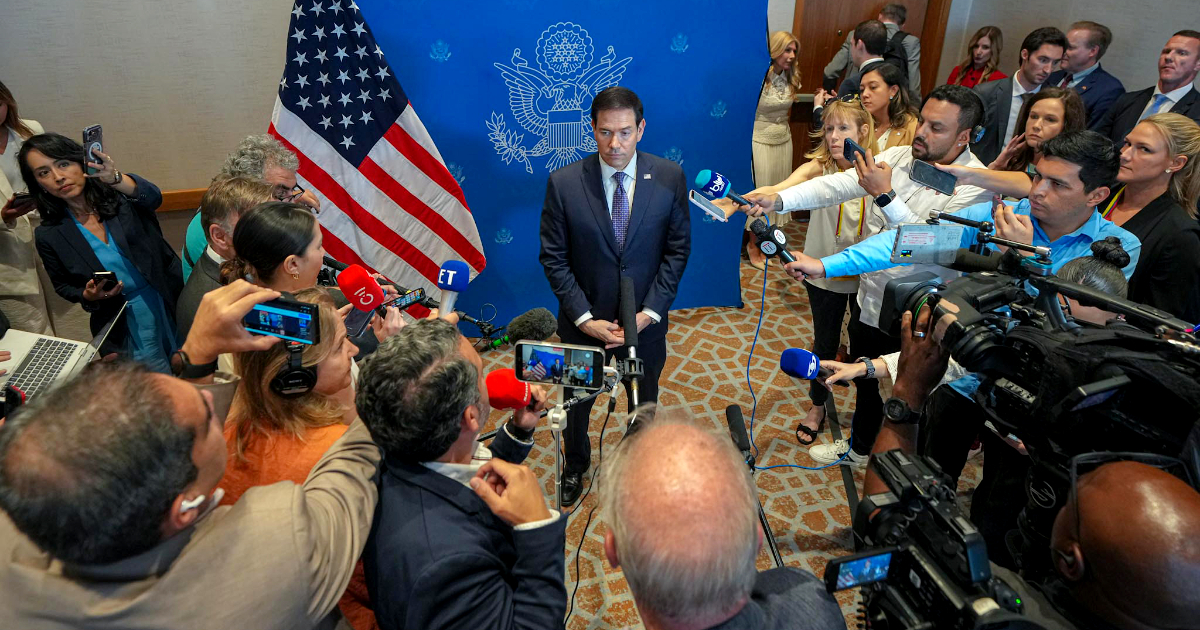
The statements that provoked the response were made by Rubio during his visit to Colombia.
The Secretary of State stated that the blackouts in Cuba predate the recent measures from Washington and linked the crisis to years of underinvestment and the regime's economic priorities.
It's not a new argument.
In May, Rubio directly targeted GAESA and questioned why the vast resources from hotels, banks, businesses, and other enterprises under its control were not used to purchase fuel or modernize the thermoelectric plants.
The Secretary of State has insisted on presenting GAESA as one of the pillars of a model that concentrates resources in structures controlled by the military elite while the population faces blackouts, shortages, and deteriorating basic services.
The official statistics raise a difficult question to evade
The issue of hotel investments, moreover, does not solely depend on the accusations from Washington.
Cuba's own official statistics have shown for years the priority given to tourism over essential sectors.
Data from the National Office of Statistics and Information (ONEI) previously cited by CiberCuba showed that in the first half of 2024, nearly 40% of investments were concentrated in tourism-related activities, while Health and Social Assistance received only 2.7% and agriculture 2.5%.
Between 2021 and 2023, approximately 36% of government investment was allocated to hotel infrastructure, compared to around 1.9% for Health and 1.3% for Education.
That history makes what Razones de Cuba does not address particularly relevant.
The platform could question Rubio's figures, justify the priority given to hotels, explain the source of those resources, or demonstrate why they could not be used for the recovery of the electrical infrastructure.
However, he sidestepped the issue and did not mention any of those things.
Cuba returns to its usual narrative
The publication chose, instead, to take the discussion into the political arena and hold the United States responsible for the crisis.
"To say that the problem is the Cuban economic model and not the deliberate suffocation by a power over a nation of eleven million people is a fallacy," he stated.
Reasons of Cuba, a platform that CiberCuba has previously documented for its ties to the State Security and its involvement in propaganda campaigns against opponents, activists, independent journalists, and critics of the regime, later dedicated a significant portion of its publication to denouncing Washington's actions and U.S. military exercises in Puerto Rico.
The maneuver ended up shifting the focus of the original accusation.
Because after quoting Rubio, the publication did not respond to how much the regime invested in hotels while the thermoelectric plants aged, why it maintained that strategy even amid increasingly severe blackouts, or what happened to the resources managed by GAESA.
Razones de Cuba responded to Rubio with its flaccid propaganda about the "blockade," but once again it failed to address the question that the official statistics make difficult to ignore: why so many hotels and so little investment in essential sectors while the Cuban electrical system was collapsing?
Related videos:
Filed under: