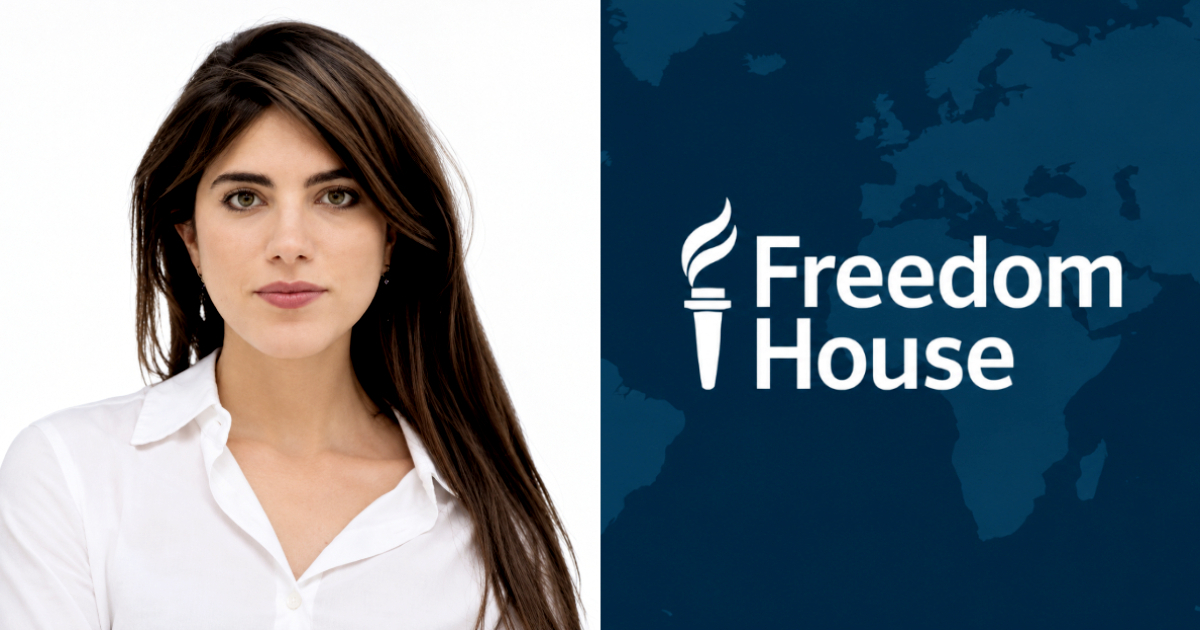
Freedom House has appointed Cuban activist Carolina Barrero as one of the five inaugural members of its new program Ambassadors for Freedom, a global initiative aimed at strengthening the defense of democracy and freedoms in the face of the rise of authoritarian regimes.
Barrero shares the designation with Iranian activist Nazanin Boniadi, Rwandan advocate Anaïse Kanimba, Russian opposition figure Vladimir Kara-Murza, and pro-democracy activist from Hong Kong Anna Kwok.
Freedom House explained that the new ambassadors will work in partnership with the organization to raise awareness of threats to freedom, engage with policymakers and the public, and encourage new generations to get involved in the defense of democracy.
“Freedom House has always believed that lasting change is driven by brave individuals willing to stand up for freedom, often at great personal cost,” stated Jamie Fly, the organization's executive director.
Fly highlighted that the five selected individuals have firsthand experience of the repression imposed by authoritarian governments and noted that their experience will be one of the main assets of the new program.
An activist emerging from the 27N movement
Freedom House introduces Barrero as a Cuban political leader, human rights defender, and political analyst, highlighting her participation in the 27N movement and in the protests related to the San Isidro Movement.
Her activism within Cuba was marked by arrests, surveillance, house arrests, and movement restrictions. Following the protests on July 11, 2021, Barrero focused much of her work on defending political prisoners and denouncing the judicial processes against demonstrators.
In January 2022, she was arrested along with other activists after protesting outside the Supreme People's Court to demand transparency in the trials related to 11J and the release of political prisoners.
A few weeks later, she left Cuba heading to Spain, which she denounced as a forced exile.
International incidence and work from exile
Since his departure from the island, Barrero has developed an international advocacy agenda focused on human rights, civil liberties, and political participation in Cuba.
In 2024, she was selected for the Sakharov Fellowship from the European Parliament, a program aimed at strengthening the capacities of human rights defenders and facilitating their relationships with international institutions and networks.
He has also participated in meetings and activities related to European institutions — where he has particularly advocated for ending the European Union's Cooperation and Political Dialogue Agreement with Cuba — the United Nations, and political forums in the United States.
She is currently the president and executive director of Ciudadanía y Libertad, an organization dedicated to strengthening independent civil society, political participation, and democratic institutions in Cuba.
Freedom House also highlighted that Barrero is currently pursuing doctoral studies at the University of Miami.
Five defenders against various repressive regimes
The other four members of the inaugural group also have backgrounds connected to the defense of human rights and opposition to authoritarian governments.
Nazanin Boniadi has developed campaigns related to women, youth, and prisoners of conscience in Iran. Anaïse Kanimba participated in the international campaign for the release of her father, Paul Rusesabagina, following his detention in Rwanda.
Vladimir Kara-Murza is a Russian opposition figure and former political prisoner who was sentenced to 25 years in prison after criticizing the invasion of Ukraine and later released in a prisoner exchange in 2024.
Anna Kwok, for her part, is a well-known pro-democracy activist from Hong Kong based in Washington. Hong Kong authorities issued a reward for information leading to her capture due to her political activities.
With this group, Freedom House aims to bring together advocates from various authoritarian contexts and provide them with a common platform to increase the international visibility of their causes and their dialogue with governments, institutions, and citizens.
Related videos:
Filed under: