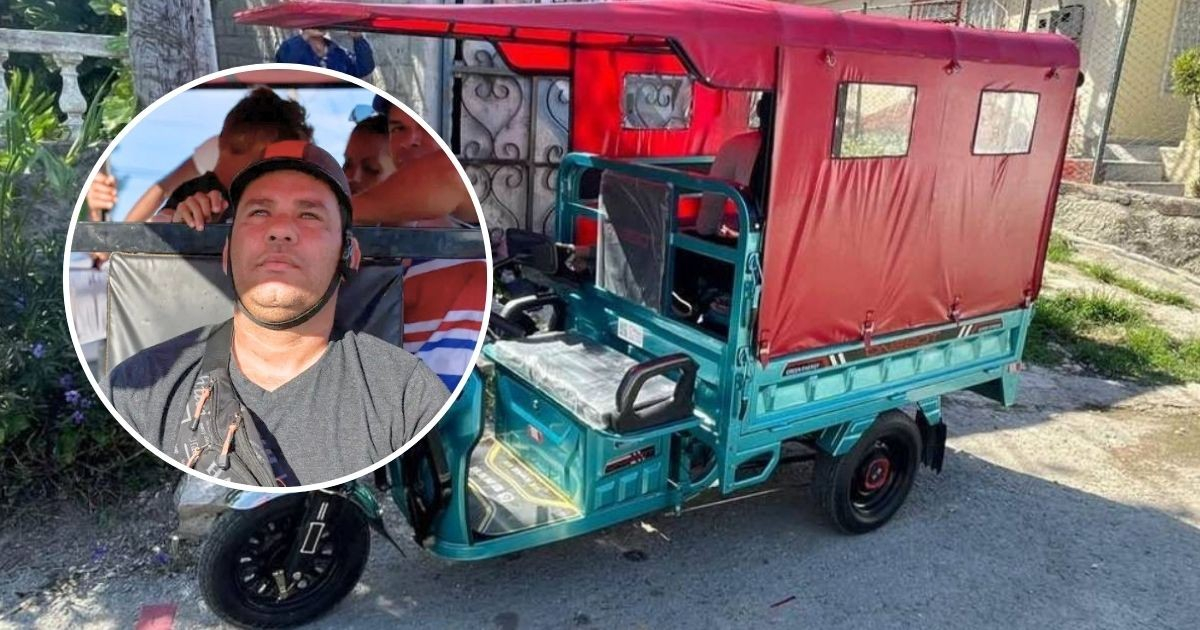
After years of trying to settle in the United States, Liexer De La Cruz returned to Cuba and resumed making a living as a taxi driver.
Now he drives a solar-powered tricycle in Havana, while trying to rebuild a life marked by migratory uncertainty and the economic difficulties of the island.
The story was published this Tuesday by Los Angeles Times, which followed De La Cruz after his return to the town of Las Minas, where he settled with his wife.
Their departure from the United States was decided after an immigration hearing held on January 9, 2026 in Miami.
According to the account, De La Cruz believed he was attending a routine procedure, but he ended up facing the dilemma of returning to Cuba or staying in the country at risk of deportation.
Finally, he chose to leave: the authorities granted him 120 days to leave the United States, and he decided to return to the island instead of trying to start over in Mexico or Canada.
His wife, who initially planned to stay in the United States to support him financially, ended up buying a ticket on the same flight and returned with him.
De La Cruz arrived in the United States through the border with Mexico in August 2021 after a lengthy migration journey.
Previously, he had attempted to settle in Suriname, Guyana, and Brazil, and later crossed the Darién Gap during a months-long journey to U.S. territory.
Once in South Florida, he became certified as an electrician and started traveling for work to states like Kentucky and Nebraska.
His goal was to reunite with his two daughters, who remained in Cuba, and one day open his own repair and maintenance business.
His immigration status is linked to the I-220A form, a document that has kept many Cubans in uncertainty for years while U.S. courts debate whether certain forms of entry allow for eligibility under the Cuban Adjustment Act.
Back in Cuba, the couple settled in the house of De La Cruz's mother and bought a solar-powered tricycle.
He resumed the job of taxi driver that he had done before emigrating.
The vehicle became his primary means of generating income at a time when tricycles have gained prominence as a transportation alternative due to fuel scarcity and the decline of public transport.
But even having an electric vehicle doesn't free one from everyday problems.
Frequent extended blackouts often force him to charge the tricycle using a solar panel, and as he explained, it can take him about eight hours to complete the charge, which sometimes means losing a day's work.
Nevertheless, he ensures that when he encounters someone who cannot pay for the trip, he tries to help them: "I don't like to leave anyone stranded," he stated.
Food has become another of their main concerns; they also had to invest in tanks to store water due to the supply issues affecting many areas of the country.
The contrast with his previous life is stark: while in the United States one of his main concerns was job security, in Cuba he must deal daily with power outages, water and fuel shortages, transportation challenges, and the high cost of food.
De La Cruz asserts that he wishes to stay permanently in his country, but he conditions that desire on an improvement in living conditions. «We are going through a very difficult time», he summarized.
The story of this Cuban reflects that of many others who, after emigrating and starting to settle in the United States, have been compelled to open a new chapter in their lives by returning to the island.
On August 21, a flight transported 127 Cubans from the United States to Havana: 113 men and 14 women.
Two of them are under investigation for their alleged involvement in crimes committed before leaving Cuba.
On that same flight arrived Dairon Fuentes, another Cuban with I-220A who had requested a voluntary departure after being detained in Texas.
His wife and two children stayed in the United States while the family hopes to reunite in the future.
Other migrants with I-220A have chosen to leave the United States before facing potential detention.
In June, Diana Fonseca voluntarily returned to Cuba after stating that she preferred to leave on her own rather than remain detained far from her daughter.
In July, Yasmany Vega Rodríguez also announced his voluntary return to the island with an I-220A, another example of Cubans who have decided to leave the United States amid uncertainty regarding their migratory future.
El caso de Liexer es uno de los muchos que marcan el panorama migratorio actual. Sigue toda la información sobre deportaciones, cortes y políticas migratorias en nuestra sección de
Related videos:
Filed under: