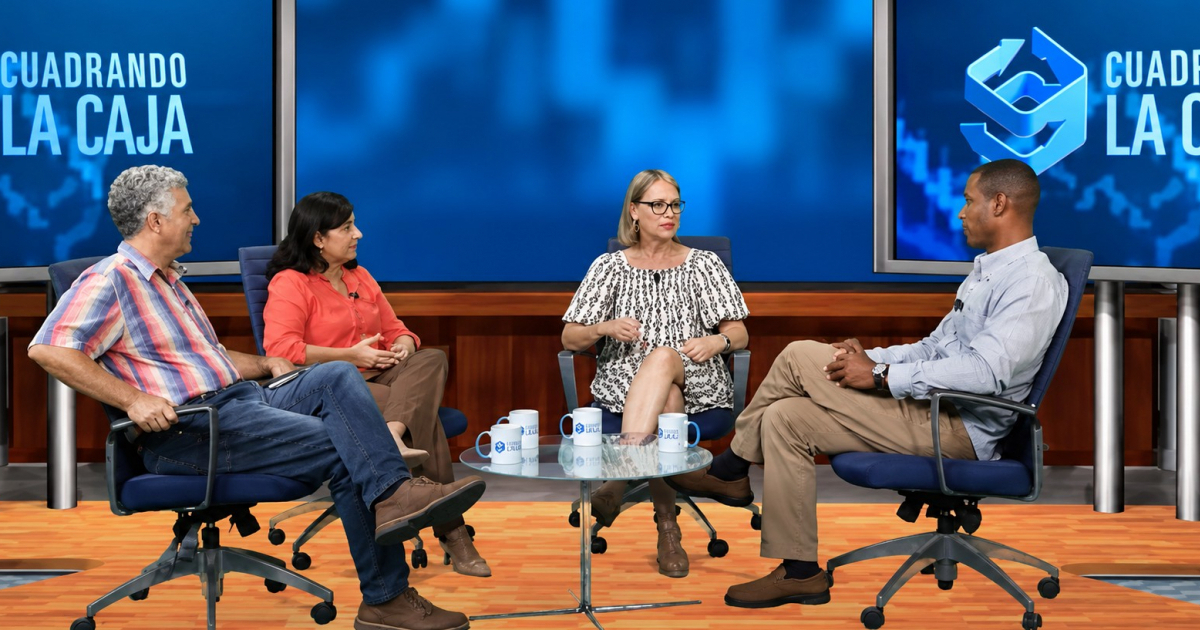
The official program "Cuadrando la Caja" dedicated an episode to defending the transformations of the Cuban state enterprise system under the Decree-Law 120, approved last July as part of the package of 176 economic measures of the regime. The response from Cubans on social media was devastating: disbelief, irony, and open denunciation of corruption.
The space, produced by the state media Cubadebate and hosted by the government spokesperson Marxlenin Pérez, brought together officials and supportive economists to explain the new classification of state enterprises and their autonomy to set prices, wages, and sell assets.
The reform of the state enterprise system includes the elimination of subsidies, the transformation of enterprises into commercial companies, and the gradual opening to the shareholding participation of private actors and individuals, whether nationals or foreigners. Despite this, the regime insists that the changes do not imply a shift in the economic model.
The guests insisted that the conversion from a state-owned enterprise to a commercial company is not mandatory, but rather a strategic option, and that the process will be "gradual." What they could not control was the public's reaction.
When the episode was published on Facebook, the comments became a gauge of the accumulated distrust stemming from decades of unfulfilled promises. The initial reaction set the tone for everything that followed.
"And is there still any (state-owned company) left?" wrote a user, even questioning the premise of the debate.
Another internet user was more explicit about the fate that, according to their predictions, these companies will face: "They will distribute them among our leaders, their relatives, and the management cadres, just like they did first in the USSR and later in Nicaragua. This is just the beginning of a story that is repeating itself."
From Cienfuegos, a user described a reality that the program did not mention: "I don't know if there are any state-owned companies left; everything is already in the hands of the private sector, even garbage collection. What is left in this country that is state-run to supply the people? Is this country still socialist, communist, or capitalist? Because when a country is driven by the private sector, it becomes a capitalist country. Every year there are new laws to boost an economy that no longer exists in Cuba."
The credibility of the program itself was also called into question: “'Cuadrando la Caja' is either foolish or just pretending to be foolish... the socialist state company, inefficient as always,” concluded another user.
Skepticism regarding the regime's reforms was summed up by a user’s comparison: "It was like the story about how the revenue from the dollar stores would supply the stores in national currency. Do you really think anyone believes these stories at this point?"
The shadow of military interests and the political elite loomed over several comments. "Make the Castro businesses prosper. In which country are such embezzlements at the military top denounced and nothing is done about it?" wrote another commentator.
Some pointed directly to the nature of the process: "Neoliberalism made in PCC," one summarized. "They will have new owners: the usual appointees," another added.
A third person was even more direct: "The state-owned company has little left. This is called capitalism. What’s needed is to implement foreign companies, factories. The State has already shed everything."
And the most striking conclusion pointed to the root of the problem: "Don't overthink it. As long as communism remains in power, they will continue to be miserable."
Within the package of 176 economic and social transformations implemented by the regime to address the crisis, the first set of measures aims to radically change the operation of state enterprises, historically regarded as the backbone of the Cuban socialist model.
For the first time, the government has had to explicitly admit that many state-owned enterprises will have to compete under similar conditions to the private sector, and that some could disappear if they are not economically viable.
In addition to being able to set their own salaries and prices and autonomously create subsidiary companies, they will be able to approve their annual economic plan, define the allocation of their profits, outline their long-term strategy, and authorize their major investments without relying on central authorities.
The Díaz-Canel has publicly defended the need to grant more autonomy to state-owned enterprises and has urged managers to prepare to exercise the new powers that the government promises to expand within the new economic transformations.
The deterioration of the Cuban state economy accelerated during the first five months of the year. By the end of May, 399 companies were reporting losses, 120 more than in the same period of the previous year.
A report from the National Office of Statistics and Information (ONEI) showed a widespread deterioration of the main indicators of the state business system: a decline in sales, a decrease in production, and a reduction in profits, efficiency, and employment.
The debate arises as Cuba faces the projection of the worst economic decline in Latin America in 2026 according to the International Monetary Fund, with shortages of food, fuel, and electricity.
Related videos:
Filed under: