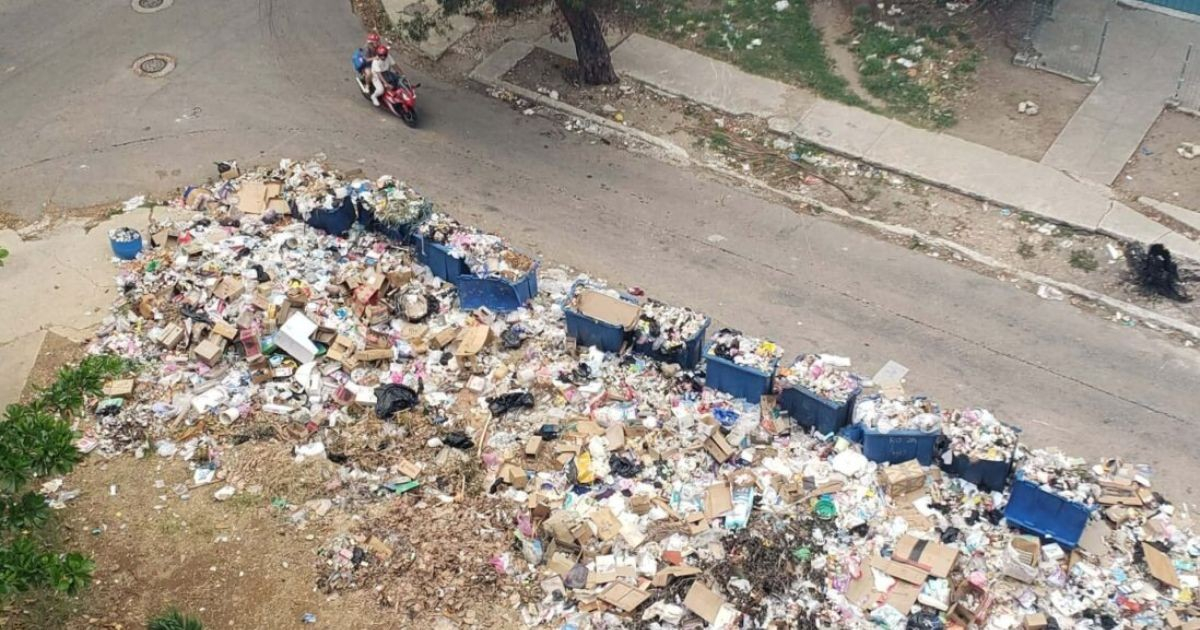
Residents of the multifamily building Minfar 3 —a property with 144 apartments located near the Plaza de la Revolución in Havana— reported a buildup of waste that has gone unresolved for over a month, which has turned San Pedro street into a practically impassable passageway, as noted this Sunday by the official media outlet Tribuna de La Habana.
The waste comes not only from Minfar 3: the refuse from the Granma, Comunicaciones, Minfar 1, and Minfar 2 buildings converges in the same area, overflowing the plastic collectors installed in the vicinity. The spillage extends along Panorama Street and reaches Colón Avenue, while the stench of decay and the proliferation of flies make it impossible to open the windows even on the highest floors of the building, the source details.
About two months ago, an ampirol—a large-capacity metal container transported by special trucks—was placed to partially reduce the spillage, but it did not address the underlying issue. Rain and wind are carrying the waste to various points in the environment and hindering the functioning of the sewers, as noted in messages from residents to the media.
The crisis of solid waste is compounded by a sanitation infrastructure problem that has persisted for over a year: a pit on Hidalgo Street, between San Pedro and Lombillo, discharges its waste without any intervention from the authorities. The only indication of its open “mouth” is a branch from a tree that the neighbors placed to prevent accidents between vehicular traffic and pedestrians.
Every morning, people can be seen in the area rummaging through the trash—commonly known as "buzos"—who, according to current health regulations, "are classified as carriers of diseases," warns the report from Tribuna. The accumulation of waste in densely populated urban areas also promotes the proliferation of vectors associated with dengue, leptospirosis, hepatitis A, and chikungunya.
As a temporary measure, heavy equipment arrived early on Sunday to remove the accumulated waste, the media reports. The article itself acknowledges that this represents an "additional expenditure of resources that we barely have" and warns that, without structural solutions, "tomorrow it will again present a picture of neglect and potential danger."
The case of Minfar 3 is not an isolated incident, but rather a local manifestation of a garbage crisis that has been affecting Havana for years and worsened in 2025 and 2026. At the beginning of this year, only 44 out of 106 waste collection trucks in the capital were operational, halted by a shortage of diesel and the mechanical deterioration of the fleet, while the city generates around 30,000 cubic meters of solid waste per day, which exceeds the collection capacity.
The municipality of Plaza de la Revolución, where the building is located, has been a recurring site for these complaints. Last July, the project "El Rampeño" was launched in the Rampa People's Council, featuring 30 electric tricycles for door-to-door waste collection at a rate of 100 pesos per month per household, as an attempt at an alternative solution that ultimately failed. Just a few days ago, a mountain of garbage blocked the passage of a passenger train in Cuba, forcing the travelers themselves to clear the tracks.
The Tribuna article concludes with a warning that encapsulates the residents' despair: without the installation of a new ampirol and the repair of the pit on Hidalgo Street, the problem “will once again present an image of neglect and potential danger due to the presence of disease-carrying agents.”
Related videos:
Filed under: