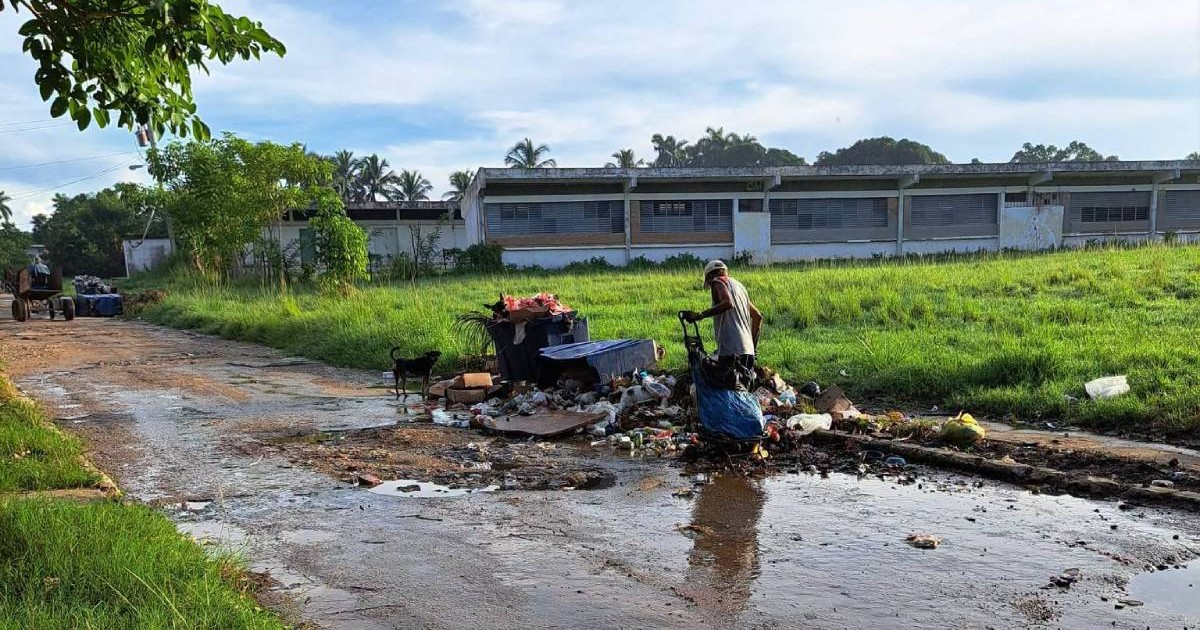
A resident of the municipality of Boyeros, in Havana, made a passionate public complaint against the local authorities regarding the collapse of the water service, the accumulation of garbage, and the overflow of sewage in the streets.
The complaint was published on Facebook by Alexis Torriente and received dozens of comments from residents of different neighborhoods confirming and elaborating on the reported situation.
"It’s urgent that chlorine be added to the water entering the cisterns. Do your job, and demand that the Hygiene and Epidemiology department of the Mulgoba Polyclinic distribute chlorine to each building so it can be added directly to each of the cisterns, in order to stop this wave of bacteria that has caused this disaster right in front of us, and yet no one is doing anything. People continue to suffer from diarrhea, and every day there are more cases of hepatitis and the virus causing severe diarrhea," he declared.
The Cuban directly accused the municipal government of inefficiency and complicity. He pointed out that the chlorinator—an essential piece of equipment for disinfecting water before it is distributed—is broken. "The water for the Aqueduct has also become another business," he wrote.
He also stated, "Schools and children's circles are without water. Where is the oversight of these establishments? This is nothing but corruption," he expressed.
Torriente described the situation as a possible sabotage and demanded that the governor, mayors, and deputy mayors of Havana be held accountable to the people.
"Where is the DTI's work that is supposed to control the corrupt? This can be classified as sabotage, and you are asleep. The one who pays is the people. The people are drinking contaminated water, silent in their ignorance and abandoned," he added.
A crisis that extends throughout Boyeros
The comments on the post reveal that the problem spans several neighborhoods in the municipality. A resident of the Abel Santa María neighborhood reported that two cisterns in her building are contaminated due to a burst sewage tank from the adjacent property. When she went to the Wajay Polyclinic, they informed her that they do not have the reagents to analyze the water.
"We have miraculously escaped death; at least we must have the bacterium Escherichia coli (known as E. coli)," he wrote.
From Aldabó, another resident described sewage water flowing from the drains, piles of garbage, and symptoms in the population that include fever, diarrhea, and rashes on knees and elbows.
In the Lídice neighborhood of Santiago de las Vegas, a resident stated that she has gone eight months without water flowing into homes and without access to tankers. From Río Verde, other residents reported multiple cases of sick individuals with no response from the authorities.
A commentator warned that boiling water does not solve the problem. "It's very important, but I boil the water and the diarrhea continues."
The water crisis in Boyeros
Since January 2026, more than 40,000 people in the municipality of Boyeros have experienced severe disruptions in their access to drinking water.
On August 21, a failure in the main pipeline of Cuenca Sur left six municipalities in Havana without water, including Boyeros.
The supply system relies on electricity for 87%, so blackouts—which in 2026 have exceeded 20 hours daily in some areas—directly halt the water pumps.
"This problem is not only in Boyeros; it exists throughout Cuba, due to unsanitary conditions and lack of everything... Cuba is facing an epidemic from Cabo de San Antonio to the tip of Maisí," summarized one of the individuals who commented on the post.
The health situation in Cuba is alarming
At the beginning of September, the United States Embassy in Havana issued an alert regarding a significant increase in diarrheal diseases linked to the deterioration of water infrastructure, identifying E. coli, norovirus, and Shigella. Outbreaks of hepatitis A have been reported in several provinces between August and September.
The president of the National Institute of Hydraulic Resources, Antonio Rodríguez Rodríguez, acknowledged in 2026 that around 2.7 million Cubans were facing , a figure that, according to data from September, could reach 3.1 million due to total or partial cuts throughout the country.
Related videos:
Filed under: