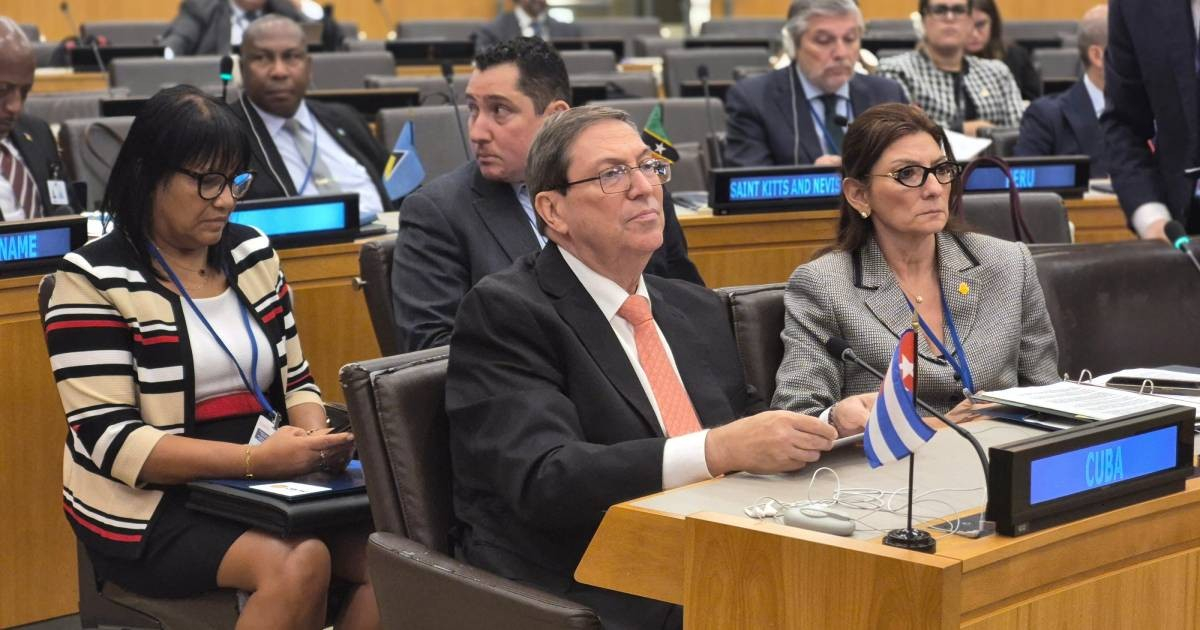
Cuban Foreign Minister Bruno Rodríguez Parrilla returned this Monday to hold the United States largely responsible for many of the problems affecting Cuba, this time during a ministerial meeting of the Community of Latin American and Caribbean States (CELAC) held in New York as part of the 81st United Nations General Assembly.
In his statements published on social media, Rodríguez accused the government of Donald Trump of attempting to impose "the outdated Monroe Doctrine" on Latin America and the Caribbean through what he described as "new and unacceptable corollaries."
The chancellor stated that Washington uses military presence linked to the fight against drug trafficking, tariffs against Latin American countries, initiatives that —he said— aim to divide the region, and actions aimed at weakening its integration mechanisms as "tools of domination."
Rodríguez also called for defending the proclamation of Latin America and the Caribbean as a Zone of Peace, approved by CELAC in Havana in 2014.
But the focus of his message was once again Cuba.
The head of the regime's diplomacy denounced an alleged "unprecedented reinforcement of the U.S. blockade" and listed among its components the so-called "energy siege," secondary sanctions, a "violent media offensive," and an alleged "threat of military aggression."
The statements come amid a sharp escalation of tensions between Havana and Washington. The Trump administration has increased economic and political pressure on the Cuban regime throughout 2026, while the island's Foreign Ministry has turned the so-called "energy blockade" into one of its main arguments to explain the deepening of the crisis.
At the beginning of September, Rodríguez himself gathered the heads of Cuban diplomatic missions abroad and once again attributed the country's situation to the embargo, secondary sanctions, and U.S. energy restrictions.
The discourse partially contrasts, however, with other international diagnoses regarding the causes of the Cuban crisis.
In July, during the process that led to the extraordinary debate held at the United Nations, the European Union called for urgent political and economic reforms in Cuba. While acknowledging the adverse impact of U.S. measures on the Cuban population, it noted that the problems facing the country cannot be solely attributed to those sanctions and also pointed to the need for internal reforms.
Washington went even further. Its ambassador to the UN, Mike Waltz, accused the Cuban government of using the United States as a constant excuse for its economic problems and demanded the release of political prisoners, greater economic freedoms, and respect for the rights of Cubans.
The vote to authorize the extraordinary debate resulted in 136 votes in favor, nine against, and 30 abstentions. Although this was a different process from the annual resolution on the embargo, the 30 abstentions greatly exceeded the 12 recorded in October 2025.
Rodríguez then presented the outcome as a diplomatic "victory."
The new statements from the chancellor come at a time when millions of Cubans are still suffering from the consequences of the deterioration of the National Electroenergetic System, with prolonged blackouts and repeated network collapses.
Havana primarily blames the U.S. restrictions on fuel and financing. However, the deterioration of thermoelectric plants, the lack of maintenance and investment over decades, and the dependence on imported fuels are also part of a structural crisis that predates Washington's recent measures.
The U.S. Secretary of State, Marco Rubio, traveled to New York to accompany Trump at the General Assembly, and he described Washington's strategy as "closing off every exit" to the Cuban regime, a stance that contrasts with the victimization narrative that Rodríguez presented to his peers at CELAC.
Related videos:
Filed under: