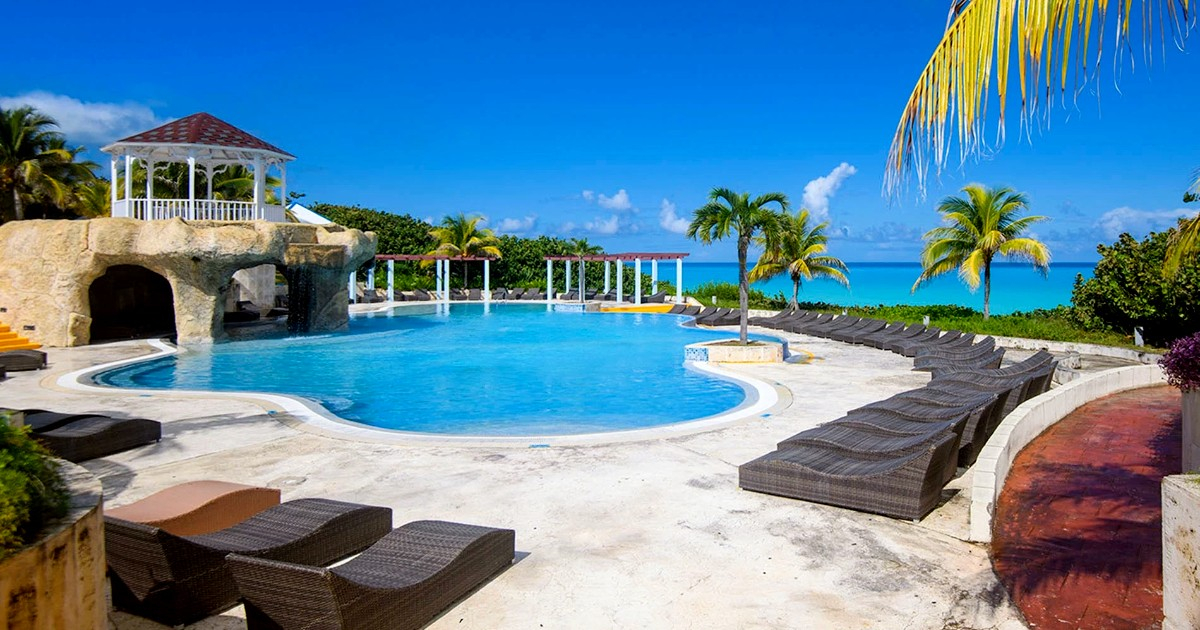
A testimony published by the independent media elTOQUE revealed from the inside the surveillance system that Military Counterintelligence (CIM) exercised over workers and tourists in the hotels of Cayo Santa María, where the military conglomerate GAESA controls a tourism monopoly that currently has more than 20 facilities closed.
According to the account of Jenny Mirabal Gómez —a former employee who worked as an entertainer and later as a guide for Gaviota Tours from 2009 to 2016—, the CIM had an office located next to the entertainers' rooms in the hotel where he worked.
Their agents did not wear military uniforms, but they were recognizable by their Suzuki motorcycles and the typical striped polos or plaid shirts. "Do not forget that despite not being dressed in military uniform, we are civilian workers of the army" was a phrase that, according to the testimony of Mirabal Gómez, was repeated countless times in Gaviota's internal meetings.
The CIM not only monitored tourists deemed suspicious: its main objective was the employees themselves. Any relationship between workers and foreign visitors was strictly monitored, and violations could lead to expulsion or legal action before the military prosecutor.
Before officially joining Gaviota Tours as a guide, the author underwent a thorough investigation that included inquiries in his neighborhood and at previous educational institutions to verify his "revolutionary attitude."
Mirabal Gómez was on the verge of being rejected because his father had served time in prison, and only after an extensive personal plea was he admitted. "I can't imagine how many cases were denied without any right to clarification," he wrote.
The account also highlighted the arbitrariness with which GAESA made its investment decisions.
In 2009, the president of Gaviota S.A. visited Cayo Santa María to "discuss" the construction of so-called "tourist villages" outside the hotel sector. He disregarded the majority opinion of the workers and concluded the debate with a phrase that encapsulates the logic of the conglomerate: "We don't want the money from Cubans; the money we want is from international tourists." The villages were built by 2011 and failed.
The wage gaps described in the testimony illustrate another contradiction of the system: a foreign general manager of Meliá Hotels could earn between 5,000 and 6,000 dollars a month, while his Cuban counterpart received just over 1,000 Cuban pesos—about 40 dollars. Employees earned between 10 and 30 dollars a month and relied on tips to survive, with no safety net in case of illness or accident.
The imbalance between hotel investment and social welfare —also highlighted by the former employee— has concrete figures: in 2023, the National Office of Statistics and Information reported 2,325 million pesos allocated to hotels and restaurants, compared to only 583 million for health and social assistance, a difference of nearly four to one that the regime has never publicly explained.
The collapse of the sector is now evident: in February 2026, Gaviota closed 20 hotels in Cayo Santa María, leaving over 7,000 workers unemployed.
Among the halted hotels is The One Gallery, a five-star establishment opened in 2023 and linked to the Cuban-American businessman Boris Arencibia, who was sentenced to 57 months in prison for trafficking in counterfeit medications and money laundering.
To conceal its military origins related to that project from the United States, Gaviota even temporarily erased all graphic identification with GAESA: it changed uniforms, bus decals, and stopped being called Gaviota.
The sanctions from Washington accelerated the collapse: on May 1, President Donald Trump signed Executive Order 14404 with secondary sanctions for foreign companies with trade links to GAESA, and the State Department designated the conglomerate and its president Ania Lastres Morera.
Chains like Meliá and Iberostar began to withdraw before the June 5 deadline.
The result is a ghost tourist destination: in the first seven months of 2026, Cuba received only 420,000 foreign visitors, a 63% decrease compared to the same period in the previous year.
Billions of dollars in investments lying completely unused, while the people suffer through blackouts and shortages of all essential goods, concluded the testimony published by elTOQUE.
Related videos:
Filed under: