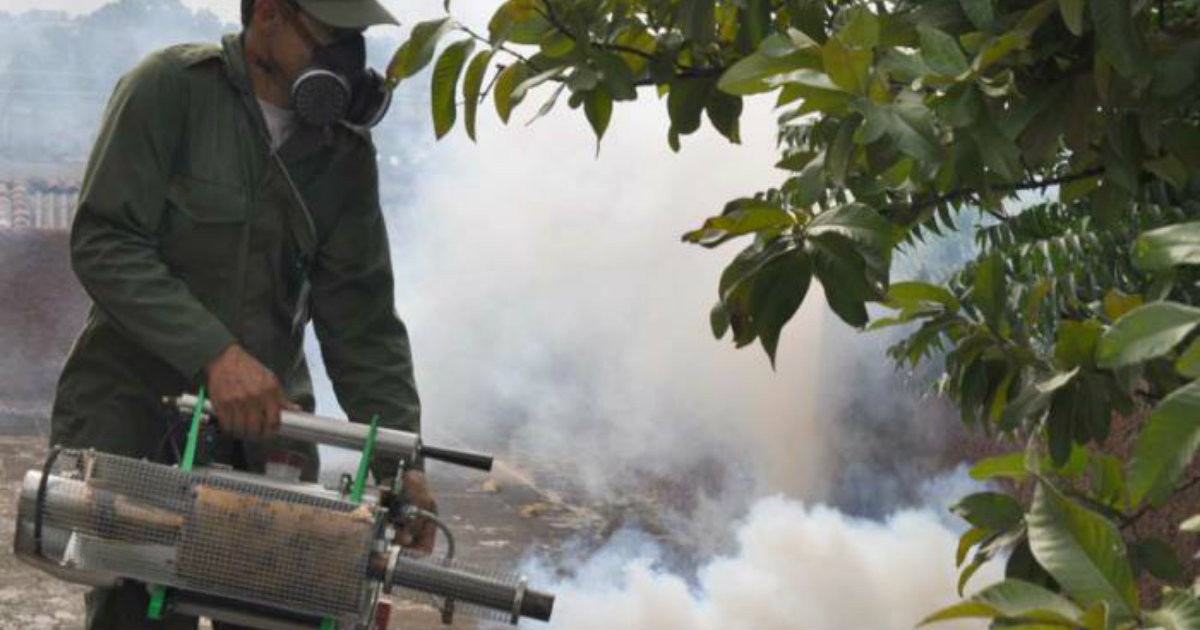
The province of Holguín is facing outbreaks of the Aedes aegypti mosquito and will strengthen its fight against the vector with 50 fumigation teams donated by the Pan American Health Organization (PAHO), at a time when environmental conditions are favorable for its reproduction and increase the risk of dengue.
The equipment, described as "new type and highly effective bazookas," will allow for the extension of a fumigation technique across the 14 municipalities of the province that utilizes water for the emulsification of the insecticide, replacing the oil used in traditional machines, the official newspaper ¡Ahora! detailed on Thursday.
Doctor Geanela Cruz Ávila, director of the Provincial Center for Hygiene, Epidemiology, and Microbiology, explained that the new system provides, according to the experience developed by the Ministry of Public Health (Minsap), an adequate effectiveness for vector control and reduces the environmental contamination associated with the traditional method.
According to the specialist, the use of water with insecticide is not new in Cuba, and for the past two years, there has been a project in the area of entomology research, within the framework of vector surveillance and control, to evaluate this alternative.
The donation arrives as the province reports outbreaks of Aedes aegypti, although health authorities assert that the issues are mainly localized in specific blocks and clearly defined areas, both in the municipality of Holguín and in other regions.
Cruz explained that during this time of year, the risk of arboviruses, primarily dengue, increases due to rising temperatures and more frequent rainfall, conditions that accelerate the mosquito's breeding cycle.
The official called for strengthening the joint efforts between health workers, surveillance and anti-vector personnel, other sectors, and the population.
He attributed part of the risks to noncompliance with preventive measures within households, such as leaving water tanks uncovered, and called for intensified actions this month to curb the infestation of the vector.
Among the measures considered essential, he also mentioned family self-focusing, especially to prevent the proliferation of mosquitoes in uncovered water containers.
The situation facing Holguín is part of a national epidemiological crisis. According to the Global Dengue Observatory of the London School of Hygiene & Tropical Medicine, dengue cases in Cuba exceed 7.4 times the expected level for 2026, with 7,133 cases reported so far this year.
August was the month with the highest burden, with an estimated 3,214 cases, and the seasonal peak usually occurs in October, indicating a possible worsening, the source warned.
The situation in Holguín is further complicated by a chronic waste collection crisis that increases the breeding grounds for the vector. Just a few days ago, a resident of the Lenin neighborhood reported large landfills next to a childcare center and a primary school, which have not had collection for over a month.
"The smell is unbearable," alerted the citizen, who warned that the accumulation of waste poses a direct danger to children due to the rise of arbovirus diseases.
The Community Services Company claims a shortage of trucks, fuel, spare parts, and personnel to justify the lack of waste collection, a situation that has recurred since the beginning of the year and which experts identify as one of the structural factors that hinder the control of Aedes aegypti in the province.
In June, the Minsap activated epidemiological surveillance in anticipation of the summer and warned that Cuba could face a new dengue epidemic if it fails to control the factors that promote the spread of the transmitting mosquito.
Related videos:
Filed under: