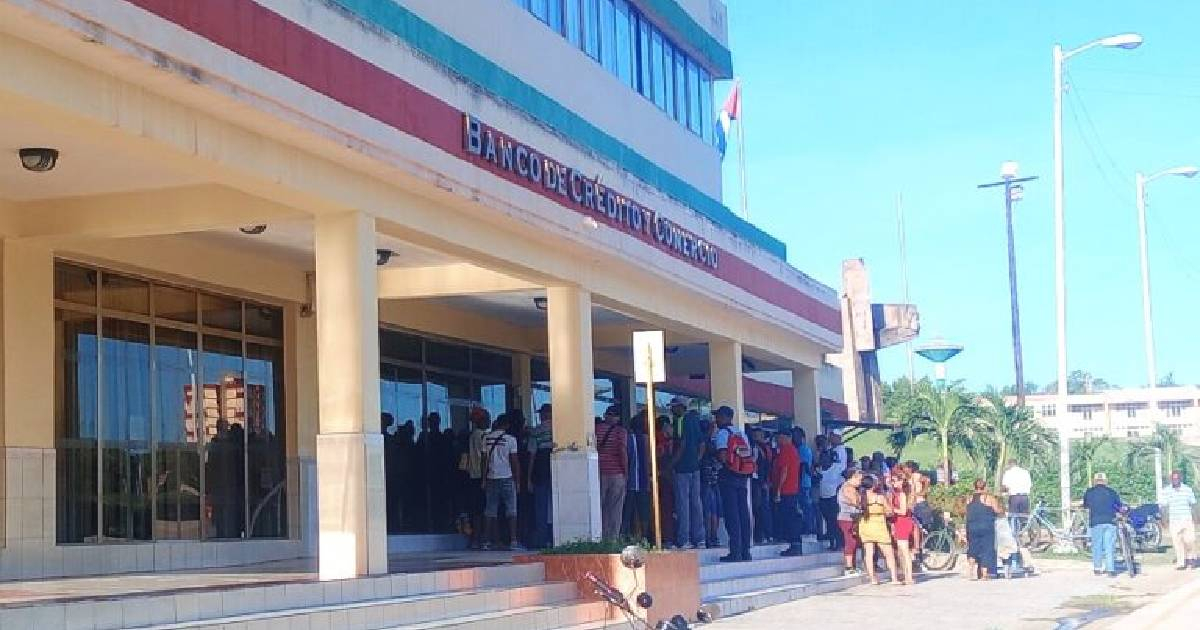
Employees of the banks BPA (Banco Popular de Ahorro) and BANDEC (Banco de Crédito y Comercio) were among those detained in Santiago de Cuba for their involvement in exchanging cash for electronic transfers, charging commissions between 30% and 50% in interest, revealed this Thursday the official profile Héroes del Moncada on Facebook.
The operation by MININT, according to the source, took place over the last few months and also included the arrest of individuals who were operating directly at ATMs. Among the implicated bank branches are number 8312 of BPA and number 8391 of BANDEC, located in Santo Tomás between Aguilera and Heredia.
According to the official publication, bank workers acted "by mutual agreement with TCP [self-employed workers] dedicating themselves to exchanging cash for transfers, charging interest rates ranging from 30% to 50%, using various cards and identity documents of users or clients to carry out these illicit operations," and benefited from cash generated by this activity.
As a result of the operation, the publication details, the authorities seized a large sum of cash, bill counting machines, magnetic cards, and notepads where the illicit transactions were recorded.
The phenomenon has recent precedents in the same city. In May, the National Revolutionary Police detained individuals at ATMs in the train terminal of Santiago for charging between 35% and 50% interest. In June, an operation led to the seizure of 380,000 pesos from a suspected reseller who charged a 20% commission. And in July, a complaint revealed that from 1,000 pesos transferred, only 600 were received in cash.
The citizen reaction to the publication of the profile linked to the MININT was largely critical. Far from celebrating the operation, many users pointed out that the real cause of the problem is the structural shortage of cash. "Yes, but if we get to the root of the problem, that's not the solution; the solution is for each person to be able to go to the ATM or the bank and withdraw the cash they want. Then, when that happens, that type of business will close on its own," wrote an internet user.
Another user agreed: "That's very good... now, that's not where the root of the problem lies; it stems from the lack of available cash. If banks and ATMs were consistently well supplied with cash, this phenomenon would simply disappear."
Other comments directly questioned the usefulness of the operation. "Let's see, geniuses of the lamp... Tell me, what did this operation resolve? Can people now withdraw cash, or can they not even do that by paying 30-50% in interest? [...] Now they have people in jail to feed (more expense for the State) and the ATMs are still out of money," wrote a user.
Another went further by questioning the possible selectivity of the arrests: "They target those who are not front men for the leaders so that they won’t pose competition, and they set them as examples […] The best business in the world isn't about selling more and cheaper, but about eliminating those who compete with your business."
The regime has attempted to alleviate the liquidity crisis with the issuance of 10,000 and 20,000 peso bills since September 16, the removal of the 5,000 peso limit for cash payments among economic actors, and the extension of pension payments through mipymes. However, a netizen summarized the contradiction that none of these measures have resolved: “It's simple; if there were money in the bank and ATMs, no one would profit from money at interest. The question here is: if there is no money for the population, where do those engaged in this business get it from?”
Related videos:
Filed under: