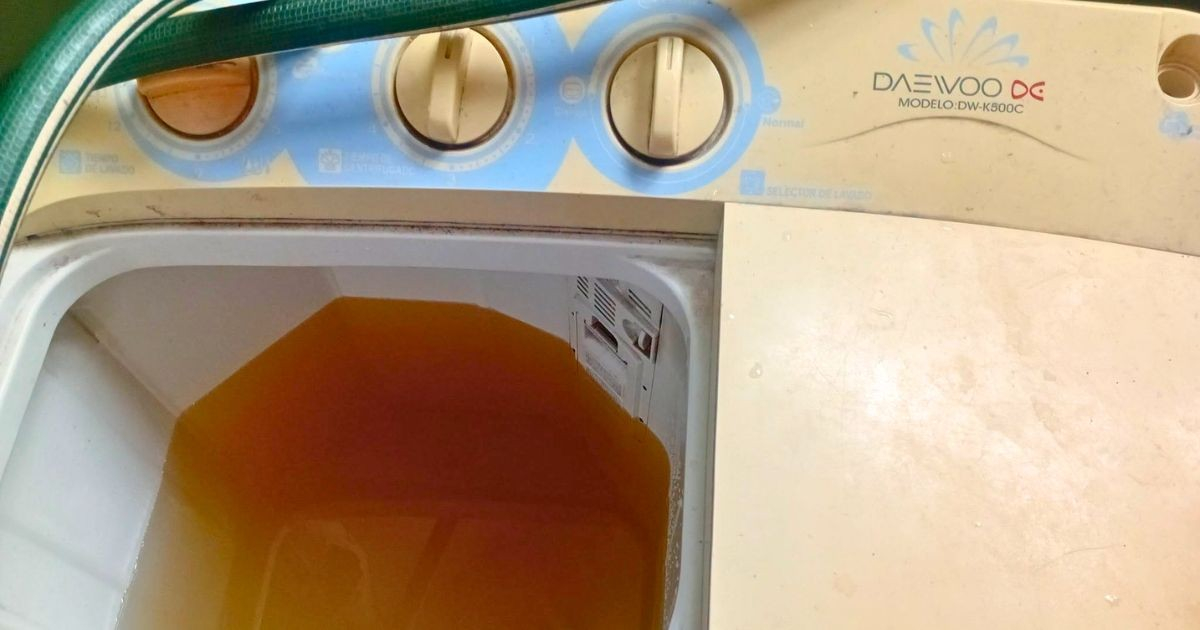
A Cuban identified as Verónica C. Barrios posted on Facebook this Friday a reflection that quickly resonated with her fellow countrymen: a comparison between the state of her old Daewoo washing machine and that of Cuba, accompanied by a photograph showing the machine’s tub filled with dark brown water, just as it came out of the tap before starting to wash.
Barrios describes the appliance with a collection of images that any Cuban can recognize in their own life: "My washing machine is old, it's tired and worn out. The passage of years, the bumps it has taken, the times I've dragged it from one place to another in the house to change its position have deteriorated its structure. It barely washes anymore. In order to make it move the clothes, I have to stick my arm in and turn and turn and turn until my shoulder gives out."
The leap from the domestic to the political comes without preamble: “My country is like my washing machine and me: tired of going around and around, mistreated, pushed, deteriorating, old, barely breathing, on the brink of collapse. But above all, it is soooooo sick of the dirty water,” he writes, clarifying in parentheses that he is not speaking literally about the liquid.
However, the photo accompanying the text allows the complaint to operate on both levels simultaneously. "The photo shows the water that came out of the tap when I started filling the washing machine to begin laundry; I hadn't washed anything yet," Barrios clarifies, making it clear that the brown liquid is not the result of the washing process, but rather from the water supply itself.
The author also anticipates and rejects any calls for resignation: "And for the whiny conformists, don’t come to me with the whining that I should be grateful for at least having that water. The oven is not ready for pastries." The publication concludes with the hashtags #SOSCuba, #Cubaagoniza, #cubaduele, #Basta, #Váyanse, and #libertad.
The account of Barrios is not an exception. The water crisis in Cuba reached dimensions in 2026 that the authorities have partially acknowledged. According to official data released in May, around 2.7 million people lacked regular access to drinking water, while others million received the service intermittently. In Havana, by July, the number of those affected by this service exceeded half a million.
The link between power outages and water shortages is structural: Cuban authorities have acknowledged that over 80% of the pumping system depends on the electrical grid, which means that each outage — and Cuba has experienced at least eight total disconnections from the national electrical system in 2026 — also halts water supply.
The quality of the water that reaches households, when it does, is another chapter of the same crisis. In Camagüey, images from April showed brown and muddy water coming directly from the aqueduct tap. In Cienfuegos, residents reported in August water with larvae, little red worms, and significant dirt. In Boyeros, over 40,000 people have faced severe issues since January.
The frustration expressed by Barrios is backed by statistical evidence. Extreme poverty now affects 94% of Cubans, while eight out of ten people have had to skip meals due to a lack of money or food, according to the IX Report on the State of Social Rights in Cuba, produced by the Cuban Observatory for Human Rights (OCDH) and the Observatory of Social Rights Cuba.
The metaphor of the old washing machine, pushed to the brink and weary of dirty water, brutally encapsulates what millions of Cubans experience daily under a dictatorship that has held power for nearly seven decades.
Related videos:
Filed under: