For four days, we have enjoyed the hospitality, kindness, and warmth of many good Germans, concerned and committed to the defense of freedom, human rights, and the core values of the Western world, including Orlando Gutiérrez Boronat, Secretary General of the Assembly of the Resistance; Javier Larrondo, President of Prisoners Defenders; Martín Paz, democracy advocate from Venezuela; and myself. Among our hosts, we had members of the Federal Parliament (Bundestag), officials from the Ministry of Foreign Affairs, and our friends from the Konrad Adenauer Foundation, and the solidarity of many good Germans.
Just about to leave for the airport, I decided to revisit a question I always ask myself in every country I visit: whom does a nation remember when thinking of those who defended its freedom, and whom does it recall when reflecting on the darkest periods of its history?
Germany offers extraordinary examples. Konrad Adenauer, precisely the man whose name the friend foundation that has welcomed us bears, was the first Chancellor of the Federal Republic of Germany. After the devastation of World War II, he played a crucial role in the democratic reconstruction of West Germany, its integration into the Western democracies, and the process of European reconciliation.
Sophie and Hans Scholl represent something profoundly admirable: the courage to say "No" when all the instruments of a totalitarian state compel you to say "Yes." These two young students were part of the White Rose. They did not have armies, weapons, or large organizations. They only had paper, ideas, conscience, and courage. They wrote and distributed leaflets denouncing the Nazi dictatorship, the war, and the crimes being committed. They were discovered distributing those writings at the University of Munich on February 18, 1943. Four days later, they were sentenced to death and executed.
Willy Brandt represents another dimension of democratic Germany. Persecuted by the Nazis and forced into exile during those years, he eventually became chancellor and developed a policy of rapprochement with Eastern Europe. His Ostpolitik aimed to reduce tensions during the Cold War and to unite the two Germanies and the peoples separated by the Iron Curtain. He was awarded the Nobel Peace Prize in 1971.
In front of these figures are some of the main perpetrators of the Nazi tragedy: Adolf Hitler, Heinrich Himmler, and Joseph Goebbels. Hitler led the dictatorship and the state that instigated a war of aggression and executed the Holocaust. Himmler transformed the SS into one of the primary instruments of persecution, concentration camps, and mass murder. Goebbels headed the Ministry of Propaganda, utilizing the press, radio, cinema, education, and culture to spread Nazi ideology, antisemitism, and the cult of the Führer. This sounds very familiar to Cubans.
There is an episode that has always been revealing to me. After the failed Beer Hall Putsch of November 1923, Hitler was tried for high treason before the People's Court in Munich. At the end of the trial, he claimed that they could declare them guilty "a thousand times," but that the Eternal Court of History would ultimately destroy that accusation and sentence because "it absolves us." The phrase is documented in the transcript of that trial.
Decades later, Fidel Castro made his famous remark: "Condemn me, it doesn't matter. History will absolve me." The Monstruo de Birán, always inclined to imitate other famous tyrants, adapted that idea and distilled it into a shorter phrase. He also capitalized on methods, styles, and experiences from various authoritarian systems, incorporating elements of political theater and mass mobilization, as well as mechanisms of control and brutal repression.
Let's continue. After my mental exercise on German heroes and villains, I told myself: let's do the same analysis for Cuba.
Let’s start with the positive. Who would you choose if you had to select three historical figures capable of uniting a large portion of Cubans around the idea of freedom? Before continuing, take a moment to decide on your top three.
Personally, I would inevitably start with José Martí. He was much more than a great thinker, poet, and writer. He founded the Cuban Revolutionary Party, organized the "Necessary War," and envisioned a republic based on human dignity, justice, and that extraordinary formula: "with everyone and for the good of everyone."
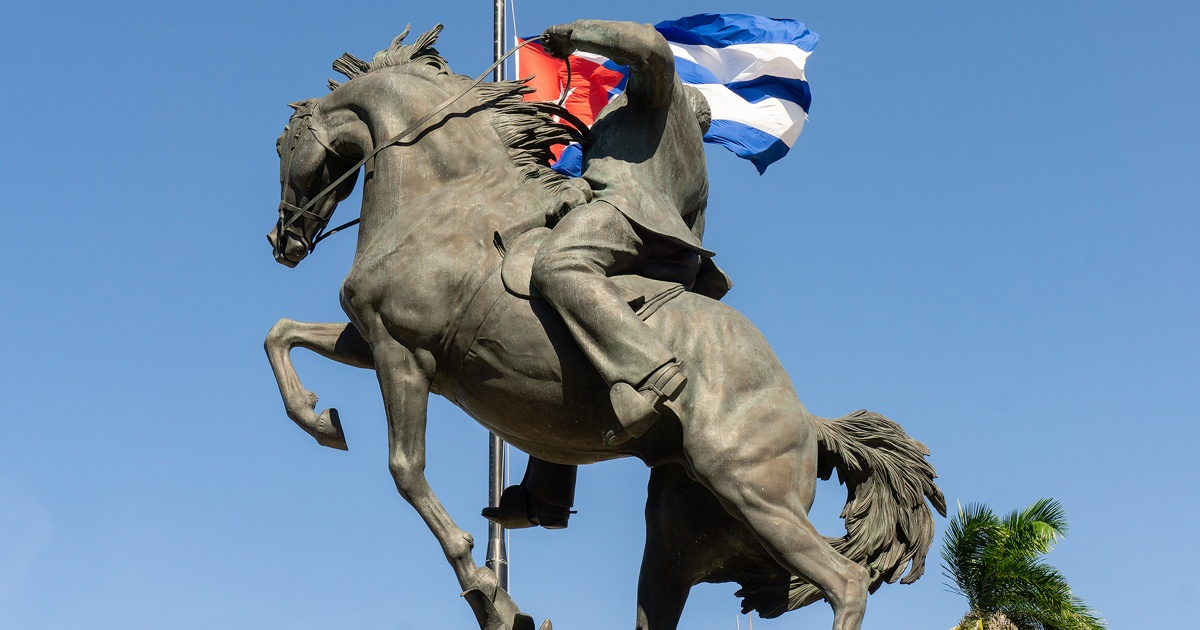
I would continue with Antonio Maceo, the Bronze Titan. Few figures better represent the Cuban determination to refuse partial freedom. The Protest of Baraguá turned a rejection into a national symbol: when peace meant relinquishing independence and leaving the abolition of slavery unfulfilled, Maceo replied with a resounding "No."
Carlos Manuel de Céspedes would be the third. We regard him as the Father of the Fatherland because on October 10, 1868, he transformed the desire for independence into action. When Spanish forces captured his son Óscar and offered to spare his life if he abandoned the fight, Céspedes rejected the blackmail and responded with a phrase that went down in history: “Óscar is not my only son; all Cubans who die for our freedoms are.” The Spaniards executed Óscar.
Now let's move on to our monsters. I invite you once again to choose your candidates. Before 1959, Cuba experienced authoritarian and repressive governments. The mambí general Gerardo Machado ended up ruling dictatorially. Fulgencio Batista destroyed the constitutional order with his coup d'état on March 10, 1952. Moreover, his trajectory had very different stages: during the previous decade, he had participated in constitutional politics and in 1940 he had support from various groups, including the Cuban communists.
I don’t know about you, but no matter how much I analyze them, I don’t see them with enough history to be considered villains deserving of the gold. The gold medal, for all the damage caused to our homeland, for all the suffering and pain inflicted on our people, undoubtedly belongs to Fidel Castro.
Reaching this point, I reevaluate Machado and Batista. I don’t like to be unfair. I want to see if one of them deserves the silver, or if both are tied for second place. But no matter how much I insisted on awarding them, the silver medal goes to, for the continuation of the destructive work in the Greater Antilles, the little brother of Lord Voldemort: Raúl Castro.
The time for bronze has come. Let's reevaluate whether Machado or Batista deserve it. What do you think? Of course, they don't qualify! They were weak. Their ambitions and their malice didn't reach the 2.45 meters of Javier Sotomayor. It's obvious that our third place doesn't come close to the 6.31 of pole vault champion, the Swedish Armand Duplantis. He can’t jump that high because he’s a real jackass with claws. But he deserves the third podium because he is the infamous manager of the Ogre of Birán. Don't get confused, the Ogre is the younger brother of the Monster. What, you still don't know who I'm talking about? I'm sure you do. He is popularly known as the one without a house. House, in English.
Let us return to good people, to true heroes like Sophie and Hans Scholl, Pedro Luis Boitel, Orlando Zapata, Oswaldo Payá, and Laura Pollán.
The greatness of civil resistance does not depend on the size of those who resist, but on the magnitude of the power they dare to confront. The Scholl siblings were practically defenseless young people in the face of one of the most brutal totalitarian regimes known to humanity. However, they understood something essential: when evil attempts to make silence the norm, speaking out becomes an act of resistance; when fear seeks to paralyze an entire society, taking action becomes an example; and when a dictatorship demands absolute obedience, preserving one’s own conscience becomes a form of freedom.
That spirit does not belong exclusively to a country or a specific time. It is also the spirit of those Cubans today—young and old, men and women, journalists, artists, religious leaders, activists, or ordinary citizens—who choose to speak their minds, organize, and fight for freedom despite knowing the consequences. It is the same moral drive that, in very different historical circumstances, inspired the mambises who followed Céspedes, Maceo, and Martí: the conviction that no power has the right to demand that a people renounce their freedom forever.
The Scholls were unable to witness a free Germany. Céspedes, Maceo, and Martí also could not fully behold the independent Cuba for which they fought. But they planted the seed. They left us an example of enduring dignity and courage. And if we fulfill our duty as Cubans today, we will soon reap the freedom for which they gave their lives.
Related videos:
Filed under:
Opinion article: Las declaraciones y opiniones expresadas en este artículo son de exclusiva responsabilidad de su autor y no representan necesariamente el punto de vista de CiberCuba.