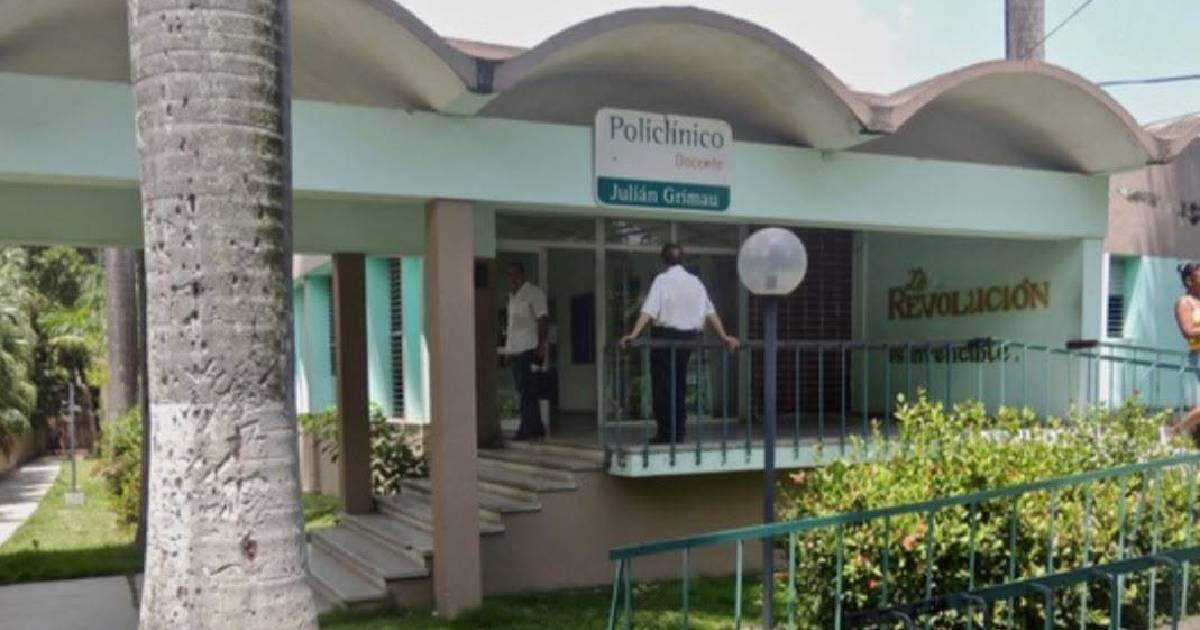
A Cuban woman reported on social media this Saturday that the Julián Grimau teaching polyclinic, located on Calzada de Diez de Octubre between Maceo and Ribera, in the Havana municipality of Arroyo Naranjo, is facing serious limitations in providing medical services due to a lack of electricity.
The complaint was published by Isa Iris Arzola in the "Facebook" group "Electric Company of Havana," where she directly questioned the PCC of Arroyo Naranjo and asked how much longer patients will have to face these shortcomings.
"Where is the medical power?" he wrote at the end of his post.
According to the testimony, the lack of electricity prevents the sterilization of materials used for administering aerosols and also limits the ability to perform electrocardiograms and X-rays. The situation even forces some patients to bring their own mouthpieces for treatment.
"I can attest to that," commented a person in the post, recounting that they recently arrived at the clinic during an asthma crisis, and the doctor asked if they had brought their own mouthpiece, because the center only had one and could not sterilize it due to electrical issues.
The complaint also raised questions about the energy infrastructure of the polyclinic itself. One of the commentators pointed out that the center's roof is covered with solar panels, but claimed that only four of them are connected.
Other users asked what happened to the generators and power plants that were supposed to ensure the operation of the service during the blackouts.
The comments broadened the complaint to other health centers in the capital. At the clinic in the Eléctrico neighborhood, one person stated that consultations cannot be offered regularly due to the lack of electricity, and that the physiotherapy and dental areas are virtually closed.
In Luyanó, another user claimed that there wasn't even a blood pressure monitor available and summarized the situation with a sarcastic question: "Medical power? That's farther away than the U.S."
From Old Havana came an even more striking comment. "The medical power has left this country," wrote another person, referring to the Cuban official discourse that for years has portrayed the healthcare system as one of the main achievements of the 1959 revolution.
The testimonies published on the social network do not independently verify all the reported deficiencies, but they reflect the discontent of users who associate the lack of electricity with the disruption or limitation of basic medical services in various clinics in Havana.
The collapse of primary care in Havana is part of a health and energy crisis that is only partially acknowledged by the government.
In February, the Minister of Public Health, José Ángel Portal Miranda, warned that the system was "on the verge of collapse". In April, more than 70% of the basic medicine supply was unavailable in state pharmacies.
The prolonged blackouts resulting from the worsened energy crisis in the country hinder the provision of services. Without electricity, X-rays, ultrasounds, clinical laboratories, and nebulization equipment become inoperable.
In July, a citizen complaint referred to the precarious service conditions of a polyclinic in Güira de Melena, in Artemisa, which was operating without medications and with solar panels that barely powered a few light bulbs.
In September, a Cuban woman exploded with anger when she was unable to vaccinate her granddaughter at the Cristóbal Labra polyclinic in La Lisa due to an unresolved electrical issue that had persisted for two months.
The UN warned in September that blackouts in Cuba jeopardize the vaccination of about 70,000 children and the operation of incubators and respirators across the country.
Related videos:
Filed under: