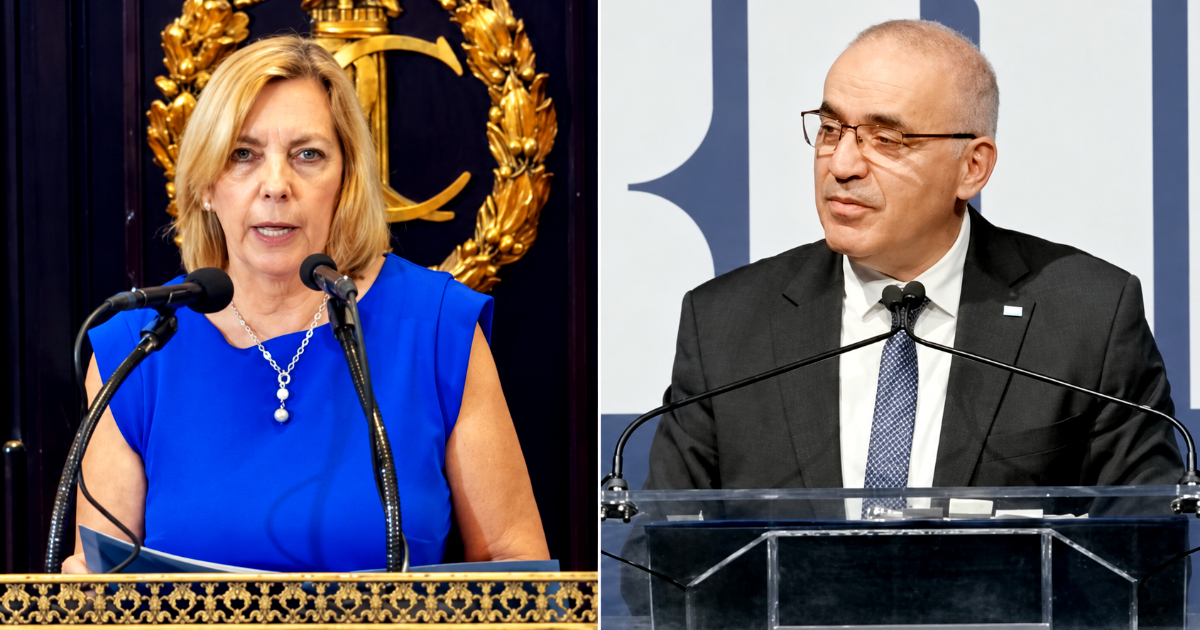
The chess player and dissident Garry Kasparov was identified as the target of an elimination plan orchestrated by the Kremlin on U.S. soil, as revealed this Wednesday by El Mundo.
U.S. authorities informed him this summer that he was a "target" of the operation and assigned him special protection for the first time since he exiled himself in New York in 2013.
The news expands on what was already known about the so-called "RIS Network," the network connected to Russian intelligence services, whose five members were formally charged by the Southern District of New York Prosecutor's Office on September 16, 2026.
Among those five are two Cubans: Oemis Romagoza Durruthy and Yaidel Delgado Suárez, known as "Vikingo".
Kasparov was not the only target on American soil. More advanced were the plans to eliminate Ilya Ponomarev, the only deputy in the Russian Duma who voted against the annexation of Crimea in 2014 and who has supported the armed defense of Ukraine from exile.
The murder of Ponomarev —identified in the case file as "Victim Number 1"— had a price of $40,000. An individual recruited by the network conducted surveillance on two locations associated with him in Washington, was detected by security cameras, and ultimately backed out.
The role of Cubans in the plot is central. Romagoza Durruthy, a dance professor who coordinated sabotage attacks in Europe from Russia in service of the GRU, was already known to the Lithuanian authorities for having induced two Spaniards to set fire to a company linked to military supplies to Ukraine in 2024, for a payment of 4,000 euros.
Delgado Suárez, 35 years old, acted as a recruiter for the planned attacks on U.S. soil alongside the Venezuelan Ángel Eduardo Castro, 22 years old.
It was precisely Castro who reached out this summer to a compatriot living in Brooklyn with a direct question: "Do you have someone trustworthy in Washington?"
The instructions that followed were detailed: delete the conversation, go to the victim's neighborhood with the phone in airplane mode, record from a distance with the left hand. The ultimate goal was to "eliminate one or two dissidents and, in the process, send a strong message to the rest."
Also listed as a possible target is the opposition figure Vladimir Kara-Murza, who was poisoned twice by Russia and released in 2024 in a prisoner exchange. In Lithuania, the network had its sights set on Ivan Tyutrin, co-founder of the Free Russia Forum alongside Kasparov, with a bounty of $25,000 for his elimination.
The criminal accusation does not hold the Cuban State responsible. The Cuban regime denied any connection with the network: the Deputy Minister of Foreign Affairs, Josefina Vidal Ferreiro, described the accusations as "yet another veiled accusation, without evidence against Cuba."
Kasparov, for his part, has not been indifferent to the Cuban cause. In March 2026, he lashed out at the "Nuestra América" flotilla headed for the island, writing on X: "How about we swap these idiots for an equal number of Cubans who want to live in the free world?"
The Deputy Attorney General for National Security, John A. Eisenberg, summarized the scope of the operation: "These defendants allegedly operated as part of a global crime network that extended to the United States, attempting to recruit American and foreign citizens to commit crimes on behalf of the Kremlin."
All the accused remain fugitives in Russia and face up to 20 years in prison for conspiracy to finance terrorism.
Related videos:
Filed under: