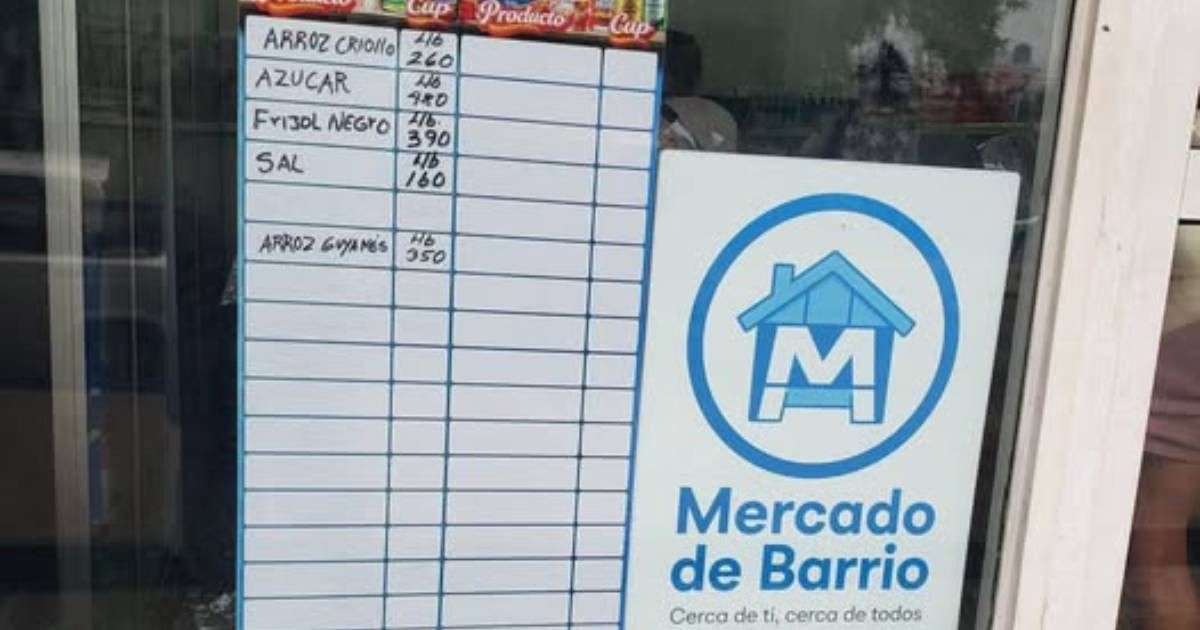
A resident of Boyeros, in Havana, contrasted this week the image of abundance projected by the official television regarding the so-called "neighborhood markets" with what he found in one of those establishments: a sign with scarcely five products and the rest of the shelves empty.
José Ernesto Veitia Pérez wrote on Facebook about two markets in the same municipality. While the establishment in the Sierra Maestra neighborhood, in the Nuevo Santiago popular council, appeared on television with fully stocked shelves, the reality he documented at the "El Actia" market, in Rancho Boyeros, was very different.
The offer consisted of criollo rice at 260 pesos per pound, sugar at 420, black beans at 390, salt at 160, and Guyanese rice at 350.
"It appears on TV that neighborhood markets have great visible offerings for everyone, but the reality is quite different when we encounter other neighborhood markets without advertising and a meager selection," he questioned.
Neighborhood markets were formalized through the , effective from August 11. This model allows small and medium-sized enterprises, cooperatives, and self-employed workers to manage state establishments such as grocery stores and butcher shops through bidding, although the State retains ownership of the properties.
The pilot project began on July 23 in Plaza de la Revolución, and according to the official newspaper Granma, by the end of September, 37 neighborhood markets were operating in nine provinces: Pinar del Río, Artemisa, Havana, Matanzas, Camagüey, Holguín, Granma, Santiago de Cuba, and Guantánamo.
Authorities have promoted these markets as an alternative with prices 10% to 15% lower than those of other stores. However, Veitia Pérez questioned whether these discounts are sufficient in light of the deterioration of Cubans' purchasing power.
"This solution of neighborhood markets is an option that will not be within reach for most people, even if the 30% discount were applied; the initial adjusted projection of 10 to 15% makes it even less likely," he warned.
The Cuban also linked the emergence of these establishments with the deep crisis of the state food distribution system.
"In fact, today the store is only distributing donations... there are no basic food baskets, that is a reality," he stated.
Scarcity hits particularly hard those who depend on state wages and pensions. Data from the Food Monitor Program released in September indicated that 33.9% of the surveyed households had at least one member who had gone to bed hungry in the past 30 days, while 79.4% spent 80% or more of their income on food.
Veitia Pérez also questioned whether the new markets will respect the announced prices, accept payments via bank transfers, and ultimately offer basic food items such as oil, eggs, and chicken at affordable prices.
"What will the retirees and pensioners, who each day join the large army of vulnerable individuals, not to say the extremely poor, do?" he asked.
For the author, neighborhood markets also represent another step towards the weakening of the supply booklet, whose operation has been impacted in recent years by delays and incomplete deliveries of basic products.
In December 2024, Prime Minister Manuel Marrero announced the gradual elimination of subsidies for basic staple products and stated that this process "is irreversible."
In response to the official promises and the five products he found in the Boyeros market, Veitia Pérez summed up his impression in a few words: "We're simply still screwed."
Related videos:
Filed under: