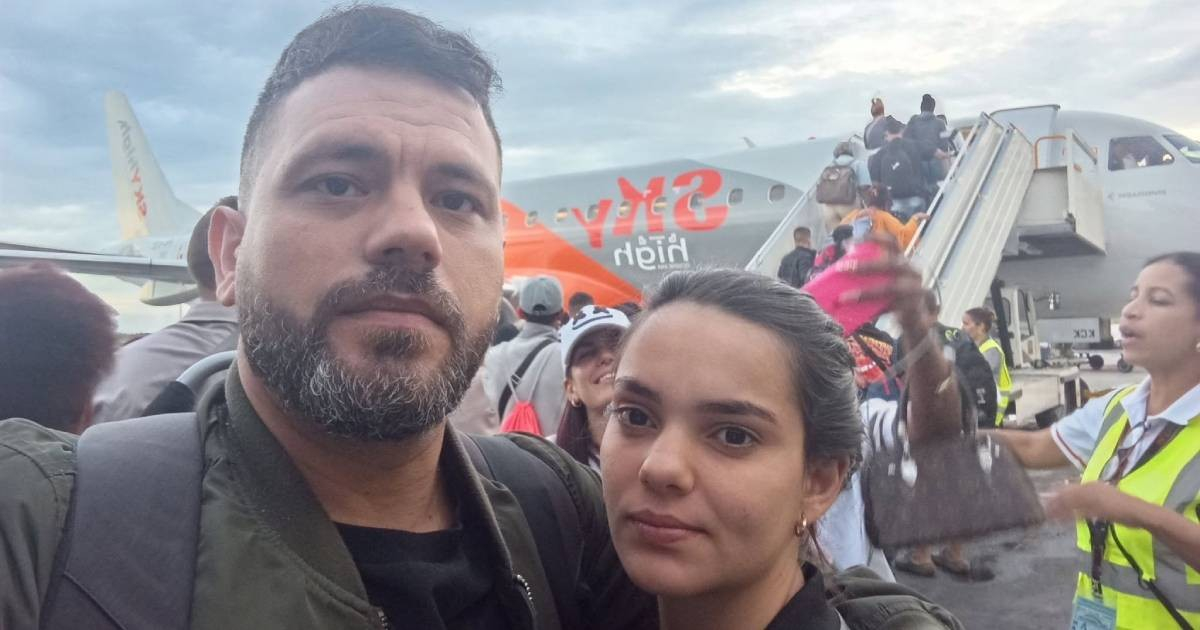
Austin Llerandi, director of the community bulletin Amanecer Habanero, left Cuba this Tuesday for Brazil with his pregnant wife, just weeks after State Security agents warned him that he needed to leave the country or face imprisonment due to his journalistic work.
The Cuban Institute for Freedom of Expression and the Press (ICLEP) condemned Llerandi's departure, describing it as "forced exile," and held the Cuban authorities responsible for the pressures that preceded his departure.
The departure brings an end to more than two months of escalating harassment that has also been documented by the Committee to Protect Journalists (CPJ).
On July 14, Llerandi was interrogated for over an hour at a police station in Marianao. According to his testimony, an agent identified as "Rodrigo" had the latest edition of Amanecer Habanero on his phone and warned him that he could be imprisoned if he continued distributing the bulletin.
"If you distribute the newsletter, the next time I call, give your wife a kiss on the belly, because you're going to jail," the officer would have said, according to the account documented by the ICLEP. The organization also documented that the agent had gone to Llerandi's father's house the day before to locate him and was aware of details regarding the couple's visits to the hospital due to the pregnancy.
Llerandi later explained to the CPJ that the interrogation was related to the general content of Amanecer Habanero, a newsletter that addresses issues of daily life in Cuba and is distributed independently from state media.
"Leave the country or you'll be imprisoned."
Pressure increased on August 21 when Llerandi returned to the Marianao station after receiving a summons. According to ICLEP, he remained there for five hours, three of which were incommunicado. The CPJ documented that during this appearance, he was informed that he was being investigated for a possible violation of Decree-Law 370.
During that interrogation, a captain identified as "Miguel" communicated the ultimatum to him.
«We are going to give you the opportunity to leave the country in two months. If you're not gone in two months, you'll go to prison. Think about your daughter," Llerandi recounted.
"None of the journalists should have to choose between prison and exile simply for doing their job," stated José Zamora, regional director for the Americas at CPJ.
Llerandi refused to sign the warning notice that, according to his testimony, the authorities presented to him. Days later, he released a video from Havana in which he stated that he would continue to work despite the pressures.
"The dictatorship exists, the dictatorship has weapons, the dictatorship has ways to repress us, countless ways to repress us. What we cannot stop doing is working," he stated.
Finally, the 36-year-old journalist left Cuba on Tuesday, September 29, along with his wife, and traveled to Brazil.
Complaints to international organizations
Before its conclusion, the case had reached international instances.
ICLEP presented a request for protective measures for Austin Llerandi and his family before the Inter-American Commission on Human Rights (IACHR). The organization explained that it made this decision due to the threat of imprisonment, the ultimatum to leave Cuba, and the use of his wife's pregnancy and their unborn daughter as tools of pressure. ICLEP also called on the United Nations to follow up on the case and to make a public statement.
The CPJ, for its part, issued two alerts regarding the case. In July, it called on the Cuban authorities to put an end to the threats against Llerandi, and after the interrogation in August, it reiterated its demand to halt the harassment and reminded of his right to remain in Cuba and practice journalism free from threats of imprisonment.
ICLEP has now requested the Inter-American Commission on Human Rights to expedite the request for precautionary measures, for the United Nations to address the case, and for Brazilian authorities to provide protection to Llerandi and his family.
An escalation against independent media
The case arises amid other episodes of pressure against independent communicators in Cuba.
In September, journalists and activists were subjected to surveillance, summons, and interrogations. Among them was Yunia Figueredo, who reported that State Security agents threatened her with opening a file for espionage and with
This includes the case of Henry Constantín, director of La Hora de Cuba, arrested on September 16 in Camagüey and subsequently incarcerated in the Kilo 7 prison. CiberCuba reported on the imposition of preventive detention.
The figures from ICLEP itself show that July was the month with the highest number of violations of freedom of expression and press recorded by its observatory in 2026. That report expressly included the case of Llerandi and documented the threats of imprisonment related to the distribution of Amanecer Habanero.
“Austin Llerandi committed no crime. He distributed a bulletin that reports on what is happening in his community, and for that, they threatened to imprison him, using his pregnant wife and unborn daughter as instruments of pressure. Today, he leaves his country carrying the burden of having been expelled for practicing journalism,” stated Normando Hernández, General Director of ICLEP.
Related videos:
Filed under: