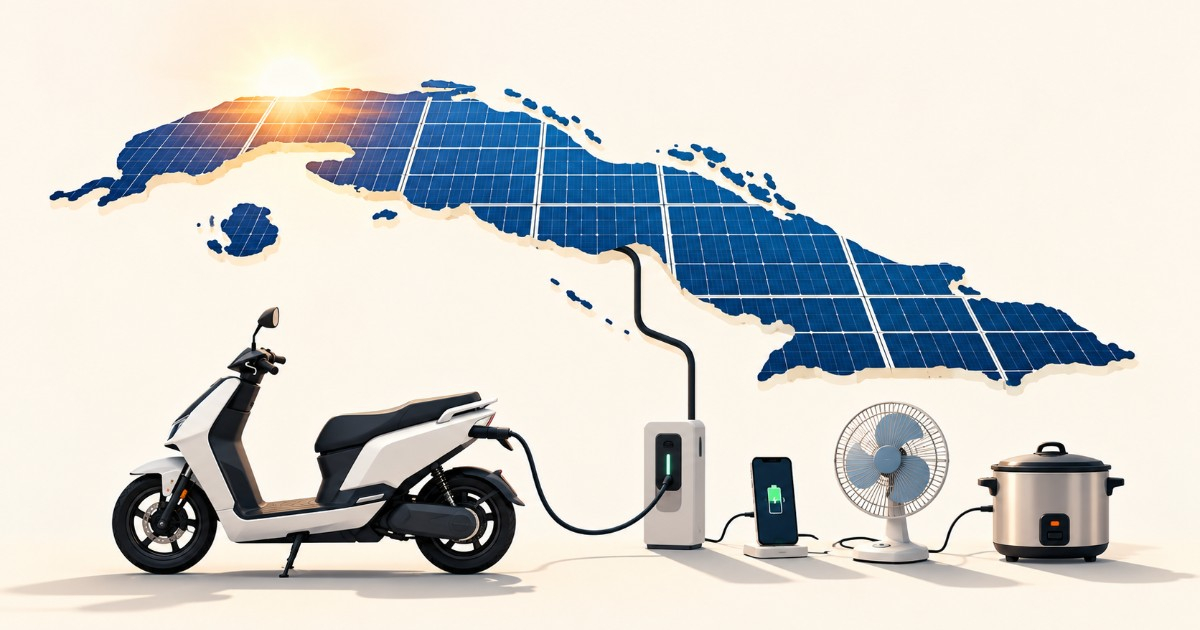
The so-called solineras have quickly transformed from isolated facilities for recharging electric vehicles into small energy centers where Cubans are trying to meet basic needs such as charging a phone, turning on a fan, or cooking during the extended power outages.
But there is no uniform national network or a single pricing system. The facilities have different capacities, owners, and prices, and the official statistics sometimes mix solar charging stations, solar power plants, and community service centers.
A review of official reports, local publications, and projects that are currently operational, however, allows us to outline an approximate map of where this new energy model is concentrated and how much it costs to utilize it.
Villa Clara: the largest known concentration
Villa Clara is the territory where the expansion is most documented. In September, provincial authorities reported 50 solar charging stations distributed across the 13 municipalities, benefiting around 5,000 families daily.
The figure should be interpreted with precision: the report groups different types of solar stations under a single balance, so not all of them necessarily offer the same performance.
According to data from the National Office for the Control of Rational Energy Use (ONURE), a typical facility in the province has about 10 kilowatts of power and 20 kilowatt-hours of storage, although there are centers with greater capacity.
Community services for charging phones, lamps, and fans, as well as cooking food, are generally offered for free, while the recharge for motorbikes, tricycles, and cars is paid.
The community model began to grow with the opening in April of the first shared solar installation in Villa Clara, located in the Virginia popular council in Santa Clara.
The official Granma report on that facility detailed that it could charge six vehicles simultaneously and connect up to 52 cooking appliances. Food preparation was provided free of charge.
Since then, private and community facilities have appeared in various locations throughout Santa Clara and other municipalities.
Among them, Solguara stands out, located on the way out of Santa Clara towards the National Highway, presented as the first Cuban station with fast and ultra-fast charging for electric vehicles. In August, prices of 1,000 CUP were reported when the user uses their own charger and a fee announced by the establishment for using their equipment, while charging cell phones, fans, and lamps remained free of charge.
Holguín: rates between 50 and 500 CUP per hour
Holguín provides one of the clearest examples of how the private business of beach chair rentals operates.
The station El Girasol, operated by the small and medium enterprise Frenas Conmigo in the Alcides Pino community, opened in June with approximately 30 kilowatts in inverters and 60 kilowatt-hours of battery backup.
Their price list provided insight into one of the first detailed public rate schedules for this type of facility.
The charge for a motorcycle is 250 CUP per hour and for an electric tricycle 300 CUP per hour. For other equipment, the known rates range from 50 CUP per hour for small devices to 500 CUP per hour for portable stations over 2,000 watts.
In contrast, charging cell phones, small rechargeable fans, and certain lamps is offered free of charge.
The prices sparked debate among residents because the system charges by connection time rather than by the actual amount of energy supplied.
CiberCuba previously documented the controversy over the rates at El Girasol, where users raised questions about how much it can cost to complete the battery of certain equipment compared to the earnings of a state employee.
Guantánamo: from riding a motorcycle to cooking during the blackout
Guantánamo is developing a different model, based on community service and loading centers that operate with solar panels and batteries.
The initial plan included around twenty centers in the main city. An official report published in May explained that they would have approximately 30 kW of photovoltaic capacity and about 60 kWh of backup, with spaces for motorcycles, tricycles, phones, lamps, fans, and cooking equipment.
By early September, at least six operational centers had been confirmed between the cities of Guantánamo, Maisí, and Imías.
In one of the private centers in the provincial capital, a rate of 300 CUP per hour for a scooter and 200 CUP to charge a portable station of the EcoFlow type was reported.
The provision of lamps and fans may be free of charge, especially for vulnerable individuals. Some facilities offer services that go beyond energy supply: food cooking, temporary refrigeration of products, cafeterias, and even community benefits related to pension payments.
The Guantanamo model also showcases a combination of private and state ownership. The city's initial centers were managed by small and medium-sized enterprises, while later, at least one was opened that was administered by a state-owned enterprise.
Havana: private gas stations and still incomplete projects
In Havana, there are also projects with very different características.
One of the best-documented operational cases can be found in Playa Mégano, east of the capital, where a private venture installed 24 solar panels, batteries, and inverters to charge small cars, motorcycles, and tricycles.
The facility could accommodate up to about 60 vehicles per day and charged, depending on the type and consumption of the vehicle, between 2 and 5 dollars for a full charge, according to a report by the EFE agency published at the end of August.
The station also receives small appliances and equipment from local residents during power outages.
The case is different for the solar shelter planned at 23 and J, in El Vedado, to support the electric tricycles used in the El Rampeño waste collection project.
By the end of August, it was still not fully completed, and weeks later, reports on the project indicated that it had panels but still partially depended on the electrical grid due to a lack of some conversion equipment.
Therefore, it is not accurate to include it yet as a fully operational community solar station equivalent to those in Villa Clara, Holguín, or Playa Mégano.
Las Tunas: the first one is still under construction
Las Tunas is one of the provinces that has just joined the map.
The city’s Ferro-Ominbus terminal is currently hosting the construction of the first service station announced in the area, through a joint project by the Provincial Transport Company Cardinal and the private small and medium enterprise Vitalcons.
As CiberCuba reported this Saturday, the facility is part of the recovery of a terminal that has suffered years of deterioration.
So far, a verifiable price list or a definitive breakdown of the services it will offer has not been published, making it impossible to compare it with the already open stations in other provinces.
Matanzas: nine were announced, but it remains to be confirmed how many are operational
In May, authorities in Matanzas announced the establishment of nine collective solar points to charge devices and facilitate cooking during power outages.
However, the review of public sources conducted for this article did not allow for an accurate determination of how many of those nine projects are currently completed and operational.
For that reason, they are not included in the count of verified operational installations.
There is no national rate for the solineras
The available prices show that each project applies its own pricing structure.
A motorbike can cost 250 CUP per hour in Holguín and 300 CUP per hour at one of the centers in Guantánamo, while a private station in Havana charges between 2 and 5 dollars to fully charge a vehicle.
In Villa Clara, on the other hand, many of the low-consumption community services are free, and vehicle prices depend on the operator.
There is also no publicly available updated national list where citizens can consult, in one place, the location, hours, capacity, type of connector, and rates of all the stations.
This makes it difficult to talk about a true national charging network yet. What exists is a constellation of local projects with different technologies, owners, and business models.
The government wants to make them part of the new energy model
Although many of the fastest-growing facilities are driven by small and medium-sized enterprises and private projects, the Cuban government formally included solar farms in its economic and energy transformations for 2026.
Among the measures proposed to the National Assembly is encouraging the installation of charging stations for the commercial use of electric vehicles, as well as requiring photovoltaic systems with storage at service stations managed by various economic actors.
The current expansion, therefore, combines an official promotion policy with private investments that have filled gaps where the deteriorated National Electrical System fails to provide continuous electricity.
A useful solution, but not an answer to the national electricity crisis
Solar energy solutions can address specific problems: keeping a phone charged, cooking a meal, moving a small motorcycle, or allowing a tricycle to continue operating.
Its impact is evident precisely because it occurs in communities where power outages last for many hours and household electricity has ceased to be a predictable service.
But even dozens of community facilities have a minimal scale compared to the energy needs of millions of people.
More than proving that the electricity crisis is resolved, the rise of solar power stations highlights how much families and small businesses have had to seek out decentralized sources of electricity for everyday activities that previously depended on the national grid.
Related videos:
Filed under: