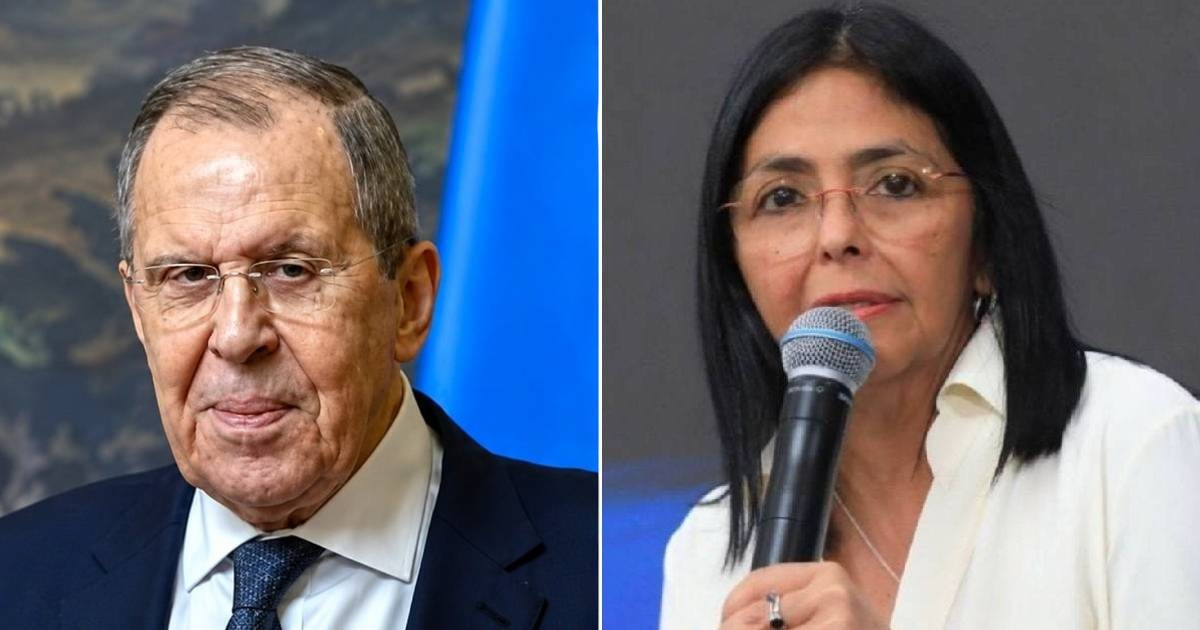
The Russian Deputy Minister of Foreign Affairs, Alexander Alimov, publicly criticized that the acting president of Venezuela, Delcy Rodríguez, avoided all contact with her historic allies during the High-Level Week of the UN General Assembly, held in New York from September 22 to 28.
In a press conference in Moscow on Thursday, Alimov was explicit: “We have noticed the absence of certain contacts. The acting president of Venezuela did not meet with the Russian Federation, nor with China, nor with Cuba, nor with Nicaragua. She left earlier, and certain reasons were given for this.”
The Russian complaint comes at a time of marked diplomatic repositioning by the interim Venezuelan government, which that very week in New York opted for a rapprochement with the West rather than strengthening its ties with the Moscow-Beijing-Havana-Managua axis.
The most striking turn was the meeting between Delcy Rodríguez and the U.S. President Donald Trump on the sidelines of the General Assembly, an encounter she referred to as "historic."
In her speech before the UN General Assembly on September 23, the leader promised elections in Venezuela, spoke of "full democracy," and of dialogue with opposition sectors, without mentioning Nicolás Maduro or the Bolivarian Revolution at any time.
This omission and the approach to Washington prompted immediate reactions among Caracas's traditional allies. The Cuban Minister of Economy and Planning, Joaquín Alonso Vázquez, called Rodríguez a "traitor" in a Facebook post that he later deleted.
The contrast with the Cuban stance was striking: Foreign Minister Bruno Rodríguez Parrilla did meet with Russian Foreign Minister Serguéi Lavrov in New York on September 23, in a meeting that the Cuban Foreign Ministry described as an exchange on the "excellent state" of bilateral relations between Havana and Moscow.
Lavrov, who led the Russian delegation following Washington's refusal to grant a visa to Alimov—a decision that Moscow labeled as an "unfriendly act"—held over forty meetings on the sidelines of the General Assembly, including a meeting with Secretary of State Marco Rubio.
Lavrov himself publicly demanded Maduro's release and called for an end to the embargo on Cuba during the high-level week, highlighting the extent to which Moscow maintains its positions while Caracas appears to be moving in the opposite direction.
The distancing between Russia and the Venezuelan interim government is not new: since January 2026, when Maduro was captured by U.S. forces, the Kremlin had already indicated that Putin did not plan for close contact with Rodríguez.
Related videos:
Filed under: