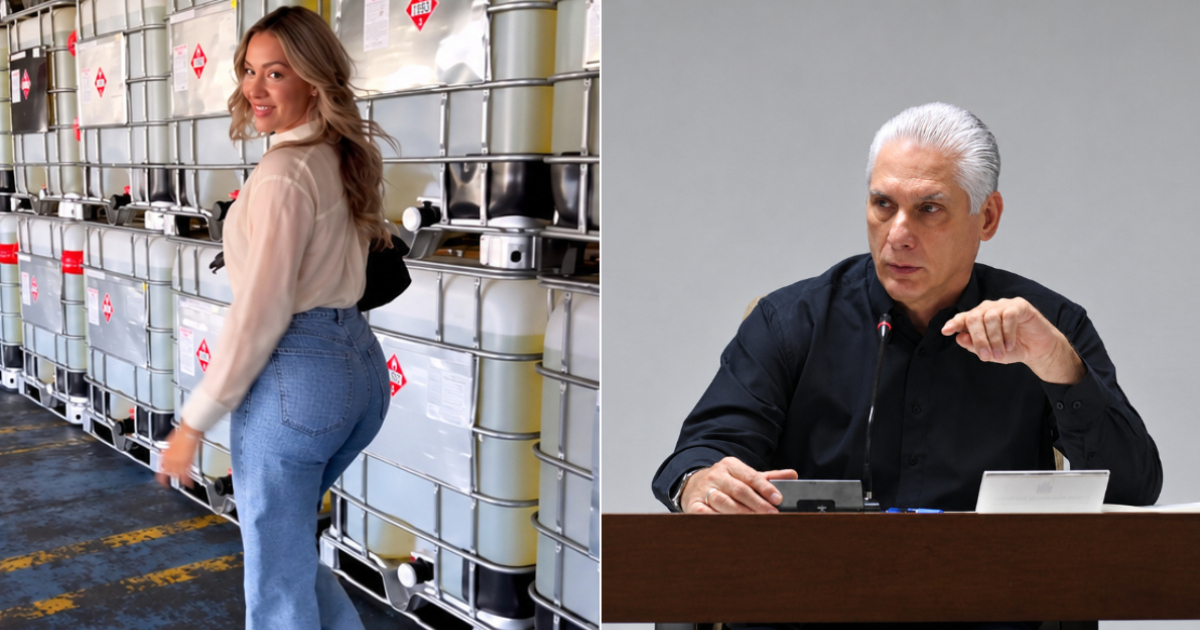
In April 2021, Miguel Díaz-Canel summarized in one sentence the regime's true conception of private activity in Cuba: “The non-state sector belongs to us.”
It was not a slip. During that meeting with self-employed workers, cooperativists, and representatives of state-owned enterprises, the leader also stated that “the Revolution will not hand over the non-state sector to the enemy” and made it clear that private forms would only be tolerated as a “complement to the state economy.”
Read today, that phrase helps to better understand the meaning of the recent measures taken by the Trump administration regarding certain financial channels linked to Cuban entrepreneurs. Washington does not appear to be acting against the existence of small private businesses, but rather against a model in which the regime has turned the "non-state" sector into a controlled extension of its system.
Díaz-Canel said it outright: that sector did not belong to the citizens, nor to a free market, nor to independent entrepreneurs. It was "ours." In other words, it belonged to the political project that authorizes, limits, uses, and punishes it. In other words, to the so-called "revolution," or in other terms, the regime.
Washington opened first
The official narrative presents the new measures from the Office of Foreign Assets Control (OFAC) of the United States as evidence that Washington wants to "suffocate" the entire Cuban economy. However, that version omits the full sequence of events.
In May 2024, during the Biden administration, the Department of the Treasury
Under Trump, channels to export fuel, gas, and other petroleum products of U.S. origin to eligible private Cuban entities and individual consumers were also opened. CiberCuba reported this year on fuel shipments to the private sector and commercial operations formally directed at micro, small, and medium enterprises (mipymes).
The initial logic was not to block entrepreneurship but to open a differentiated pathway, with one essential condition: that these resources did not end up benefiting the Cuban state, the Armed Forces, GAESA, CUPET, sanctioned entities, or intelligence and security structures.
The trap was in the internal control
The problem is that in Cuba, a micro-small and medium-sized enterprise (mipyme) can be privately registered but still operate within a state framework that controls the crucial aspects: licenses, banks, customs, ports, importers, storage, distribution, permits, oversight, and access to foreign currency.
The fuel is clearly illustrated. Although a private entity could carry out the formal purchase, the operation within Cuba had to go through authorized importers, state infrastructure, CUPET, CIMEX, ports, and distribution channels controlled by the regime.
There lies the gray area that concerns Washington: operations designed to support the private sector could end up generating commissions, logistical control, foreign currency, supplies, or indirect advantages for the state itself.
Suspicion does not arise from an abstract theory. In March 2026, the Department of Commerce had already suspended certain exceptions when they involved deposits of foreign funds in banks owned by Cuban entities, due to the risk of benefiting the Government, the military apparatus, or intelligence services.
Controlled opening, not economic freedom
The 176 economic and social measures announced by Havana in 2026 reinforce this interpretation.
The package included private banking, private currency exchanges, private remittance operators, foreign investment in the non-state sector, greater leeway for importing and exporting, the removal of the 100-worker limit, and formulas for private participation in structures previously reserved for the State.
The regime avoids calling it privatization. They talk about "selective opening," "new economic actors," "co-responsibility," or "necessary transformations." But the underlying truth is clear: they need private capital, foreign currency, imports, logistics, and services that the State can no longer guarantee.
That does not contradict Díaz-Canel's statement in 2021. It updates it. The "non-state" sector remains "ours," only now it is more necessary for importing, selling, collecting, paying, donating, financing propaganda, and addressing social gaps.
Surnames, permits, and propaganda
In recent years, independent media have documented cases demonstrating how a segment of the more visible or favored private sector appears to be connected to powerful surnames, former officials, state institutions, or propaganda spaces.
CiberCuba reported the case of Gaia Mercado, a food microenterprise attributed to Lisa Titolo Castro, daughter of Mariela Castro and granddaughter of Raúl Castro. The business operates in a sensitive sector —food— and receives payments from abroad for purchases intended for relatives in Cuba.
CubaNet has investigated other businesses associated with descendants or relatives of the elite, as well as companies that transitioned from state structures or local projects to operate as small and medium enterprises (mipymes). This pattern does not prove that every entrepreneur is a frontman, but it does dismantle the image of a homogeneous sector that is independent and separate from power.
MYPIMES are also used as a friendly face for propaganda. CiberCuba reported that Cubamodela paid for advertising in Cubadebate, a state-run media outlet under the Communist Party. Later, it was revealed that Ideas Multimedio, a conglomerate that includes Cubadebate and other official platforms, generated significant revenue from advertising paid by MYPIMES.
The relationship is revealing: the regime restricts, monitors, and distrusts the private sector, but accepts its money when it funds their communication apparatus.
Entrepreneurs as showcases of the regime
Subordination is also expressed in the transformation of certain entrepreneurs into functional figures of the official discourse.
The case of Dofleini S.R.L. and its director, Carlos Miguel Pérez Reyes, has been highlighted by independent media for the intersection between private enterprise, political institutions, and alignment with the regime's campaigns. Díaz-Canel visited this technological small and medium-sized enterprise (mipyme) and presented it as an example, while its director is a deputy of the National Assembly of People's Power and has held positions within official structures.
The message to the rest of the sector is clear: it is possible to grow, gain visibility, and access official spaces, as long as the venture does not turn into autonomy.
From private business to social workers
Control is not only economic or propagandistic. It is also social.
CiberCuba reported in 2024 that the regime was seeking to involve "new economic actors" in its social policies, particularly in areas such as care, poverty, support for vulnerable groups, assistance for the elderly, and community aid.
The term used by official officials was "co-responsibility." The word reveals the retreat of the State. After decades of promising that “no one would be left unprotected,” the regime is attempting to shift part of that burden to small and medium-sized enterprises, self-employed individuals, and private entrepreneurs.
Thus, the new economic actors are integrated into a logic of political utility: when the State needs foreign currency, it allows them to import; when it needs propaganda, it showcases them; and when it needs to cover up the failures of its public policies, it calls upon them to be "co-responsible."
The bridge from Miami
The gray area is not limited to Cuba. It also extends to companies based in the United States, particularly in South Florida, that have operated as trade, logistics, or financial bridges to the island.
In 2026, Miami-Dade began a comprehensive review of thousands of businesses that could be conducting operations related to Cuba without the required federal documentation. The action targeted a much broader ecosystem than just a few isolated operations.
Among the most notable cases are Katapulk Marketplace LLC and Maravana Cargo Inc., companies based in Miami linked to exports to Cuba. CiberCuba reported that federal licenses used to export vehicles were revoked or questioned due to non-compliance with conditions.
The case of Vanguard Energy, based in Coral Gables, was even more illustrative. The company reached an agreement related to the shipment and sale of fuel in Cuba, but the operation involved storage facilities of CUPET, a sanctioned state-owned Cuban company. Miami-Dade ultimately revoked its local business license.
It was also reported that the license of Lux Sky Cargo LLC was revoked, cited for alleged business ties with ENETEC S.A., a Cuban state entity sanctioned in the energy sector.
The pattern is the same: even when an operation appears to be focused on the private sector, it often needs to go through state-owned companies, ports, energy infrastructure, importers, or intermediaries authorized by the regime.
Remittances and screens
The remittance front shows a similar mechanism.
When FINCIMEX, linked to GAESA, came under sanctions, Orbit S.A. emerged as the new processor for money transfers to Cuba.
Investigative journalism later indicated that Orbit was under the control of the GAESA network through CIMEX. The United States ultimately sanctioned Orbit, and companies such as Western Union and Cubamax suspended operations or were affected by this connection.
The pattern is well-known: when a route is closed due to sanctions, another formally different structure emerges to occupy the same space. The name changes, the facade changes, but the control remains.
That background helps to understand why Washington views certain operations linked to the Cuban private sector with suspicion. The experience with remittances showed that the regime can shift its strategy, replace sanctioned companies, and maintain control over foreign currency flows under a renewed facade.
OFAC targets indirect transactions
The OFAC measures, effective from September 30, 2026, specifically target that area of intermediaries.
Washington removed the authorization for U.S. banks to open or maintain accounts for independent Cuban private entrepreneurs, ordered the blocking of affected accounts unless a specific license is obtained, eliminated financial U-Turn operations related to Cuba, and expanded restrictions on indirect transactions with entities listed on Cuba's Restricted List.
The key word is "indirect". OFAC not only examines whether a transfer explicitly names GAESA, CUPET, FINCIMEX, CIMEX, or a military company. It also considers whether the ultimate benefit may reach those structures through intermediaries, private businesses, operators in third countries, banks, payment platforms, or companies authorized by Havana.
Therefore, the measure cannot be seen merely as a punishment for entrepreneurship. It is a course correction in response to a model in which the regime has shown an ability to use the private sector as a facade.
The false argument of the "people"
The official reaction was immediate. Díaz-Canel, Bruno Rodríguez, officials from MINREX, state media, and aligned accounts attempted to convey the same message: the United States is not acting against the Government, but against the Cuban people.
The propaganda operation is obvious. The regime presents small and medium-sized enterprises as synonymous with the population, even though in daily life, most Cubans do not view these businesses as a stable solution to their basic needs.
Micro, small, and medium enterprises sell products that often do not appear in the state market, but at prices that are inaccessible for salaries and pensions. A large part of the population views this circuit from the outside, relying on remittances to make purchases in it or simply unable to partake.
The population does not control imports, does not sign contracts with CUPET, does not open companies in Miami, does not process remittances through structures authorized by the Central Bank, does not purchase advertising in state-controlled media, nor does it decide which private actors can thrive.
The people are the emotional argument of the regime, not the primary beneficiary of the model.
Not all small and medium-sized enterprises (SMEs) are part of the regime
The conclusion should not be simplistic. Not all small and medium-sized enterprises belong to the regime. Not all entrepreneurs are front men. There are thousands of Cubans who are trying to survive and work under blackouts, inflation, taxes, inspections, legal insecurity, restrictions, and state arbitrariness.
But neither can the opposing narrative be accepted: that the Cuban private sector is a free, autonomous space separate from power.
In Cuba, any private actor that reaches a certain scale, handles foreign currency, imports goods, gains access to fuel, operates with banks, uses ports, negotiates with state entities, or connects with foreign companies depends on the permits, structures, and decisions of the regime.
That dependency is the heart of the problem.
When Díaz-Canel said "the non-state sector is ours", he described a design of control. The subsequent reforms, the cases of private small and medium-sized enterprises linked to power, official propaganda, social "co-responsibility", businesses from Miami, and financial screens have only confirmed this.
The new measures from the Trump administration are not born out of an abstract hostility toward private enterprise. They stem from a political and practical observation: in Cuba, private ventures can be exploited by the regime as economic oxygen, a commercial facade, a financial channel, a propaganda tool, and a mechanism to evade sanctions.
That is why Havana insists on saying that Washington is attacking the people. Because the real discussion puts it in a worse position: if the non-state sector is "theirs," as Díaz-Canel said, then it cannot suddenly be presented as a completely independent space when sanctions arrive.
The phrase from 2021 has turned into an involuntary confession. The regime wants the world to treat the Cuban private sector as independent from Washington, but within Cuba, it controls it as part of its political project.
That is the point that helps to understand OFAC's shift: not to punish the small entrepreneur, but to close the channels through which the Cuban totalitarian regime could continue disguising what it never stopped considering "ours" as private.
Related videos:
Filed under: